How do we meet rising housing needs in Wales?

2 March 2026

On February 12th, 2026, the Welsh Government published updated estimates of housing need[1]. These figures replace the 2019-based estimates and draw on the latest available data, including the 2022-based household projections[2] published in November 2025.
 
The 2022 based household projections estimate the future number of households in Wales and assumes that past trends in births, deaths, and migration continue as they did between mid-2018 and mid-2022. The trend-based estimates provide a baseline for the number of new homes required in order to meet newly arising housing need.
 
Existing unmet need is an additional figure that has been estimated by Welsh Government from households that are both overcrowded and concealed as well as homeless households in temporary accommodation.
  
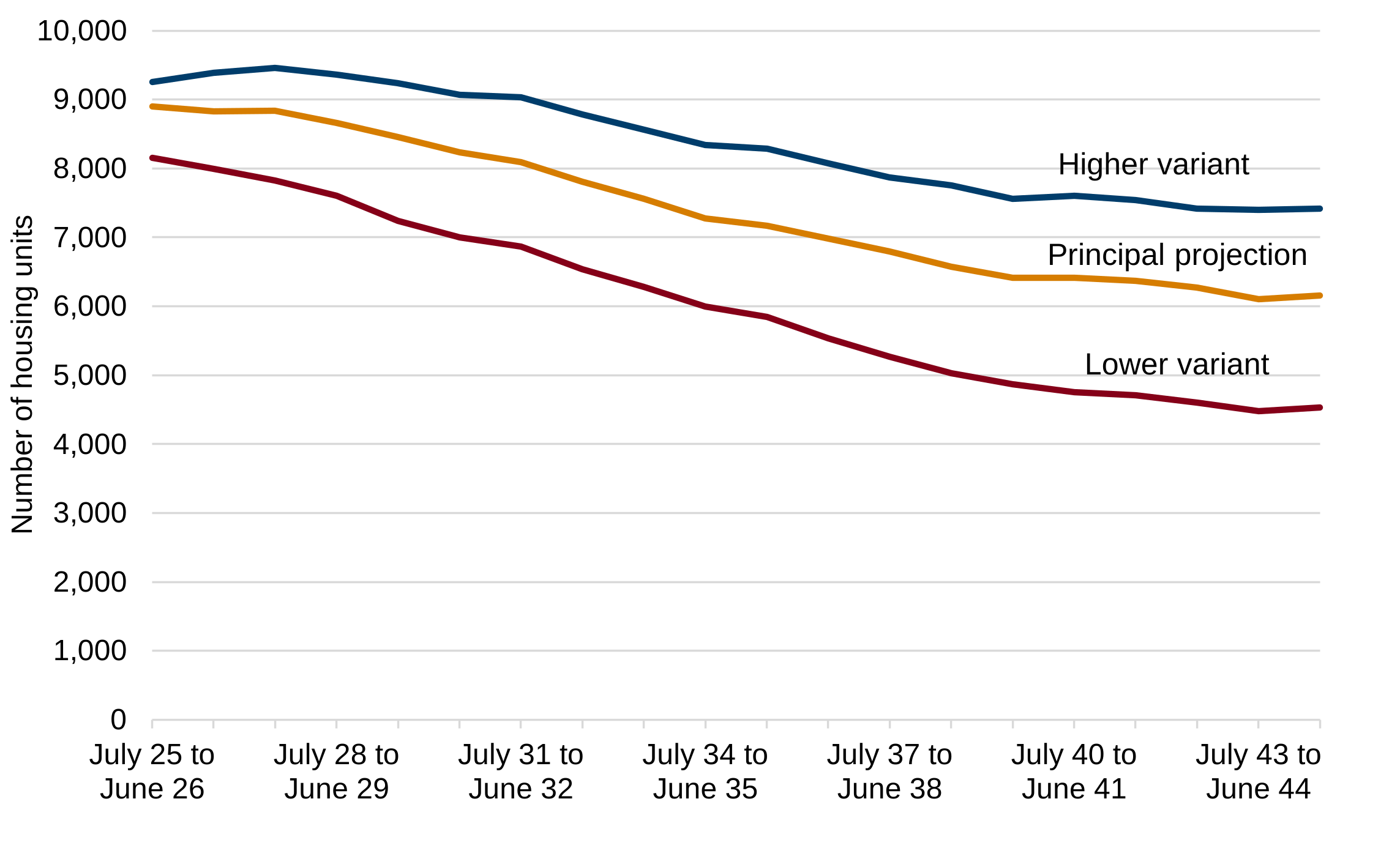
The Welsh Government estimates that there is a future housing need of between 7,800 and 9,300 additional homes each year (within the first five years - July 2025 to June 2030) with a central estimate of around 8,700 dwellings per annum (dpa).
  
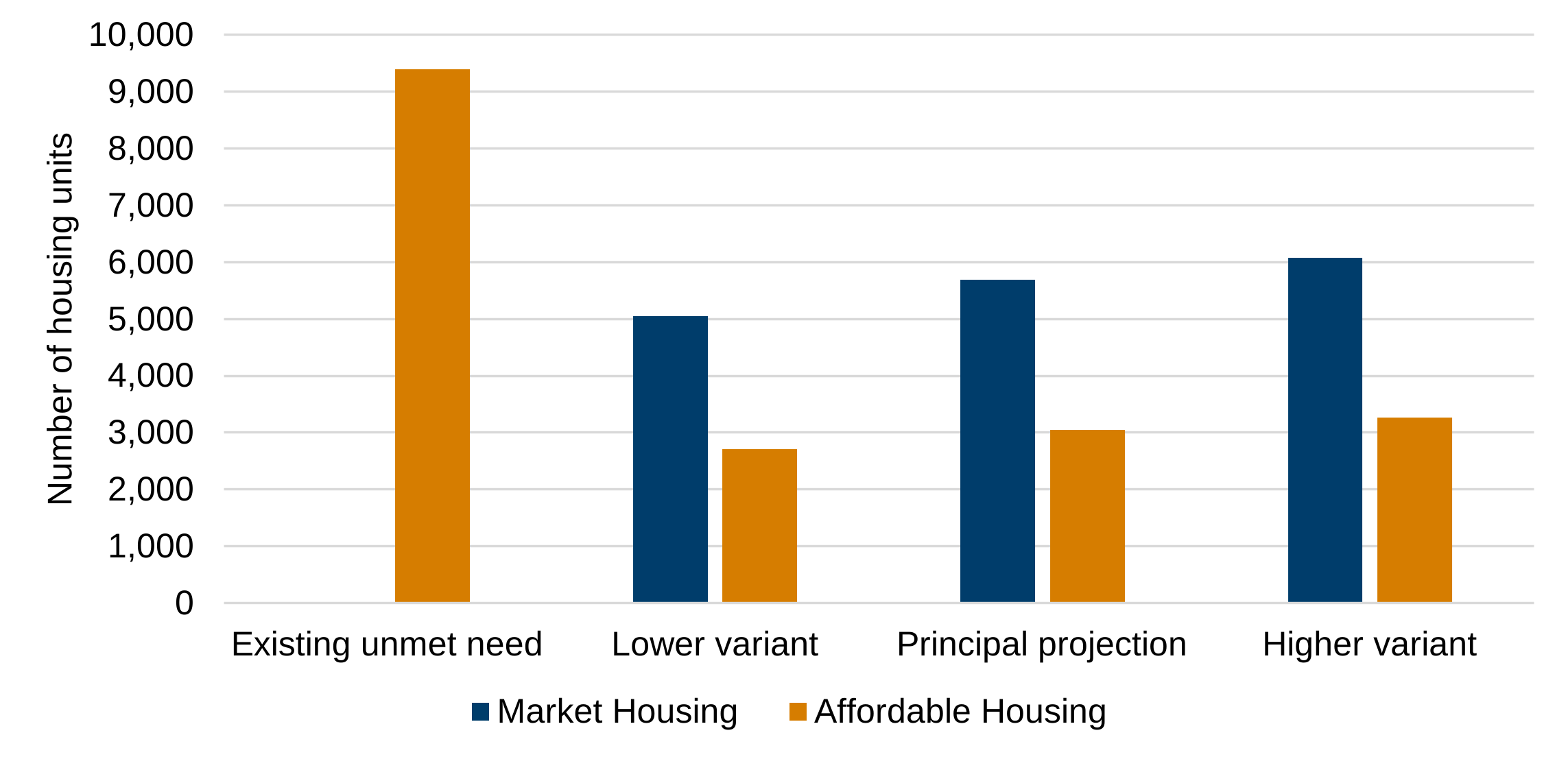
Under the central estimate, newly arising need gradually reduces from 8,700 dpa in 2025/26 to 6,200dpa in 2044/25. However, this does not include existing unmet need which is noted as ‘currently’ (Feb 2026?) being 9,400 housing units. The Chief Statistician notes, however that this figure is likely to be an underestimate of the true level of unmet need as some households who need housing will not appear in this data.
  
The previous 2019 based estimates of housing need for Wales re-distributed the existing unmet need over the first 5 years to reflect the priority given to meeting affordable housing delivery. However, this is not done for the 2025 based estimates where existing unmet need is set out as a separate figure. If the same methodology was applied as used in the 2019 dwelling estimates, and set out in Future Wales, the annual dwelling need figure (2025-2030) would be 10,620 dwellings. This represents a like for like increase of 43% between the 2019 and 2025 Estimates of Housing Need figures for Wales.
  
Table 1 Comparison of 2019 and 2025 housing estimates for different tenures

Source: Welsh Government and Lichfields Analysis
* not like for like comparison as 2025 figure does not include existing backlog of need 

 
As a result of the change in methodology, it is not possible to directly compare the change in affordable housing need between the two sets of estimates. A comparison is, however, possible of the change in market housing need over the first five years of each set of estimates. The annual central estimates for 2025-2030 of 5,680 dpa are 47% higher than the central estimates of 3,856 dpa 2019-2024 that inform the dwelling estimates in Future Wales.
 
The Welsh Government notes that the increase in the Estimates of Housing Need in Wales reflect higher projected household growth in the 2022‑based household projections compared with the 2018‑based projections used previously.
 
Figure 1 newly arising need: 2022-based household projections

Source: Welsh Government


Affordable - Market Split

The 2019 based estimates noted a split between estimates of need between market and affordable homes of 52% market and 48% affordable in the first five years. This tenure split is also set out in Future Wales. These figures are in Lichfields view misleading in that they are not comparing like for like trend estimates for market and affordable housing. Instead, the affordable element includes an assumption that all existing unmet affordable housing need would be met in the first five years. The affordable housing need estimate therefore included a ‘policy on’ aspiration whilst the market housing estimate was purely a trend based ‘policy off’ figure.
 
The 2025 based estimates notes that the split between market and affordable homes required is 65% market and 35% affordable.  Lichfields understand that this difference reflects and the fact that existing unmet need has not been re-distributed and added onto the estimate of affordable needs. Lichfields welcome this change in approach in that it gives a better and more transparent understanding of estimates of future housing need by tenure without ignoring the very significant unmet housing needs.
 
Figure 2 average annual estimates of additional housing need, split by tenure, July 2025 to June 2030. Note that that ‘existing unmet need’ is a one off figure at a point in time

Source: Welsh Government


Households to dwellings

Lichfields note that paragraph 5.37 of the Development Plan Manual (DPM) states that “LPAs must use a household conversion factor when translating households to dwellings”. This is set out as a 4% increase conversion factor as a benchmark but notes that in practice this has varied from 3% to 13% across Wales, reflecting local circumstances, empty homes strategies and impacts of second homes.
 
Lichfields analysis suggests that the 2025 based estimates of housing need have not included a conversion factor when translating households to dwellings. If the guidance in the DPM is followed then the estimate of newly arising housing need for Wales will be approximately 4% higher than the statistics noted in the estimates.
 
Table 2 Household projections for 5 year period with 4% conversion factor applied

Source: Welsh Government and Lichfields Analysis


Why are household projections important?

The Welsh Government website for the 2019 based projections states:
 
“Estimates of housing need are key to future planning requirements at a national and regional level and will be used to inform the National Development Framework (NDF) and housing policy development.”
 
As the national development framework, Future Wales is the highest tier of development plan and is focused on solutions to issues and challenges at a national scale. Strategic and Local Development Plans are required to be in conformity with Future Wales and must be kept up to date to ensure they and Future Wales work together effectively.
 
Policy 7 of Future Wales refers to the 2019 based estimates. Lichfields assume that the long-awaited updated version of Future Wales will refer to the 2025 based estimates. Policy 7 correctly identifies that the estimates do not reflect future policies or events and are not a housing requirement for Wales or the regions. However, they provide a good starting point on which housing policy and requirements can be based. Future Wales does not set out estimates of housing need below the regional level. Instead, it is for each local authority to prepare their own estimate of housing need.
 
Paragraph 5.34 of the Development Plans Manual (DMP) states:
“In terms of considering the level of housing provision for a plan, the most up-to- date suite of Welsh Government Population and Household Projections are a fundamental part of the evidence base.”
 
Para 5.35 then states:
 
“All LPAs should use these projections and the resultant household numbers when considering the level of housing provision for a plan period.”
  
As the most up to date projections, Lichfields assume that all emerging LDPs and the SDPs will need to properly account for the new dataset.
 
In line with the requirements of the DPM Lichfields anticipate that the housing requirements in emerging RLDPs will need to reflect not only a conversion figure from households to dwellings but an adjustment to reflect the wider policy aspirations of the plan. This will be especially important in those LPAs that Future Wales define as part of the National Growth Area. Here it must be assumed that the outcomes sought by RLDPs in terms of economic growth and social equity will result in household growth and associated dwelling delivery above a continuation of past trends.
 
Any policy led uplifts to the housing requirement figures in RLDPs will also need to address the existing unmet needs identified through their housing market assessments.
 
There is a risk that LDPs may need to take a brief pause to understand the implications of the recent 2025 based household estimates. We note that as part of both the forthcoming examination of the Cardiff and Monmouthshire RLDPs that the Inspectors have already requested the Council review the implications of the 2022-based household projections on the submitted RLDP.
 
Any brief delay to the RLDP Examination process is in Lichfields view justified to ensure a sufficient supply of housing is secured in the short and medium term rather than awaiting the next round of RLDPs, which based on current rates of review will be at least 7-10 years away.


Delivering against the targets

As quantified earlier, the 2025 estimates of newly arising housing need are much higher than the 2019 estimates. However, it is apparent that the estimates should be treated as a minimum given that 1) the existing unmet needed is treated as a separate number, and 2) a conversion factor has not been applied to convert households to dwellings as required by the DPM. It is also disappointing that estimates are only provided at national level rather than broken down into regional level as has been done in previous estimates. This reduces the value of the estimates as a plan making tool at SDP stage.
 
Even without taking account of the 9,400 units of existing unmet need or the lack of a household to dwellings conversion factor, a significant step change in delivery will be required to meet the new estimates of housing need. This is because the number of housing completions in Wales has been particularly low in the last few years. The five-year trend is 5,015 completions per annum with only 4,631 delivered in 2024/25.


Figure 3 Housing completions in Wales 2000-2025

Source: Welsh Government and Lichfields Analysis 

 
Several reasons have been given for the low levels of housing delivery in Wales but two key themes surround:
  • Land banking
  • Operation of the planning system


Land Banking

 A key issue of concern expressed in some sectors including by Welsh Government has been around the issue of ‘land banking’. This issue formed part of a wider ranging review by the Competition and Markets Authority (CMA) who reported back in February 2024. The CMA found that:
 
“42. Overall, we do not consider that competition in the land market, or the land banks held by different housebuilders individually or in aggregate either locally or nationally, is significantly distorting competition between housebuilders in delivering houses. While it is likely that the amount of land being held in housebuilders’ land banks is above the level we would see in a well-functioning market, this is primarily a symptom of wider problems in the market, mainly driven by the time and uncertainty associated with obtaining planning permission. Artificially reducing the levels of land banks without addressing these underlying drivers would be most likely to have a negative effect on the amount of housing that is being built.”
 
The CMA view then is that the primary issues surrounding delivery of new housing in Wales is the functioning of the planning system and not land banking.
 
In relation to the planning system the CMA found that:
 
“58(b)… there is a lack of predictability for housebuilders when navigating the system, the process is significantly costly, lengthy and complex, and there are mixed and inconsistent incentives for LPAs to meet housing need.”
 
The CMA proposed several recommendations for reform to the planning system:
 
Option 2.1: More objective and effective use of targets to ensure housing need is met.
 
Option 2.2: Effective monitoring and enforcement of local plans to encourage housebuilders to bring forward successful planning applications and build new houses.
 
Option 2.3: Streamlining the planning system to significantly increase the ability of housebuilders to begin work on new projects sooner and bring forward marginal projects which may have previously been non-viable due to the costs of taking them forward.   
 
Welsh Government published its response to the CMA study in October 2024 and was seemingly of the view that no changes to the planning system were required. Certainly, no significant changes to the planning system have subsequently been enacted to promote increased housing delivery.
 
In Lichfields view this was a missed opportunity, and it is an issue that should be addressed by which ever administration is responsible for planning following the Senedd elections in May 2026.
 
The lack of up-to-date LDPs in Wales and the protracted time taken to undertake reviews is in Lichfields view the main reason for poor housing delivery. Wales like the rest of the UK has a plan led system. The difference in Wales is that there is no fail safe to ensure housing delivery is maintained if there isn’t an up-to-date plan.
 
In the last five years (2021-2025) only two new LDPs (Bridgend and Flintshire) have been adopted in Wales whilst most of the remaining are stuck in the preparation stage for significantly longer than the 3 ½ years prescribed in the DPM. Over half of the LDPs in Wales are now time expired and fail to provide a positive basis for future housing delivery.  
 
Since TAN1 was revoked in March 2020 there is no policy mechanism to support developers in coming forward with new sites to remedy the poor delivery. Lichfields considers that a proper monitoring and action policy (with appropriate triggers and actions in the event of under delivery) will be essential so that Wales is able to deliver the quantum of houses that is required to meet identified need. The existence of such a mechanism would also give impetus for Council’s to ensure up to date LDP coverage.



Conclusion

The 2025 based estimates identify the need for 8,700 new homes per year over the next 5 years which is not only significantly above the previous estimates but nearly double the housing completion levels in 2023/24 and 2024/25 respectively.
 
These annual estimates are a minimum in that they don’t account for existing unmet need which unlike the 2019 estimates is expressed as a separate standalone figure. The estimates of housing need are essentially aggregated from the Nov 2025 household projections. They fail to apply any conversion factor from households to dwellings as required by the DPM. This would increase the estimates further by approximately 4%.
 
Lichfields welcomes the new estimates of housing need as they highlight the important outcome of the most recent household projections and provide a better basis for addressing the housing crisis in Wales. The DPM confirms that emerging LDPs and the SDP should use the latest household projections as a starting point for establishing their housing requirement figures. It will be important for those LDPs that are being reviewed to take account of this up-to-date information.
 
Given the ongoing delays to preparation of RLDPs Lichfields advocate for a policy mechanism to allow sustainable, well located housing sites to come forward in the interim based on proper monitoring of delivery. Otherwise, delivering anything near the numbers identified in the estimates of housing need will remain extremely challenging.


Authors


Footnotes


Image credit: Redrow Homes (South Wales) Ltd 
 
Disclaimer: This publication has been written in general terms and cannot be relied on to cover specific situations. We recommend that you obtain professional advice before acting or refraining from acting on any of the contents of this publication. Lichfields accepts no duty of care or liability for any loss occasioned to any person acting or refraining from acting as a result of any material in this publication. Lichfields is the trading name of Nathaniel Lichfield & Partners Limited. Registered in England, no.2778116