


Planning matters

Our award winning blog gives a fresh perspective on the latest trends in planning and development.

Payback for build out: the PM’s case for social housing
At Prime Minister’s Questions on Wednesday 9th September, Andy Burnham argued that a major council housebuilding programme could save billions in Housing Benefit,[1] describing it as “the Labour way”.[2]
The PM referred to research from the National Housing Federation (NHF), which is seemingly the 2024 report by CEBR for NHF and Shelter.[3] It estimates that 90,000 Social Rent homes would generate £86.5bn of gross economic and social benefits over 30 years, including a net Exchequer benefit of  £11.896 billion.
The report makes a strong strategic case for Social Rent. But its use in a debate about reducing welfare spending (to increase defence spending to 3.5% by 2035) raises three initial questions:
 
  1. Do Housing Benefit savings pay for Social Rent homes?

  2. How dependable are the other benefits? and

  3. Where does the necessary funding come from?


There is also – as ever – a fundamental land and planning question about whether Section 106 can deliver the assumed cross subsidy the NHF/Shelter analysis requires of it.[4]


What the report says


The analysis covers a single annual cohort of 90,000 homes.[5] Although the wider proposition is a ten-year programme of 900,000 homes, CEBR does not model successive cohorts and notes that their operating environment and assumptions may differ. [6]
 

Table 1: The Report's Key Measures

Key Measure
Figure
Social Rent homes 90,000
Total development cost  £35.367bn
Government grant  £11.825bn
Provider and other funding c.£23.5bn
Initial annual Housing Benefit saving £243.8m
Housing Benefit saving, 30-year PV £4.485bn
Gross Exchequer benefits £23.721bn
Net Exchequer benefit £11.896bn
Gross socioeconomics benefits £86.5bn
Net socioeconomic value £51.183bn

 
Source: CEBR


The £11.825bn grant required for one cohort is about three times the current programme’s average annual investment of £3.9bn, under which the Government expects 18,000 Social Rent homes a year.[7]


Do Housing Benefit savings pay for Social Rent homes?


No, and the NHF/Shelter report does not claim they would. The £4.485 billion saving is a discounted 30-year present value, compared with £11.825bn of government grant. The initial annual savings is £243.8 million.[8] 
That estimate is based on a series of linked assumptions, for example, that 75% of occupants receive housing support and that vacancy chains ultimately release 65,292 homes to households otherwise living in the private rented sector, generating an annual rent-support saving of £3,735.5.  Yet lettings data shows tenants come from a varied set of previous tenures and circumstances. Actual savings would depend on the circumstances and previous tenures of those housed.[9]


How dependable are the other benefits?


Of course, the potential savings for the Government are not limited to Housing Benefit (see Table 2), and the total (including housing benefit) is estimated at £23.8bn against a government grant for the programme of £11.8bn.

Table 2: Exchequer benefits from building 90,000 social rented homes

Exchequer benefit
30-year present value
Housing benefit saving £4.485bn
Tax revenue from construction £2.473bn
Universal credit saving £3.289bn
Healthcare saving £5.170bn
Homelessness-services saving £4.512bn
Income Tax and NI from employment £3.793bn
Gross Exchequer benefit c.£23.7bn
Less government grant £11.825bn
Claimed net Exchequer benefit £11.896bn

Source: CEBR, Table 12

This wider fiscal case is credible in principle: secure housing can reduce homelessness and healthcare pressures and support employment.[10]  But the estimates vary in robustness. Rent and temporary-accommodation savings follow relatively directly from lower housing costs. Healthcare, employment and tax benefits depend on longer causal chains, while construction taxes are net additional only to the extent that the programme does not displace other activity. The £23.7bn total should therefore be understood as a modelled estimate, not a guaranteed fiscal return.


Where does the necessary funding come from?


The NHF/Shelter report assumes £35.367bn of total development cost. Government provides £11.825bn of grant towards 60,000 homes; the remainder comes from provider resources, borrowing, rents and market activity, while 30,000 homes are assumed to be delivered without grant through cross-subsidy such as Section 106. The claimed fiscal return therefore depends not only on public grant but also on about £23.5bn from other sources.[11]
The funding ask is demanding:
 
  1. The £11.825bn Government grant would need to be funded through borrowing, taxation, or savings. Given the current state of the public finances, it is reasonable to assume any programme of this kind would rely on borrowing. For all the long term benefits, it is not clear this uplift in funding would improve the Chancellor’s near-term fiscal headroom.[12]
     
  2. Registered Providers face higher borrowing costs and increased spending on existing homes, while councils face construction-cost inflation, retrofit and safety obligations, and wider financial pressures.[13] The model treats the availability of this funding as an input rather than testing whether the sectors can provide it. In 2024/25, excluding s.106 homes, the sector itself delivered around 40,380 affordable homes, of which just 8,600 were Social Rent.[14] The Regulator of Social Housing reports on the 2025 Global Accounts of private Registered Providers says: “Providers continued to spend record amounts on improving the quality and safety of existing homes whilst also maintaining investment in new supply. When combined with higher rates of interest on new and refinanced debt, financial capacity remains constrained and some financial indicators have weakened at a sector level.”[15]
     
  3. Meanwhile, 2024 research by UCL found whilst Council housebuilding is a mainstream activity, local authorities face a combination of obstacles, including construction-cost inflation, higher borrowing costs, housing-safety and retrofit obligations, wider local-government financial pressures and uncertainty over future planning and funding arrangements.[16]


Can the sector increase its total volume by 50% with a shift in its tenure towards a product with a lower revenue stream?[17] Obviously, the NPPF reforms and more Government funding as suggested by NHF/Shelter might help unblock latent capacity and address some of these issues.[18] But the report’s modelling still assumes a significant boost in investment from two sectors operating with financial pressures. The report treats funding flows as an input and does not test the realism of it being achieved.
Further, the above numbers relate to a single year. Repeated over ten years, the proposition would imply 900,000 Social Rent homes, £353.7bn of development cost, £118.3bn of grant and about £235bn of other funding. Stable procurement could improve productivity, but sustained demand might also increase land, labour and construction costs. A programme on this scale would therefore require explicit modelling of delivery trajectories, debt capacity, inflation and delivery lags.
Delivering the 60,000 grant-supported homes would also require councils and Registered Providers to act more extensively as developers: promoting and acquiring land, partnering with developers and progressing schemes ahead of plan allocations under NPPF Policies S45 and S5. Increased affordable housing funding can strengthen demand for consented land, but it does not create that land. Supply will take time to respond to the more permissive planning framework.


The big land and planning question


We come now to the third of Social Rent homes that the NHF/Shelter proposition says require no grant because they are funded through S.106.  
Section 106 affordable housing is funded from development value after allowing for construction and finance costs, infrastructure, developer return and a competitive landowner return.[19]  The CEBR results assume this mechanism can deliver 30,000 Social Rent homes each year without grant, but do not test whether that assumption is viable.[20]
 
 
Social Rent and Viability


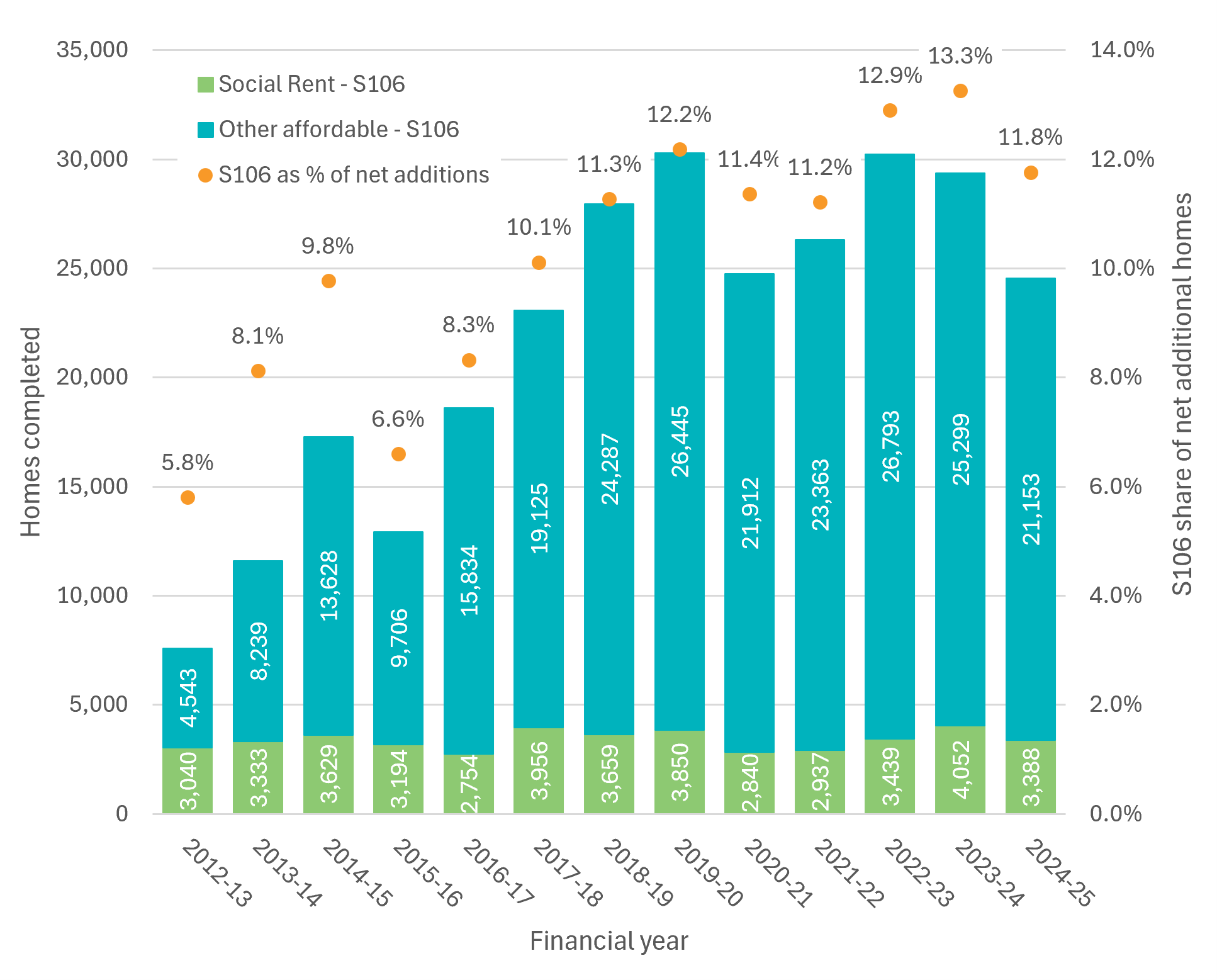
Recent Section 106 delivery of around 20,000 to 26,500 affordable homes a year might make the 30,000-home assumption appear achievable.[21] However, this ignores two critical factors, as shown by Figure 1.
 

Figure 1: Affordable Housing delivered through s.106
Source: MHCLG / Lichfields Analysis

Firstly, s.106 affordable housing delivery is cyclical: it dropped 19% last year to about 23,400 homes, with more units funded by grant. This reflects the widely recognised squeeze in the housing market and difficulties experienced finding Registered Providers who want to take on new stock.[22]
Secondly, only 11–14% of s.106 homes are Social Rent, and annual delivery of those has never exceeded 4,000; the rest is Affordable Rent or intermediate products such as shared ownership.[23]
This reflects the underlying economics. Social Rent generates the greatest benefits through lower rents, but those same rents reduce the value available to fund construction. Without grant, delivery requires lower land values, few competing obligations, a strong sales market, a lower affordable housing percentage, or some combination.[24]
 
 
Overall housing delivery


The NHF/Shelter report does not calculate the total amount of market-led development needed to generate 30,000 cross-subsidised Social Rent homes. Our scenario testing below shows how quickly the denominator grows depending on the percentage of the total that is achievable reduces to respond to viability.
Effective affordable housing share
Total homes on market-led schemes
Other homes (i.e. market) within those schemes
20% 150,000 120,000
15% 200,000 170,000
10% 300,000 270,000
5% 600,000 570,000
Adding the 60,000 grant-supported homes produces total annual housing activity of 210,000 at a 20% Section 106 share, rising to 660,000 at 5%. Given the much lower value of Social Rent, achieving 30,000 units at 10% would be highly demanding; at 5%, it would require 570,000 associated market homes. The exercise underlines both the importance of meeting the Standard Method total of about 370,000 homes and the sensitivity of the proposition to viability.
Whatever the precise percentage, delivery depends on a planning system that releases sufficient land and a private market capable of generating the value needed for cross-subsidy. That requires buyer demand, mortgage availability, development finance and confidence that land pipelines can be replenished. Planning reform addresses only the supply side; some form of demand support may also be needed to increase build-out and Section 106 delivery.


Is the PM’s proposition sound?


The ‘housing theory of everything’ is a popular explanation for many societal ills.[25] The Prime Minister is clearly a subscriber. More genuinely additional Social Rent housing can reduce Housing Benefit, temporary-accommodation expenditure and other public-service costs, particularly in expensive housing markets.
The Prime Minister cited the NHF/Shelter research as the basis for his ‘Labour way’ approach to rebalancing public spending away from welfare. Yet the Government’s current grant funding programme for affordable housing – while a significant increase on what it replaced - is just a third of the scale that the NHF/Shelter report advocates. It will deliver some Exchequer benefits, but relative to the total size of the state (£1.29 trillion),[26] the scale will be modest.
What is the case for going further? Under the NHF/Shelter assumptions, one 90,000-home cohort initially saves £243.8 million a year in Housing Benefit and delivers a host of other benefits, including a net Exchequer saving of £11.896bn over 30 years.  
The attractions to the PM of this argument are obvious. But there are nevertheless a series of challenges and unanswered questions: 
 
  1. The report does not show that Social Rent pays for itself through savings on Housing Benefit. The modelled 30-year saving is £4.485bn against £11.825bn of government grant
     
  2. The claimed £11.896bn net Exchequer benefit depends on combining that saving with less direct and inherently less certain assumptions about health, employment, Universal Credit, homelessness and tax receipts. These benefits are plausible, but many are downstream of the direct intervention or subject to other assumptions.
     
  3. Most importantly, the result depends on Government funding only one third of the £35.367bn development cost. Councils, Registered Providers, rental income and market activity must pick up the rest. 
     
  4. Councils and Registered Providers face financial pressures and their capacity to deliver at scale – at least in the short term - is uncertain. 

  5. 30,000 Social Rent homes are assumed to be delivered without grant through cross-subsidy such as s.106. This is the report’s most demanding assumption: 
     
a. Recent s.106 delivery has been below 25,000 affordable homes of all tenures, with only a small proportion provided as Social Rent;
 
b. Currently, around 10-13% of net additional homes each year are delivered through s.106, and this model is under viability pressure. If Social Rent represented 10% of homes on relevant market-led schemes, delivering 30,000 units would require 270,000 associated market homes. At 5%, it would require 570,000. The fiscal proposition therefore relies on land being released at least in line with the Government’s Standard Method target, schemes remaining viable and the private market absorbing homes at a sufficient rate, likely supported by some kind of demand-side assistance.
 
  1. The significance of these points for the Government’s wider agenda for re-balancing spending is this: 
     
a. The net Exchequer benefits depend on the Government achieving 90,000 Social Rent homes through directly funding only one third of the cost. 
 
b. If cross-subsidised homes were not delivered, and the same £11.825bn grant produced only 60,000 Social Rent homes the modelled net Exchequer benefit would fall to about £4bn over 30 years; within the margin of error given the causal chain involved.
 
c. If Government instead had to double its grant investment to £23.65bn because of weaknesses in other funding from Local Authorities or Registered Providers, or viability of s.106, almost all the claimed Exchequer benefit would disappear.


The central point is that Social Rent does not sit apart from the wider housing market. Large-scale provision can create substantial public value, but the fiscal return is not axiomatic. In addition to huge questions over public spending, it depends on sufficient land supply, viable development, Section 106 delivery, council and Registered Provider capacity, and a functioning private sales market. Any attempt by Government to go further and faster on its affordable housing programme will need to address those dependencies if it wants to realise the benefits.


Footnotes


[1] He said: “We have set out plans for the biggest council house building programme this country has seen in a generation. If the right hon. Lady looks at research from the National Housing Federation, she will see that that is the route to save billions from housing benefit.” Hansard, 9th September, Column 1037
[2] See this BBC News Story National security can't come at expense of social security, Burnham says 9th September 2026, accessed 10th September 2026

[3] CEBR, The economic impact of building social housing report produced for NHF and Shelter, February 2024
[4] It wouldn’t be a Lichfields blog without one.

[5] Based on the need analysis in the Glen Bramley’s 2019 research on housing supply requirements
[6] See footnote 6 of the NHF/Shelter report.

[7] MHCLG Policy paper: Social and Affordable Homes Programme 2026-2036: MHCLG policy statement to accompany guidance to bidders from Homes England and the Greater London Authority, 7th November 2025. The 18,000 is out of a total of 30,000 Affordable Homes, with the balance made up by other tenures.
[8] See Sections 4.2 and 5, Tables 12–14, pp. 48–54. The discounted Housing Benefit saving recovers about 38% of the public contribution before financing or opportunity costs

[9] MHCLG, Social housing lettings in England, tenants: April 2024 to March 2025, 13th November 2025. The statistics show the variety of previous circumstances from which households enter social housing, including private renting, temporary accommodation, owner occupation, living with family and friends, and other routes, illustrating the uncertainty around assumptions concerning future vacancy chains and Housing Benefit savings

[10] See for example the analysis here (drawn from the Milburn Review on NEETS) and here (the Lichfields work for HBF on the impact of reducing housing supply)
[11] See the NHF/Shelter report - Section 2.1, pp. 16–17, and Section 4.5, p. 50.
[12] The Debt Management Office's own results show a Treasury Gilt maturing in 2054 priced at a yield of 4.5699% in January 2024, and as high as 5.8168% on 8th September 2026. See UK Debt Management Office Results of Syndicated Offerings

[13] See the NHF/Shelter report - Section 2.4, pp. 32–36.
[14] See MHCLG Table 1000 on affordable housing supply
[15] Regulator of Social Housing, 2025 Global Accounts of private registered providers, 15 January 2026
[16] UCL Local authority Direct Provision of Housing: Fourth Research Report January 2024

[17] Taking an illustrative example of a market rent of £1,500 per calendar month (ONS Private rent and house prices, UK: August 2026 shows average rents of £1,451 in England), affordable rent at 80% equates to £14,400 annually, whereas Social Rent at 50% would be £9,000. This would create a gross annual gap of up to £5,400 per home, which across 30,000 homes would amount to up to £162m before other costs.  See this 2026 Policy Statement on rents for social housing

[18] Just as the Government’s boost in funding for affordable housing in 2025 has been welcomed by NHF for these reasons.

[19] My blogs on LVC (in the context of the debate on hope value) and the Green Belt Golden Rules explored this approach. 
[20] See NHF/Shelter Report - Section 2.1, pp. 16–17, and Section 4.5, p. 50.

[21] See MHCLG Table 1000 on affordable housing supply

[22] Yielding this Government response Policy statement: a roadmap for Section 106 delivery in England, March 2026
[23] See MHCLG Table 1000 on affordable housing supply

[24] See the PPG on Viability. The number of affordable homes currently being delivered by s.106 are the product of Government viability guidance which requires plans to specify and test the amount and type of affordable housing, including minimum Social Rent requirements
[25] The housing theory of everything - Works in Progress Magazine

[26] HMT Public Spending Statistics, May 2026

CONTINUE READING

Spatial development strategies and national policy

Edward Clarke, Dominic Bowers & Jennie Baker 02 Sept 2026
The roll-out of strategic planning has started, reflecting the last Government’s intention that there would be England-wide coverage by the end of this Parliament, expected to be in Summer 2029. Strategic planning will be via spatial development strategies (SDS), albeit there is a current separate consultation on Mayors of strategic authorities having development management powers ahead of an SDS being published[1].
The legislative basis for SDSs and the bodies that prepare them is in the Planning and Infrastructure Act 2025 and the English Devolution and Community Empowerment Act 2026.
Earlier Lichfields analysis of the legislation and of a consultation on SDS geographies provides a background to this blog.
The last Government consulted on the proposed geographies over which each SDS will apply, from February to March 2026, with the outcome awaited. The Lichfields blog Spatial Development Strategy Geographies: Will the map change the landscape? considered the make-up of the proposed new geographies and explored some metrics related to two of their key priorities: meeting housing needs and growing the economy. The findings of that blog remain relevant, so we do not delve into them here.
Bethan Haynes explained the intention and challenges for SDSs, including how they are administered, and reflected on the (then) Planning and Infrastructure Bill requirements, in her blog of March 2025[2]. A follow up to that blog, ‘Big plan theory’, considered the progress that had been made on SDSs by the end of last year[3]. In that blog, Ed, Dom and Myles considered changes to the then English Devolution and Community Empowerment Bill as it had progressed through the Houses. This blog further considers some of the queries raised in the 'Big plan theory' blog, with reference to the NPPF as now published.
Beyond the legislation and the awaited consultation outcome on geographies, the National Planning Policy Framework (NPPF)[4] sets out the national policy for plan-making, including 17 specific plan-making policies. This blog focuses on plan-making policies particularly applicable to SDS preparation.
The NPPF defines a spatial development strategy in its glossary at Annex A:
“Spatial development strategy: A plan containing policies on the development and use of land on matters of strategic importance to the area prepared by strategic planning authorities and the Mayor of London”.

National plan-making policies


The NPPF’s introduction explains that there is some interpretation needed when applying national policy to Spatial Development Strategies (SDS), because whether SDS, local plans and/or supplementary plans address certain thematic plan-making policies will depend on the area to which the plan relates.
This is discussed further below, in the context of the need for collaboration across boundaries and between bodies.
It also reminds of an important point when considering the role of SDS in the development plan: “The relevant legislation does not allow spatial development strategies to allocate specific sites or designate specific areas of land”.
The NPPF also explains how SDS should be prepared and examined. Policy PM14 says that a sound SDS should satisfy tests of being “positive”, “appropriate”, "effective" and "consistent with national policy".

PM1: Spatial development strategies


Policy PM1 is the overarching national policy regarding the preparation of SDS. PM1(1) sets the tone:
“[An SDS should] set a positive vision for future growth and change at a sub-regional scale and provide a clear spatial framework for investment and growth, including for new housing”
Setting out the aims of an SDS, the NPPF is clear that its “Content should be genuinely strategic in nature”. Parliamentary debates during the passage of SDS related legislation made clear that the last Government and other politicians were keen to avoid future strategic plans having the length or detail of the London Plan.
The draft new London Plan is out for consultation at present. Sally Furminger and Ross Raftery's blog 'Assessing the draft London Plan's position on housing: does it make the grade?' observes that the emerging London Plan is likely to be the first SDS to be tested against the NPPF 2026. Sally and Ross give an initial verdict on the draft London Plan’s approach to housing matters against the tests of soundness in the then draft NPPF policy PM14, which is broadly unchanged in the final version. They conclude that "There is a positive shift in approach, but some policies and the new 'boxes' remain long and detailed". It will be interesting to see the extent to which the final published London Plan provides a model for strategic authorities outside of London, albeit that London has unique issues which mean that its SDSs are always likely to be somewhat different to others in England. The current will naturally be a trailblazer against the NPPF in any event. 
The current Government has continued to seek to design the system to avoid unnecessary policy duplication or complication, including the ‘layering’ of policies. More detailed or locally specific issues should go into local or supplementary plans as “other parts of the development plan” or will have been picked up through National Decision Making Policies[5] .
The NPPF sets out nine ways that the positive vision, clear spatial framework and genuinely strategic content should be achieved, lettered a-i, which provides a list of minimum contents, evidence and analysis for SDSs (PM1(2)).
We review or provide a summary of each.

Plan period, monitoring and implementation – strategic means strategic


PM1(2) a. and b. set out timescales and the locations for growth that should be identified.
“a. Setting out a strategy for a sustainable pattern of growth covering a period of at least 25 years, including through the apportionment to local planning authorities in the strategy area of objectively assessed needs for housing and other uses that are best considered at a strategic scale for the duration of the plan period;”
And
“b. Identifying broad locations for growth and regeneration, including new settlements, major urban extensions, major cross-boundary development and other key locations with the potential for significant new homes, jobs and other development [which should extend over strategic site allocations in adopted plans]”;
The draft NPPF consultation document proposed a 20-year period. The Government has increased this to 25 years “To support long-term certainty for planning, infrastructure delivery and investment”, according to its response to the national policy consultation[6].
The 25-year period is a different timescale to the 10 years for which an LPA must consider housing needs via the local plan (the local plan period was to be 15 years in the consultation NPPF).
The SDS period should be read with the monitoring and implementation policy for SDSs, set out at i. This says that commencing preparation of a replacement or altered version should happen no later than seven years after the current version was adopted, or earlier, if certain criteria are met. The criteria are essentially where either the strategic planning authority or Mayor of London consider the SDS inconsistent with national policy, or changes are planned to infrastructure that might affect delivery or to respond to new evidence that show significant changes to needs, opportunities or development constraints.
Setting strategic development locations will be a key priority for SDSs; the ability to plan over 25 years will allow for medium to large sites to be planned for in this way along with enabling infrastructure. However, our research on planning and development timelines has shown, that for the largest of sites for example new settlements, this time frame will remain challenging.
Indeed, the last NPPF (2024) was clear that “Where larger scale developments such as new settlements or significant extensions to existing villages and towns form part of the strategy for the area, policies should be set within a vision that looks further ahead (at least 30 years), to take into account the likely timescale for delivery”. If, as directed by PM1, SDS should identify ‘broad locations’ for growth and if HO4 requires development plans to identify suitable locations for strategic sites for housing-led development  – both of which includes new settlements – SDS should surely look ahead at least 30 years?
The interface of plan-making, between SDS and local plans, is explored in Matthew Spry’s recent blog Make more little Plans? The NPPF’s shift to ten-year local plan periods.
PM1 says SDSs should also be:
“c. Supporting economic growth by providing a spatial framework for strategic investments and giving spatial expression to strategic elements of Local Growth Plans and the Industrial Strategy[…];
d. Identifying the general extent of areas established as Green Belt and broad locations where changes to Green Belt boundaries may need to be considered through local plan preparation, if necessary to meet the development needs of the strategy area;
e. Identifying broad locations for nature conservation and habitat enhancement, restoration and creation; and addressing strategic issues relating to the protection and enhancement of the historic environment;
f. Setting out the type, extent and broad location of strategic infrastructure needed to enable development and serve existing communities […] [and make provision for certain committed infrastructure];
g. Using appropriate maps and diagrams to illustrate and communicate the strategy;
h. Providing a proportionate level of information on the mechanisms for delivering the strategy”
[…];”
The SDS will be expected to identify the broad locations for infrastructure investments, and other aspects (as above) with local plans covering the detail. The ‘general extent’ of Green Belt boundaries might be open to interpretation and will likely be contested locally in areas with Green Belt constraints, where the combined housing needs of an SDS area are high.
With regard to requirement g., appropriate maps and diagrams, policy S2(2) (Producing a spatial strategy) says:
“The spatial strategy should be illustrated on a key diagram forming part of a spatial development strategy and/or local plan (or minerals and waste plan, where relevant), with the boundaries of specific policy areas, land-use designations and allocations identified on a policies map”.
The policies map[7] is a map required by the new plan-making system, which identifies all the development plan allocations on an Ordnance Survey base. A spatial development strategy cannot allocate sites and so the key diagram will not be included on the policies map. The policies map allocations are the fine grained, follow up to the broad locations identified on the key diagram.

General principles – do not duplicate policy


In addition to the emphasis on SDSs planning at a strategic level in PM1, policy PM6 sets out plan-making principles that are applicable to all plan-makers, including SDS authors. Of note, plan-makers should:
a. Only address matters, and include policies, that are necessary and relevant to the plan being prepared, and that avoid unnecessary duplication of other parts of the development plan;
c. Not include policies which duplicate, substantively restate or are inconsistent with the content of national decision-making policies, unless directed by other policies in this Framework;
PM6(1)c. above reflects the "consistent with national policy" soundness test in PM14, as one would expect, albeit allowing for the NPPF itself to cause policy duplication, restatement or inconsistency. PM6(1)a. above indicates that duplication across a development plan might be acceptable in some instances, given that plan-makers should "avoid unnecessary duplication of other parts of the development plan" (our emphasis).
Overall, the NPPF seeks to establish a clear delineation between national, strategic and local policy in terms of policy formulation. However, establishing such policy boundaries will not be straightforward, as the NPPF itself acknowledges, because the NPPF leaves open to interpretation which level of policy making should address certain matters, as discussed below.

Local plan interface and cross-boundary cooperation


Policy PM10 sets the approach to maintaining cooperation on cross-boundary matters and PM11 on demonstrating cooperation.
PM10 requires plan-making authorities to engage “proactively and regularly with infrastructure providers, neighbouring and other relevant plan-making authorities (where there are strategic interdependencies across boundaries)”. It also requires similar engagement with “other relevant bodies” regarding the need to address cross-boundary matters, identifying additional infrastructure, identifying development needs extending beyond a plan area and determining optimal growth locations as needing such cooperation.
The Government’s response to the national policy consultation says that PM10 and PM11 “support flexible and proportionate approach” and that guidance will also be published to support authorities in meeting those policies.
Acknowledging the wide range of bodies that the need for cooperation applies to, the response also says, “The government will also continue to work with relevant government departments and infrastructure bodies to improve alignment between long-term infrastructure planning and development plan-making, including through wider infrastructure planning reforms”.
The vision and spatial strategy of a local plan should support the delivery of the spatial development strategy (PM2). Relating back to that important interface between local plans and SDS, and linked to PM6 regarding duplication, PM10(3) also states that:
“Where matters are already addressed by an adopted spatial development strategy, plan-making authorities within the strategy area do not need to revisit them when preparing their plans”.
The ‘matters already addressed’ referred to in the policy wording includes housing targets i.e. SDSs will be required to set out each constituent LPA’s housing need figures against which their local plans and housing delivery test measurements will be assessed.
PM10(4) refers to using ‘available information’ a term carried over from the superseded NPPF 2024:
“Where there is uncertainty about the future direction of other parts of the development plan or the plans of infrastructure providers, such as due to misaligned timings, plan-making authorities should make pragmatic decisions on the basis of available information rather than waiting for a full set of evidence from other bodies”.
In many areas this is likely to be crucial, given the potential lag between an SDS and a local plan being prepared, as it avoids the pitfall of the uncertainty of ‘unmet need’ numbers.
A potential challenge to this new system is how to deal with the unmet need in an SDS that cannot meet its own housing needs within its boundaries. For example, an urban combined authority that might have previously (under the duty to co-operate) shared need with neighbouring local authorities, that form part of the same housing market area but are now in a different SDS. Essentially, the challenge is how to deal with unmet need that remains at an SDS level across different SDS areas.
A further key issue to consider here, and as noted above, is that some making policies in the NPPF ask that a matter is addressed “at the most appropriate plan level”.
The NPPF’s introduction says:
“The plan-making policies should be read as a whole (including relevant footnotes and annexes), and applied in a way that is appropriate to the type of plan being produced, the area that it covers and the period it is intended to cover. Reflecting this, some of the plan making policies indicate actions that should be taken at the most appropriate level, which recognises that plan-making arrangements will vary across the country (for example in the geographic scale of spatial development strategies and local plans). Where policies relate to matters that are primarily local in scale, and/or are concerned with detailed implementation, they will not generally apply to spatial development strategies."
In some cases, particularly where an allocation is referenced, this will mean deciding whether or not the policy should be in the local plan or in a new, statutory, supplementary plan, rather than in an SDS. In other cases, such as looking at housing need for different groups, providing for economic growth and/or avoiding constraints on expansion of renewable and low carbon energy, particular collaboration between SDS plan-makers and local plan-makers will be needed. Alternatively, it seems possible that if evidence shows that a local plan would be justified in addressing a given matter via a new policy, notwithstanding that a similar SDS policy addressing the matter being in place (and vice versa), that new policy can be adopted/published. In such a case, the most recent policy will prevail if there is any inconsistency[8]. This alternative may also apply to the ‘matters already addressed’ in an SDS (PM2), discussed above.
The Government’s SDS geographies consultation said effective cooperation would be tested at examination and noted particular locations where such cooperation will be important:
“There are some large-scale growth areas that cross multiple SDSs, such as the Northern Growth Corridor, Oxford-Cambridge Growth Corridor or the Thames Estuary. The government will expect SDSs to be supportive of the growth ambitions of these areas and to have consistent approaches across SDS boundaries.
There are also several parts of the country where national park authorities straddle proposed SDS boundaries and are the local planning authorities.  Engagement with these authorities will be particularly important for the relevant strategic planning authorities”.
In areas undergoing local government reorganisation and where there is some uncertainty over boundaries, there is an additional layer of matters to consider when SDS plan-makers and local plan-makers collaborate. The Government has said it will “publish transitional regulations in due course to deal with the various plan-making complexities arising because of local government reorganisation”[9].


Positive plan-making


The plan-making policies within the chapter on achieving sustainable development and policy PM14 (Examining spatial development strategies), emphasise the need for positive plan-making. Policy S1 says that planning positively means providing for new development and environmental improvements in a way that promotes a sustainable pattern of growth and seeks to mitigate climate change and adapt to its effects. It also means “providing for objectively assessed needs for housing, business and other uses (including supporting infrastructure), as well as any needs that cannot be met within neighbouring areas, unless:
i) The application of the policies in this Framework that protect areas or assets of particular importance [FN24][10] provides a strong reason for restricting the overall scale, type or distribution of development in the plan area; or 
 
ii) Any adverse impacts of doing so would substantially outweigh the benefits, when assessed against the policies in this Framework taken as a whole”.


With regard to the “positive” test of soundness, PM14(2)(a) says:
“The strategy sets out a positive approach to delivering growth which, as a minimum, seeks to meet the area’s objectively assessed needs, and is based on effective joint working on cross-boundary strategic matters. A strategy which does not provide for objectively assessed needs should be considered an exception, and only where it is evidenced that stringent efforts have been taken to meet those needs through cooperation with other strategic planning authorities”
The explicit reference to a need for the SDS to be positive is helpful, with the emphasis on these plans meeting their needs except when there is evidence “that stringent efforts have been taken to meet those needs”. Positive planning means “meeting the development needs of an area” is described as a minimum, for both SDSs and local plans.
Under this framework, an SDS becomes the basis for the level of development in an area (including as PM10 notes, housing need). SDS are considered to address both the duty to cooperate issues that arose in the last plan-making system and to address broader land supply challenges.

Other plan-making policies


National plan-making policies that expressly guide SDS preparation and application include:
  • HO1/HO2 – SDS to assess the need for homes and establish a housing requirement
  • M1 – SDS to assess the provision needed for aggregate and industrial minerals, where appropriate
  • GB2 – assess the strategic role of Green Belt land within the strategy area and identify where boundaries may require further consideration in local plans
  • TR1 – SDS may set thresholds for what constitutes a significant amount of [transport] movement arising from new development.
In addition to policies that expressly state what an SDS should include, SDS plan-makers will need to consider how to address themes that might require agreement between the strategic authority and its constituent local authorities as to which is the ‘most appropriate plan level’ for a given policy, as discussed above. These include policy E1, which says that development plans should, at the most appropriate level, provide the conditions for long-term economic growth. 

Final thoughts


As noted in earlier Lichfields analysis, strategic planning has the potential to overcome some of the most significant barriers to development that we have seen over the last decade and to unlock a genuine solution to cross-boundary issues like infrastructure and housing. The ongoing challenge of local government reorganisation and strategic authorities will be key to ‘getting the geography right’ in some of the most politically sensitive areas, as well as the capacity and institution building necessary to get effective plans means that we are still a way off from universal coverage. Political crosswinds, economic challenges and the ongoing stasis in much of the economy will continue to challenge development in many areas. However, for the strategic authorities that are already in a position to start preparing their SDS, there is the potential to provide effective integrated strategic plans that reflect local needs and cover the next twenty five years of development. 
As the conclusion to the Lichfields ‘Spatial Development Strategy Geographies: Will the map change the landscape?’ blog says:
“It is early days and a mixed picture. The strategic planning landscape in some areas continues to look auspicious, notably the Combined Authorities with mayors who are keen to win the race to be first to adopt an SDS”.
Work has started on SDSs in Strategic Authorities outside of London that are run by elected mayors. See Table 1 for our understanding of current progress in these authorities.

Table 1

Strategic authority
Status
Target adoption year
Notes
Greater London Published  Published 2021  Draft plan to replace existing plan released in July 2026, with adoption target of 2028. 
Liverpool City Region  In development  2027 In preparation since 2019. Aiming to publish a draft version of the SDS for consultation in late 2026, with submission and possible adoption target of 2027. 
East Midlands  Early in development  2028  Work formally approved in March 2026, with adoption target of 2028.
North East  Early in development  2028  Began preparation this summer. Aiming to be one of the first regions with an SDS in England, with submission target of late 2027 and adoption of 2028.
West of England and North Somerset Early in development 2029 Begun preparation, with consultation target of autumn 2027 and adoption target of spring 2029.
Tees Valley Early in development Not yet announced Appointed a consultant to begin preparing an SDS in August 2026.
Cambridgeshire and Peterborough Early stage scoping Not yet announced  
Greater Manchester Early stage scoping Not yet announced  
West Midlands Early stage scoping Not yet announced  
South Yorkshire Early stage scoping Not yet announced  
West Yorkshire Early stage scoping Not yet announced  
York and North Yorkshire Early stage scoping Not yet announced  
Greater Lincolnshire Early stage scoping Not yet announced  
Hull and East Yorkshire Early stage scoping Not yet announced  


Footnotes


[1] Planning powers for mayors in England, open consultation, closes 5 October 2026

[5] National decision-making policies are a critical material consideration when determining planning applications, according to the NPPF

[8] Section 38(5) of the Planning and Compulsory Purchase Act 2004

[10] Footnote 24 says: The policies referred to are those in this Framework (rather than those in development plans) relating to: habitats sites and/or designated as Sites of Special Scientific Interest; land designated as Green Belt, Local Green Space, a National Landscape, a National Park (or within the Broads Authority) or defined as Heritage Coast; irreplaceable habitats; designated heritage assets; and areas at risk of flooding or coastal change.

CONTINUE READING