The publication of the Draft London Plan marks the latest chapter in the evolution of the Mayor's affordable housing strategy. Affordable housing remains one of the most important and debated areas of London planning policy. The challenge for the new London Plan is clear: it must provide a suitably positive platform to overcome the multitude of factors inhibiting housing development while providing a framework capable of supporting affordable housing delivery across different boroughs and under varying market conditions throughout the plan period.
While much of the Draft London Plan seeks to streamline planning policy and accelerate housing delivery, the affordable housing policy adopts a more targeted and nuanced approach. Rather than fundamentally changing the existing system, it builds on the current threshold-based approach and introduces a more varied set of requirements based on locational factors, land ownership, development type and scheme size. For developers, landowners, housing providers and local authorities, the changes present both opportunities and challenges.
The current London Plan’s approach to affordable housing has generated significant criticism in recent years. Many stakeholders consider the 35% threshold to be impossible to achieve in the current market, requiring developers to submit viability evidence, endure lengthy viability negotiations, and incur inhibitive late-stage viability reviews. In the face of profound economic headwinds, current policy has inadvertently slowed London’s affordable housing delivery to a near standstill. Against this backdrop, the Draft London Plan looks to retain and adapt the Mayor's threshold approach, introducing more targeted requirements that reflect London’s geographical sub-markets, differential land values and development economics across London.
The result is a proposed affordable housing policy framework that is far more location-specific than ever before. Affordable housing requirements for schemes over 35 units would vary under the new policy depending on borough location banding or land profile. Additional provisions then allow for relaxation of the applicable thresholds in certain circumstances. This creates a more bespoke and nuanced approach to affordable housing policy but also introduces far more variables for applicants and decision-makers to grapple with when assessing development proposals.
Adjusted Threshold Approach
The threshold approach remains at the heart of the affordable housing policy framework, but the Draft London Plan introduces significantly more variation than under the current London Plan.
Affordable housing thresholds now differ depending on:
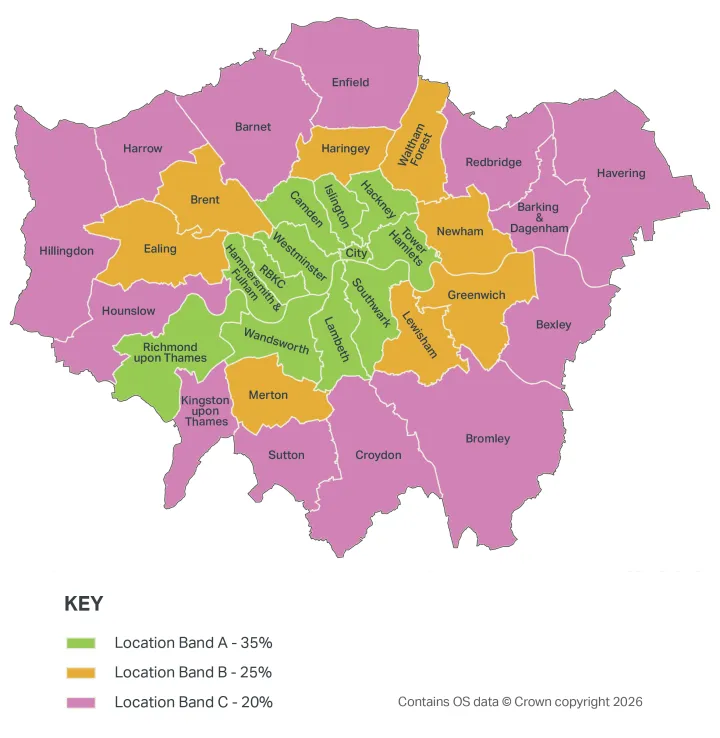
· Borough banding (map shown below).
· Whether land is public sector land.
· Whether development is proposed on Green Belt land.
· Whether industrial land is involved.
The Draft London Plan also introduces consistency across different residential and living sector uses. Conventional C3 housing, co-living, PBSA and older persons' accommodation are all now subject to broadly aligned thresholds. Development on Green Belt land and estate regeneration remain exceptions, with schemes required to follow the viability-tested route unless they achieve 50% affordable housing.
Smaller housing schemes are also differentiated from larger developments, with a consistent, London-wide affordable housing threshold proposed in an attempt to unlock small- and medium-scale development. Developments delivering between 10 and 35 homes would be subject to a standardised affordable housing requirement rather than the full range of threshold variations, with 20% for non-Green Belt land and 50% for Green Belt land.
The approach creates the potential for different affordable housing requirements between neighbouring sites located in different boroughs, meaning that affordable housing obligations could vary on opposite sides of the same road. A development on one side of a section of Finchley Road in Barnet, for example, would have an affordable housing threshold of 20% (Band C) whereas a site immediately across the road in neighbouring Camden would have a threshold of 35% (Band A).
There is some flexibility built into the system though; boroughs in Bands B and C will be able to review and potentially amend their classifications through Local Plans where supported by viability evidence.
Importantly, the supporting text also proposes that changes to affordable housing thresholds can be made through London Plan Guidance or a focused review of the Plan, rather than through a wholesale update to the London Plan; a measure intended to avoid the legal challenges associated with the GLA’s recent emergency measures.
Tenure Mix
One of the more welcome changes is the relaxation and simplification of affordable housing tenure requirements.
The existing London Plan’s suggested tenure split, which sought to achieve 30% Social Rent, 30% intermediate housing and 40% to be set locally by the borough, has been replaced by a more streamlined 60/40 social rent to intermediate tenure split. Given that most adopted Local Plans currently seek a 70/30 split between social rent and intermediate, this will provide greater flexibility to introduce a higher proportion of intermediate homes.
The Draft London Plan also introduces Key Worker Living Rent (KWLR), a new affordable housing product. The introduction of KWLR reflects growing recognition of the housing affordability pressures faced by middle-income workers who do not qualify for traditional social housing but equally remain priced out of market housing. These units will include rents set according to average household income, they will be more affordable than private rented homes, and the expectation is that tenants can stay in the long term, but they also allow for flexibility if short-term tenancies are required for employment reasons.
Circumstances Supporting a Lower Threshold
Perhaps most significantly, within nearly all location bands or land profiles there are potential circumstances outlined where the threshold affordable housing requirement is altered where certain tenure or infrastructure circumstances are met (see table 3.2 below). For example, a scheme in location band A delivering 100% social rent could see its threshold lowered from 35% to 25%, while a scheme in location band B that is at least 80% KWLR could see its threshold reduced from 25% to 20%. However, in this latter example the reduction for the new KWLR tenure only applies in the current draft to Build to Rent schemes.
Draft London Plan Affordable Housing Policy HN3 Table 3.2
Location or land profile
|
Affordable housing requirement
|
Circumstances under which the threshold affordable housing requirement is altered
|
Altered affordable housing requirement
|
Location band A
|
35%
|
Development is for 100% social rent homes
OR
100% KWLR Homes in the case of BtR development
|
25%
|
Location band B
|
25%
|
Development is for at least 80% social rent homes
OR
at least 80% KWLR homes in the case of BtR
|
20%
|
Location band C
|
20%
|
None
|
N/A
|
Green Belt land
|
50%
|
Development is proposing significant transport infrastructure delivery
|
35%
|
Public sector land
|
40%
|
Development is proposing significant strategic transport (or in some limited cases – subject to agreement with the GLA – strategic health) infrastructure delivery
OR
is part of a Public Sector Land Portfolio Agreement with the Mayor
|
25%
|
Industrial land
|
35%
|
None
|
N/A
|
One notable area of uncertainty from this table is the reference to the delivery of "significant transport infrastructure” or “significant strategic transport” which would influence threshold requirements on Green Belt and public sector land respectively. Without clearer definitions of these terms, there is likely to be debate over what level of infrastructure/transport delivery justifies a change in affordable housing expectations.
Purpose Built Student Accommodation (PBSA)
The Draft London Plan introduces a more favourable framework for PBSA based around three alternative affordable housing options. PBSA developments are subject to the threshold approach and can follow the fast track through committing to either:
· On-site affordable student accommodation at the same levels as C3 housing; or
· A combination of 10% affordable student provision and a payment in lieu towards conventional affordable housing; or
· Provision of conventional C3 affordable housing on-site at the same levels.
This represents a more flexible approach than previous policy and appears designed to encourage greater contributions from PBSA towards conventional C3 affordable housing delivery where appropriate.
Co-Living
The co-living sector is likely to be one of the biggest beneficiaries of the Draft London Plan’s approach to affordable housing. The current London Plan itself promotes a payment-in-lieu based approach to affordable housing for co-living schemes. The GLA’s Affordable Housing LPG then introduced the option for co-living schemes to provide C3 affordable housing on site. This has unlocked many co-living schemes across the capital, however, co-living (like PBSA) was excluded from the GLA’s emergency measures, meaning that a higher affordable housing threshold continues to apply to co-living schemes than conventional housing. The Draft London Plan now looks to rectify this. It continues to support on-site C3 conventional affordable housing provision under the threshold route, but, importantly, co-living schemes are now subject to the same affordable housing thresholds as conventional residential development. This brings greater consistency across housing typologies.
This approach will be particularly welcomed in boroughs within Locational Bands B and C where the affordable housing threshold for co-living (and other housing products) would be lowered to 25% and 20% respectively. This means that co-living developments in appropriate locations within Brent, Ealing, Greenwich, Haringey, Lewisham, Newham and Waltham Forest can follow the fast-track route with 25% affordable housing, while co-living schemes in Harrow, Hillingdon, Hounslow and Kingston are able to do so with 20% on site C3 affordable housing.
Estate Regeneration
While the Draft London Plan's overall approach to estate regeneration remains broadly unchanged, a number of specific alterations are proposed to be introduced.
Estate schemes delivering 50% affordable housing, including the replacement of existing homes, will now be able to utilise the Fast Track Route. While this is a positive change, the threshold remains challenging for many estate regeneration projects that already face significant viability pressures.
The policy also strengthens the existing requirements for replacement housing, with existing Social Rent homes expected to be replaced as Social Rent homes regardless of whether existing residents have a right to return. In practice, many estate regeneration projects already deliver replacement Social Rent housing through grant-supported delivery programmes, so the practical implications may be limited.
The Draft London Plan also places greater emphasis on options appraisal work where development proposals include the demolition and replacement of affordable homes. This is a strengthened requirement of the existing policy, requiring a robust assessment of the benefits and disbenefits of alternative options and ensuring potential benefits of demolition and replacement are weighted against wider social and environmental impacts.
Viability Reviews
The proposed approach to viability reviews in the Draft London Plan remains largely unchanged. All developments are still expected to undergo early-stage viability reviews where ‘substantial implementation’ has not progressed within an agreed period from the date of the permission (typically two years). A late-stage review is still required for viability-tested schemes on completion and occupation of 75% of their proposed units. Mid-term reviews may also be imposed for large, multi-phased permissions.
The Draft London Plan does introduce new policy wording which places increased emphasis on the quality and credibility of viability evidence. Decision-makers are directed to consider whether an appraisal is "objective, reasonable and realistic" before determining what weight should be given to it in the planning balance. This is likely to increase the importance of well-reasoned narrative justification alongside viability appraisals, requiring applicants to demonstrate not only that their assumptions are robust, but that the overall viability assessment presents a credible picture of deliverability.
Modular Temporary Accommodation
The Draft London Plan includes explicit support for modular temporary accommodation as a meanwhile use. This reflects the growing role that temporary modular housing can play in addressing urgent housing need, particularly on sites awaiting longer-term redevelopment. The policy acknowledges the potential to optimise underutilised land in the short term while contributing towards immediate local housing needs.
Lichfields’ Thoughts
The Draft London Plan proposes a more nuanced and targeted approach to affordable housing, with differential thresholds introduced in response to locational considerations, a site’s Green Belt status, land ownership and proposed use. It also proposes circumstances whereby the headline affordable housing threshold can be reduced based on tenure commitments, public transport delivery or a portfolio-based approach to affordable housing. In doing so, the draft policy moves away from a more standardised, London-wide approach to affordable housing.
Several of the proposed changes will go some way towards facilitating and incentivising housing development. For example, lower affordable housing thresholds in much of outer London and adjusted tenure expectations are welcome, and the ability to lower affordable housing requirements based on tenure commitments will help unlock developments. A more standardised approach to living sector uses, bringing co-living, PBSA and older persons accommodation in line with C3 housing, is a particularly positive move and will be welcomed by many co-living and PBSA developers.
At the same time though, the framework introduces a wider range of policy considerations than the current London Plan, adding another layer of complexity to an already challenging system. Borough bandings, land-based classifications, varying thresholds and alternative compliance routes mean that affordable housing requirements will increasingly depend on the specific characteristics of both the site and the development being proposed. As a result, there is likely to be a greater emphasis on testing different delivery scenarios and affordable housing outcomes at the inception of each project and throughout the planning process.
The big question is whether the Draft London Plan goes far enough to accelerate housing delivery, while delivering the affordable homes London needs. The proposed policy introduces more flexibility and incentivisation in some areas, but the fundamental structure remains heavily reliant on threshold testing and viability review mechanisms. In the current climate, many schemes will continue to be unable to meet the threshold requirements, and the viability-tested route and associated review mechanisms will remain a significant deterrent to investment.
Ultimately, the Draft London Plan seeks to balance a number of competing objectives: unlocking housing delivery amidst a long-stalled market, securing enough affordable homes, responding to sub-regional market variations and accommodating a range of products and uses within London’s increasingly diverse housing sector. Whether the proposed policy provides a suitably sophisticated and nuanced framework to unlock delivery, or simply adds to the complexity and gridlock of delivering affordable homes in London, will no doubt remain a key question considered as the Draft London Plan moves through consultation and examination.