The Government has laid the draft regulations necessary to bring the national scheme of delegation into effect, for approval of both houses of Parliament. The intended commencement date is 31 October 2026. This is 20 weeks away, so some applications already in the system will be affected. However, local authorities will need to start preparing for the change immediately.
In this blog we:
-
explain the changes made to the draft regulations following consultation;
-
provide a table showing the categories of decision making that different planning applications will fall into; and
-
set out some key points in the guidance, including on the operation of the application of the Gateway test for deciding whether or not an application goes to committee for decision.
The regulations will not apply to development corporations, Homes and Communities Agency, National Park Authorities or the Broads Authority, because they are not
“relevant planning authorities”. Therefore, these authorities will not need to amend their constitutions, committee sizes or decision-making processes by the end of October. Throughout this blog we refer to local planning authorities (LPAs), but this should be read as excluding the authorities listed above.
Draft legislation and summary of consultation outcome
The Government has published its response
[2] to the consultation on planning committee reform, including the proposed ‘national scheme of delegation’ for England. The consultation, which ran from 26 March to 23 April 2026, sought views on the technical detail and drafting of the regulations and guidance. Analysis of the proposals can be found
in this Lichfields blog.
Also published is the statutory guidance
[3] for LPAs in England, which they are required to follow when implementing planning committee reform and when otherwise applying the (currently draft) Town and Country Planning (Discharge of Local Planning Authority Functions) (England) Regulations 2026 (‘the draft regulations’)
[4][5]. The guidance is clear that even if an application is in the Schedule of application types that may be taken to committee, applications being referred to committee should be for exceptional cases only.
A total of 611 responses were received to the consultation, over half being from individuals. A quarter of responses, 156, were from LPAs, which means that just under half of LPAs responded.
The government response notes that the same key themes were raised by all categories of respondent. These include views on which Schedule applications should fall into (explained below), seeking the ability for members to call-in applications, concerns about committee size limits being limited especially given local government reorganisation and concerns about defining which applications are linked to officers, members or the authority.
Individual respondents
[6] expressed strong opposition to a national scheme of delegation, based on concerns that democratic oversight through consideration at planning committee would be lost. Not all those in the category of individual respondent will have made that objection, but individuals made up more than half of all respondents in a number (333) – coincidentally almost equal to the number of LPAs in England (337). While the government has not rolled back its plans to introduce a national scheme of delegation, the changes to the draft regulations since their last iteration include:
-
the implementation date has been delayed from 30 September 2026 to 31 October 2026 to give LPAs time to make the necessary arrangements;
-
‘large outline planning application’, a new definition (see below), will determine the Schedule a reserved matters application (RMA) falls within – rather than whether or not the RMA relates to a phased outline planning permission, as was consulted on;
-
Section 73 applications will now be in the same Schedule as the ‘original’ application;
-
‘Own-interest applications’ is the term for applications where an authority is itself or any of its members or officers are the applicant, or are considered to have an interest in the application - these were consulted on as ‘linked person applications’, with a slightly different definition; and
-
clarifying that ‘minor residential applications’ includes only dwellings and development for purposes incidental to the enjoyment of dwellings.
The forthcoming national scheme of delegation and controls on committee size are among other new or emerging ‘fail safes’ on local decision making. Since 31 March, where a LPA intends to refuse planning permission for a housing scheme of 150 dwellings or more, they must consult the Secretary of State to enable Ministers to decide whether to use their existing powers to call in that planning application. The Government has consulted on the same requirement applying where LPAs are minded to refuse planning permission for commercial development with a floorspace of 15,000sqm or more (see
this blog).
The Schedules applying to reserved matters approval applications
The Government previously proposed that only reserved matters applications relating to non-phased outline permissions were included in Schedule 1 of the regulations. This was to address previously expressed concerns that reserved matters applications can relate to large scale phased development taking place over many years in a changing context and can represent substantial major development, requiring examination at committee. This now dropped approach to reserved matters applications drew a “mixed” consultation response.
The Government has decided to change its approach and has introduced a size-based criteria for determining the applicable Schedule.
The regulations introduce a new definition:
““large outline permission” means an outline planning permission which permits development involving either or both of—
(a) the provision of 500 or more dwellings;
(b) the provision of a building or buildings where the floorspace to be created by the development is 50,000 square metres or more;”
The definition is provided because Schedule 2 includes “A reserved matters approval application in respect of a large outline permission”.
Only reserved matters applications relating to a large outline planning permission will fall into Schedule 2. Reserved matters approval applications relating to smaller outline planning permissions will fall into Schedule 1 and be determined by officers. The statutory guidance refers to a “large outline phase permission”, but this may be corrected in due course, as there are no longer references to phasing in the draft Regulations.
This suggests that, where the outline permission permits up to 500 homes, the reserved matters application would fall within Schedule 2, even if the final phase shows that less than 500 homes will be built.
This will mean that the proposals within an outline planning permission that do not constitute floorspace, such as caravan bases, will not be relevant to whether the permission is a ‘large outline’ and thus whether a related RMA falls within Schedule 1 or Schedule 2.
However, the key point in this context is the intention that in all cases the referral to committee should be exceptional, regardless of which Schedule an application falls into.
Schedules and own-interest applications
Category
|
Delegated to officers?
|
Application type
|
|
Schedule 1
|
Always
|
Minor residential application [7]Reserved matters application other than those made in respect of a “large outline permission”
Application for s96A non-material amendments
Section 73 application where the original/previous application was in Schedule 1, unless it relates to a listed building consent or variation of
Application made for approvals in a relation to a planning condition
Application for approval of the Biodiversity Net Gain (BNG) Plan
Application for prior approval or a determination as to whether it is required (related to permitted development rights)
Lawful Development Certificate application
Certificates of Appropriate Alternative Development application
Application for Permission in Principle
Application to modify or discharge a s106 obligation, where it is connected to a Schedule 1 approval
|
|
Schedule 2
|
By default, unless the Chief Planner and Chair of Committee decide it should go to Committee based on meeting statutory criteria ‘the Gateway Test’
|
Reserved matters approval application in respect of a large outline permission (at least 500 dwellings and/or at least 50,000sqm floorspace created)
Section 73 application where the original/previous application was in Schedule 2
Section 73A (retrospective) application
Application to modify or discharge a s106 obligation, where it is connected to a Schedule 2 approval
Application for listed building consent, application to vary or discharge a listed building consent condition and any planning application that the LPA considers is connected with these consent types
Advertisement consent application
Tree preservation order applications
Review of mineral planning conditions
|
|
Own-interest applications
|
Can be determined by officers. Alternatively, the nominated member and nominated officer may refer it to a committee
|
An application made, whether jointly with another person or not, to an authority to which the Regulations apply, by or on behalf of that authority, or a member or officer of that authority or if in the view of the nominated member and the nominated officer, the authority or any of its members or officers otherwise has an interest in the application made.
|
The national scheme of delegation does not apply to development corporations, Homes and Communities Agency, National Park Authorities and the Broads Authority.
There is no reference to hybrid planning applications, probably because they don’t exist in planning legislation. In our view, when establishing whether or not a reserved matters application relating to the outline part of a hybrid permission falls within Schedule 1 or 2, only the housing or floorspace proposed in the outline part of the permission would be counted towards the 500 unit/50,000sqm threshold for Schedule 2.
The guidance doesn’t explain which Schedule section 73 (s73) applications relating to applications determined prior to the new system will fall into, so it seems likely that if the original application was determined by planning committee then the s73 will fall within Schedule 2.
The guidance confirms:
“Where a planning function is not listed in either Schedule 1 or 2, it is for the local planning authority to decide whether it should be delegated to an officer or referred to a committee or sub-committee for a decision (as part of its local constitution)”.
Where an application falls to be determined by an officer, the LPA must not make arrangements that limit the officer’s discretion as to how to determine that application.
The statutory criteria for referral to Committee ‘the Gateway Test’
The criteria for referral of applications to committee, known as the Gateway Test, has been criticised, including in consultation responses, as being too broad and open to interpretation. The Government has decided that these concerns should be addressed in guidance and they have expanded the statutory guidance published alongside the draft regulations. The Planning Advisory Service (PAS) will continue to work with government to develop good practice advice to support LPAs in applying the reforms.
The updated guidance clarifies that it is not a requirement of the national scheme of delegation that nominated officers and nominated members consider all Schedule 2 applications or all own-interest applications for potential referral to committee. It will be up to LPAs to determine which applications should be considered for referral and Schedule 2 applications can be determined by officers.
It will be for LPAs to determine their own arrangements for triaging Schedule 2 applications in terms of how they are taken through the Gateway Test and deciding the route that they should follow
[9]. The guidance is clear that LPAs are under no obligation to establish a triaging system but may follow this route if they wish. Own interest applications can be taken to committee without needing to pass the Gateway Test.
The guidance notes that the “overriding presumption” should be that applications are determined by officers and determined by committee as an exception.
At least one of the statutory criteria must be met for a Schedule 2 application
[10] to be referred to committee for decision. The statutory criteria (a) and (b) are set out in the Regulations and in the statutory guidance (A and B). Regulation 5 says that the nominated member and nominated officer, having had regarding to the statutory guidance,
“may agree to refer a Schedule 2 application to a committee if in their view it raises—(a) one or more issues of economic, social or environmental significance to the local area, or
(b) one or more significant planning matters having regard to the development plan and any other material considerations”.
If they decide not to refer to the Committee, then an officer must determine that application.
The statutory guidance lists the below three potential examples of what may constitute a significant issue to the local area under criterion A
[11], while noting that there will be local variations:
“an application for outline planning permission for a large multi-phase residential development allocated in the local plan
an application for planning permission for change of use of a community shop in a rural area
an application for planning permission or listed building consent for changes to a notable listed building in a town centre”
For criterion B, the guidance says that the following circumstances are unlikely to raise a significant planning matter:
"where the application for development broadly complies with a detailed site allocation and other relevant policies set out in a local or neighbourhood plan and national decision making policies set out in the National Planning Policy Framework. Significant planning matters may arise if new material considerations are raised by the application
where a specific planning matter (e.g. highways or flood risk) was initially raised by a statutory consultee as a concern, but the development proposal has been modified to make it acceptable in the view of the statutory consultee (unless the nominated officer has compelling reasons to consider otherwise)."
These examples, in paragraphs 23 and 24 of the guidance
[12], are the same as those consulted on, and of very limited use. It will be much more helpful to discuss interpretations of ‘significant’ directly with local officers and to monitor emerging patterns. Local knowledge will be increasingly important in this regard. The record that should be kept of cases that the nominated officer and member have considered, setting out their reasons for the determination route decided, will be important too. The consultation response says that the Government will work with the PAS to see if greater clarity on how the gateway process should operate and advice on interpreting the gateway criteria might be incorporated into the good practice advice PAS is developing to support local authorities.
Delegation default
The diagram below aims to capture what we understand about the new decision-making procedures. It draws out how many opportunities there are in the process for a Schedule 2 application to be decided by officers, reflecting the policy ambition.
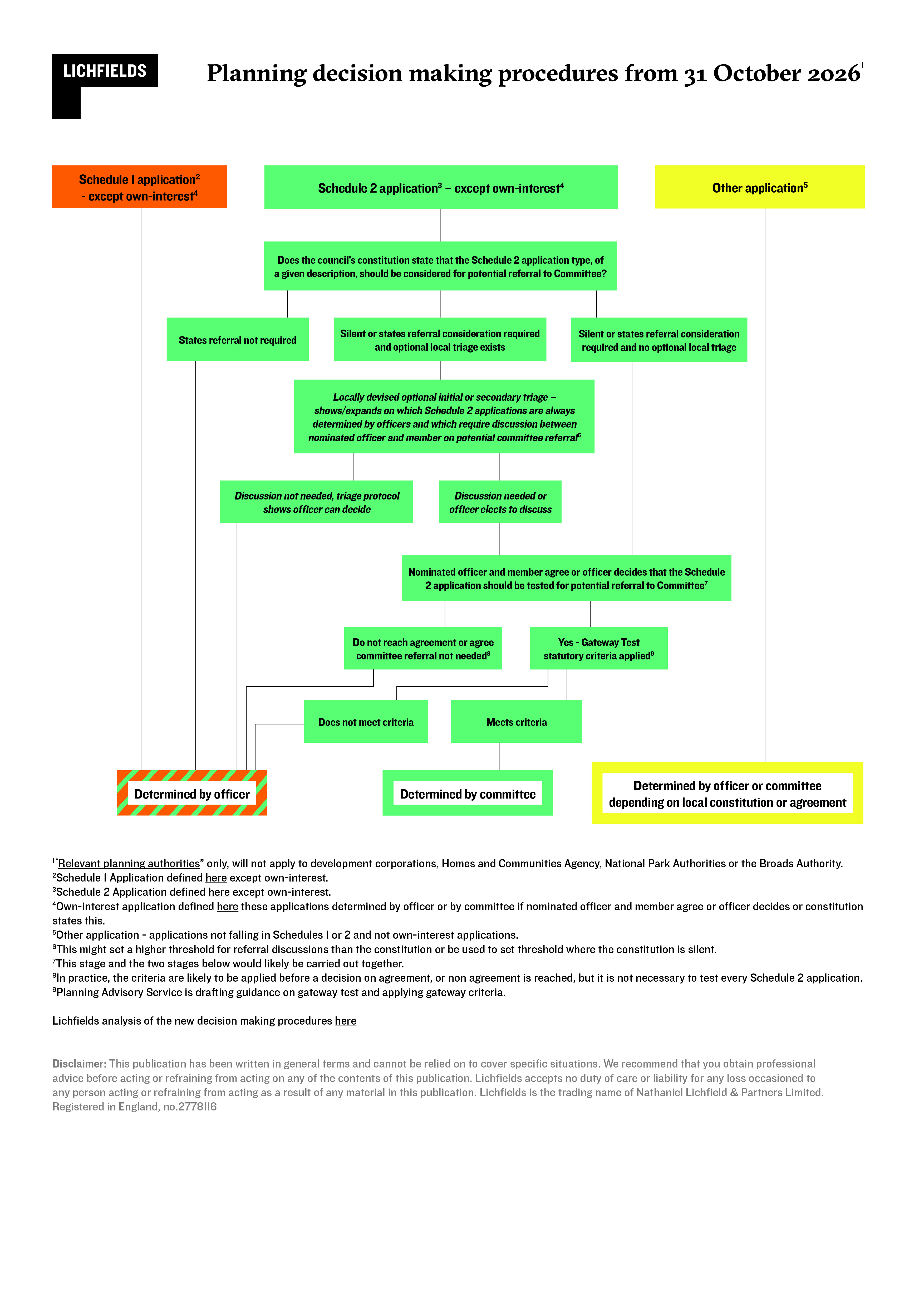 View Planning decision making procedures diagram
Refer or not refer – who decides?
The regulations say that “the nominated member and nominated officer may agree to refer a Schedule 2 application to a committee” if it raises a Criteria A or B concern. Similarly, the draft regulations say that “The nominated member and nominated officer may agree to refer an own-interest application to a committee”. The draft regulations do not provide a process for situations where the officer and member do not agree on whether an application should go to Committee.
However, para 15 of the statutory guidance says (our emphasis):
“Nominated officers and nominated members should make every effort to reach agreement on which cases should be referred to committee. However, where agreement is not possible, the case must be determined by officers in accordance with regulation 5(2) or regulation 6(3)”.
Regulation 5(2) says that Schedule 2 applications not referred must be decided by an officer. Regulation 6(3) says the same for own-interest applications. Therefore, the statutory guidance is key – and some members will push hard against this. Political reasons to take an application to committee with the intention of approving it would include the press coverage of a popular approval. But, on the whole, a key driver for a councillor will be either to vote for refusal of an application, to seek additional conditions, or to be seen to be objecting to an application. Planning is about people and many councillors are likely to question and then be frustrated by the casting vote of the chief planner, particularly as the system beds in.
Our diagram emphasises that this isn’t a straightforward system and it may be that it results in more applications being considered at Planning Committee, particularly where councils revisit schemes of delegation. This may be the case particularly where councils are under new leadership and/or have no overall control.
As one would expect, the Planning Officers’ Society has published detailed analysis of the decision-making procedures, within its ‘Good Practice Guidance Note - National Scheme of Delegation’
[13]. This includes guidance on approaches to triage and templates of the documents that need to be updated.
Maximum committee size – and training in the future
From 31 October, the maximum number of members on a planning committee will be 13, which is unchanged from the consultation. Again, the limit on committee size only applies to “relevant planning authorities”. The guidance says:
“This is a maximum figure to accommodate local planning authorities where members are from multiple political parties. Local planning authorities should consider whether a smaller number of members would be more appropriate in their area to support effective decision making”.
In a recent PAS and MHCLG seminar
[14], MHCLG’s Deputy Director of Planning confirmed that the focus for now is on the scheme of delegation, with legislation and guidance on councillor training to follow. The Government intends to carry out
“further sector engagement to get the correct approach”. It is worth noting PAS research regarding member training here:
“The PAS planning committee survey 2025 identified that 81 per cent of planning committees in England made it a mandatory requirement for councillors to be trained if they wish to sit on the planning committee”[15].
Therefore, less than a fifth of planning committees (and perhaps considerably less), have no training requirement at present. The quote is taken from the PAS ‘Planning committee best practice self-assessment toolkit’
[16] which notes that Councils not training planning committee members, even ahead of it being a national requirement, may be at risk of challenge.
While the vast majority have a training requirement, current training standards may vary and PAS advises Councils to “check progress on national changes before reviewing your own council’s schedule of training”.
Potential impact
The draft Impact Assessment (IA) of the draft Regulations sets out how the national scheme of delegation is likely to affect decision making and appeals, based on past trends and data.
The IA refers to Lichfields research that looked at 640 planning appeals for developments including at least 50 residential units in England from January 2021 to August 2024 and found that 33% arose from a refusal by planning committee contrary to officer recommendation. The draft IA assumes, in the absence of additional data, that the Lichfields 33% figure is appropriate to apply to all appeals relating to major applications (both residential and commercial).
The Government's data and analysis was used to assume that 3% of minor appeals arising from committee's refusing against officer recommendation. MHCLG officials' own analysis found that 40% of major appeals related to applications that had been refused by a planning committee, despite being included in a local plan. The analysis assumes that these applications would now all be approved, but acknowledges that risks overstating the impact. Instead 20% is used as the likely reduction in appeals (with a sensitivity testing range of 5%-40%). Taking into account these factors and others set out in the IA, the authors expect the average annual number of appeals to be reduced by 85 (of which 5 reductions would be major commercial appeals).
Use of Lichfields research has informed an estimate that up to 485 additional homes will be delivered annually this Parliament, as a result of the national scheme of delegation, based on the Office for Budgetary Responsibility (OBR) trajectory of new homes.
Regulation review
There will be a duty in the regulations in the Secretary of State to undertake and publish a review of the regulations by 31 October 2028, providing an opportunity to assess the effectiveness of the reforms after two years in operation and make any necessary changes.
Practical implementation consequences
The final regulations are due to be made in July and are scheduled to come into force on 31 October 2026. The guidance expressly notes that if a planning committee makes a decision on or after 31 October, which the Regulations require that only an officer should make, that decision may be subject to judicial review by an aggrieved party, which could lead to the decision being quashed. In practice this situation is unlikely to arise, but it serves as a written warning to frustrated councillors who might conclude that they have less and less control on decision-making - particularly those with an out of date local plan.
As noted at the start of the blog, local authorities will already be thinking about the administration of these changes. Beyond the changes to constitutions and member/councillor protocols, perhaps whether or not to triage Schedule 2 applications will be given particular consideration by planning teams and councillors. With the recent significant changes in leadership of local authorities across England and the new planning committees just bedding in, in many places there will be no existing working relationship between the planning committee chair and the chief planner or equivalents. Against that backdrop, it will be interesting to see which LPAs decide that the planning committee chair will review every Schedule 2 application, which decide solely the Chief Planner will lead on it and, where there is a formalised triage approach, as to whether or not a Schedule 2 discussion is needed.
Given that the chief planner has the casting Gateway Test vote on whether an application is referred to Committee, a triage might only happen where there are truly engaged and collaborative officer/member relationships – or where officers and members want to build them.
There will be much work for officers to do in terms of considering what might be a significant issue or matter in their area, when considering the Gateway Test criteria, in order to derive consistency when making or not making referrals. Consistency will be apparent from the record of discussion that should be kept. Officers will need to liaise with the chair of the planning committee or other nominated member and may also liaise with Councillors more widely on their intended approach.
At this year’s Haymarket Planning Summit
[19], concerns were raised about the additional pressure the national scheme of delegation will put on nominated officers, both in terms of discussions with councillors and the public focus on who ultimately made the planning decision. Referring to her attendance at the Summit, albeit not those concerns specifically, Baroness Taylor, Lords Minister for Housing and Local Government, said in Parliament
[20]:
“I was with a group of planning officers this morning. If ever a group of council officers suffer this kind of harassment, it is our planning officers. That has to stop. They need to be able to do their job and their consultations without risking harassment and intimidation and be able to make decisions according to law and their professional expertise without fear of harassment”.
Notwithstanding potential alternative approaches to implementation, it is clear that chief planners will wield significantly more control in decision making from Monday 2 November.
Town and Country Planning Act 1990, Interpretation of sections 319ZZC to 319ZZE