From tRESP to Full Spatial Energy Planning
In my previous blog,
“Why the tRESP Consultation Matters for the Future of Energy Investment”, I explored how the Transitional Regional Energy Strategic Plan (tRESP) was a first step towards a more coordinated, place-based approach to planning Great Britain’s energy system. That consultation introduced new regional evidence, future Pathways, Consistent Planning Assumptions (CPAs) and Strategic Investment Needs (SI Needs), with a clear link to ED3 price controls and the UK’s 2030 decarbonised grid and 2050 net zero targets.
The new Regional Energy Strategic Planning (RESP) Draft Methodology Consultation is the next stage in that journey. It moves from a transitional, mainly electricity-focused exercise to a full, whole-energy, bottom-up methodology for how NESO will prepare Regional Energy Strategic Plans for Scotland, Wales and the nine English regions. These plans are intended to provide the strategic coordination of energy distribution networks so that local areas get the energy system they need to meet local and national goals, while delivering value for consumers.
For energy developers, operators and investors, this consultation matters because it sets out how future RESPs will be built: how local priorities will be captured, how evidence will be assembled, how Pathways will be modelled, and how Strategic Investment Needs will be identified and justified. In short, it describes the rules of the game that will sit upstream of the investment and connections environment you operate in.
From Transitional tRESP to Full RESP
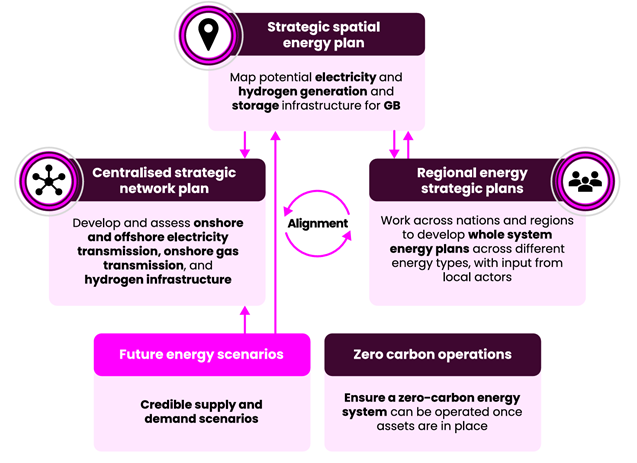
NESO’s RESP role is now a formal part of the strategic planning landscape. Through RESP, NESO will produce first-of-a-kind, whole-energy strategic plans for each nation and region, sitting alongside the Strategic Spatial Energy Plan (SSEP) and Centralised Strategic Network Plan (CSNP).
Figure 1 Interactions between NESO’s strategic energy plans
Source: NESO – Regional Energy Strategic Planning: Draft Methodology for Consultation (November 2025)
The tRESP was a pilot and bridge – designed to support the ED3 price control (2028–2033), test methods and start building a regional evidence base. The RESP Draft Methodology explicitly takes learnings from tRESP and extends the same core components – Contexts, Pathways, CPAs and SI Needs – into a fuller, whole-energy, more spatially explicit approach.
If you engaged with tRESP – for example by providing pipeline information or highlighting growth areas – this consultation is about how that type of information will be used and weighted in future, and what the enduring RESP process will look like.
The Core RESP Components – What Stays and What Evolves
The methodology retains and formalises the main elements that appeared in tRESP:
-
Nations and Regions Contexts – regional evidence base
-
Pathways – scenarios for demand and supply
-
Consistent Planning Assumptions (CPAs) – common inputs to network impact modelling
-
Spatial Context – a geospatial view of system need (a stronger emphasis than in tRESP)
-
Specification of Strategic Investment Need (SI Need) – identifying where more complex or strategic investment may be needed
Taken together, these provide an end-to-end logic:
-
Contexts and local evidence shape the Pathways.
-
CPAs ensure that network impacts are modelled consistently.
-
Pathways, network data and local priorities are brought together in the Spatial Context.
-
All of this underpins the identification of Strategic Investment Needs.
It’s important to emphasise that RESP does not replace detailed network planning by distribution network operators (DNOs) and gas distribution networks (GDNs). Instead, it provides a strategic steer and evidence base – highlighting where business-as-usual may be insufficient and where more complex, cross-boundary or earlier investment is justified.
Nations and Regions Contexts and Pathways – A Sharper View of Place and Futures
The Nations and Regions Contexts are the foundation of each RESP. They pull together data on demographics, industry, existing energy infrastructure, transport, heating, local and national net zero targets, and – crucially – local plans, Local Area Energy Plans (LAEPs) and Local Heat and Energy Efficiency Strategies (LHEES) where they exist.
For developers and operators, the opportunity here is that project pipelines, strategic sites and growth corridors can be reflected in the regional story, not just as individual loads but as part of an overall pattern of future energy need.
The RESP Pathways build on the tRESP work but move from an electricity focus to whole-energy – electricity, gas, hydrogen and heat. NESO proposes a single short-term Pathway (to support near-term investment) and multiple longer-term Pathways aligned with the Future Energy Scenarios (FES) to explore uncertainty out to 2050.
For the sector, this is where regional demand and supply expectations are crystallised: how quickly electrification accelerates, where hydrogen may come into play, and how industrial and domestic needs evolve over time.
Pathways remain scenarios, not forecasts. The consultation is therefore an opportunity to comment on whether the proposed approach to Pathways – and the way uncertainty is handled – reflects what you are seeing in the market and in your project pipeline.
CPAs and Spatial Context – From Numbers to Maps
CPAs continue to play a central role by providing common planning assumptions for translating the deployment of technologies (EVs, heat pumps, efficiency improvements, etc.) into network impacts. For developers and operators, this is key to getting a consistent view of headroom and reinforcement needs across regions.
As with tRESP, there is a balance to strike between consistency and local realism. The RESP methodology starts to codify decision-making criteria for CPAs, and this consultation is an opportunity to highlight where national assumptions would be out of step with local conditions or markets.
A major evolution from tRESP is the emphasis on Spatial Context. NESO proposes a geospatial layer that overlays the Pathways with network information to identify spatial patterns of system need – essentially, where “hotspots” for investment are likely to emerge.
Spatial Context will not only cover electricity, but also gas, biomethane, hydrogen and heat networks, giving a multi-vector view of where demand and infrastructure pressures could arise. For anyone used to working with planning allocations maps and infrastructure plans, this is the energy-system equivalent – a strategic spatial picture rather than a detailed engineering solution.
The detail of how Spatial Context is presented and used will matter. It will be important that it is seen as a strategic evidence layer, not a replacement for local planning or detailed network studies.
Strategic Investment Needs – The Crucial Interface with Projects
The methodology sharpens the approach to Strategic Investment Needs (SI Needs). NESO defines SI Needs as complex, high-value energy needs that cannot easily be met by business-as-usual network planning and that may require earlier, more coordinated or more strategic investment.
Complexity is framed in three broad ways:
-
Timescale complexity – major growth areas where energy needs arise quickly (e.g. large housing or employment zones, AI/data clusters, investment zones).
-
Geographical complexity – needs that span multiple licence areas or vector boundaries.
-
Trade-off complexity – situations where multiple technologies and stakeholders interact, such as industrial decarbonisation clusters.
For developers and operators, this is where RESP comes closest to your project reality. If your schemes sit within, or contribute to, these complex needs, there is a route for them to be recognised as part of a wider SI Need cluster rather than treated purely as isolated loads in queues.
RESP will not specify individual projects or reinforcement schemes – that remains the role of networks – but it will signal where and why strategic investment may be warranted, which can help shape the context for future price controls and business plans.
Engagement, Governance and Local Actor Support
One of the clearest signals in the methodology is the importance of governance and engagement. NESO proposes:
-
Strategic Boards in each nation/region, bringing together local authorities, electricity and gas networks, cross-sector bodies and devolved governments.
-
Supporting working groups on key themes.
-
A GB-wide Steering Committee to align approaches across regions.
NESO also acknowledges the reality that many local actors lack capacity, data or analytical tools to participate effectively. The methodology therefore includes proposals for Local Actor Support – from energy planning literacy material to signposting existing tools and, over time, more structured support.
For developers and operators, the practical takeaway is that RESP will create new forums and channels through which regional energy priorities are debated and shaped. Engaging either directly, via partnerships with local authorities, or via sector bodies will be key to ensuring that your part of the energy transition is properly reflected.
Opportunities and Risks for the Sector
If implemented well, the RESP methodology offers several key opportunities:
-
A more coherent, region-by-region view of future demand and supply, grounded in local priorities.
-
A spatially explicit picture of system needs and constraints across energy vectors.
-
Clearer pathways for complex, high-value projects to be recognised as strategic and not just incremental loads.
-
Stronger alignment between energy planning, spatial planning, and economic strategies.
However, there are also risks:
-
If engagement is patchy, RESP may default to national datasets, under-representing local development pipelines and innovation.
-
If Spatial Context is poorly communicated, it could be misinterpreted as a substitute for detailed planning or network studies.
-
If SI Need is not clearly reflected in regulatory decisions, expectations about anticipatory investment may not be met.
For energy developers and operators, the key is to lean in early: help NESO design a methodology that works for real project development, not just for modelling.
Why This Consultation Deserves a Response
NESO describes this consultation as “a significant step forward in strategic energy planning,” bringing together GB-wide and local plans, and embedding tRESP learnings into a whole-energy, bottom-up framework.
The consultation runs from 17 November 2025 to 16 January 2026, with responses invited via NESO’s online portal. This is the window in which developers, operators, investors and local authorities can shape:
-
How Nations and Regions Contexts will be built and used.
-
How Pathways and CPAs will handle uncertainty and local variation.
-
How Spatial Context will visualise system need.
-
How SI Needs will be identified, assessed and specified.
In combination with tRESP – which you may already have responded to – this methodology will define how regional energy planning and investment decisions are made in the years ahead.
The UK’s energy transition isn’t just about technology – it’s about place. This consultation is your opportunity to ensure that the methodology for RESP reflects the realities of development on the ground, supports growth, and delivers an energy system capable of meeting both net zero and local ambitions.
Now is the moment to engage – not just to comment on a document, but to help shape the rules of the game for regional energy investment and spatial energy planning for the decades to come.