Planning matters

Our award winning blog gives a fresh perspective on the latest trends in planning and development.

Cutting Down to Size: How the New NPPF Proposes to Ease the Burden for Small Sites
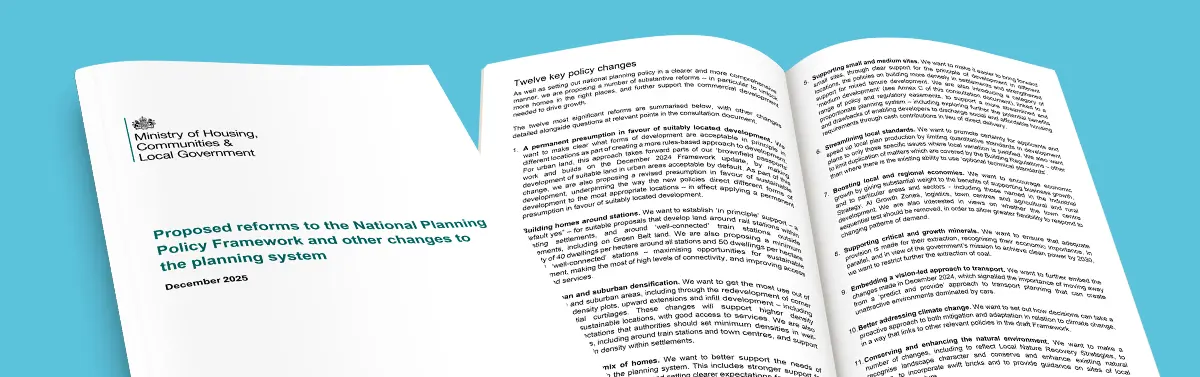
As part of Lichfields analysis of the draft NPPF (published for consultation on 16 December 2025[1])  this blog focuses on the changes for development of small-to-medium (StoM) sized housing sites and considers the implications for housing delivery.
Plan-making and Development Management: a proportionate approach that reduces documentation requirements
 
The government highlights delivery of homes on StoM sized sites as one of its “twelve key policy changes”, intending to provide clearer support for the principle of development across a wider range of locations in plan-making.
 
L1: Planning for an effective use of land
This promotes the allocation of sites of different scales, including StoM-sized sites, and the use of design guides and design codes to establish common design principles and highlight development opportunities of sites of StoM-sized sites.
This would replace the paragraph 73 of the 2024 NPPF, which requires at least 10% of a housing requirement be met on sites no larger than one hectare.
 
 
DM1: Preparing development proposals and DM2: Information requirements.
The draft NPPF emphasises that planning requirements should be proportionate to site size, introducing a new “medium development” category in Annex C for schemes of 10–49 homes on sites of up to 2.5 hectares, supported by policy and regulatory easements intended to streamline development on sites of this scale.
The consultation states that the “medium development” category should not be subject to information requirements designed for larger developments (at pre-app or application stage), where these would be disproportionate to the scale of the proposal:
 
  1.  Pre-application engagement: Draft Policy DM1 states that pre-application engagement should be proportionate to the nature of the scheme and those likely to be affected.
     
  2.  Local validation lists: Draft Policy DM2 states local validation lists should only require additional information above what is required by the national decision-making policies when they are supported by local policies. Validation requirements should also distinguish between major, medium and other forms of development, to ensure they are proportionate to scale and potential impacts.
What do these changes mean? The shortage of suitable land for smaller sites and builders has contributed to the decline in SME-led housing delivery in recent years.[2] The Federation of Master Builders has estimated that, given the right conditions, the SME housing building sector could increase housing output by up to fivefold.[3] The changes in the new NPPF might go some way to help address this.
According to Lichfields’ research for the HBF’s Planning for Small Sites (2025), negotiating matters such as design and residential amenity is among the top three issues debated for urban small-site applications. [4] The draft NPPF seeks to address this - at least in part - through the extended use of design guides and design codes on smaller sites. The aim is for greater clarity on local authority expectations, reducing the scope for negotiation.
Furthermore, a greater emphasis on allocation StoM-sized sites would reduce the need for applicants to establish the principle of development on a site-by-site basis. Our research for the LPDF - Small builders, big burdens (2023) - indicates that SME developers are often required to go beyond proportionate validation and policy requirements, leading to increased financial risk and delays.[5] Reducing documentation requirements to proportionate levels would help lower upfront development costs, minimise delays, and accelerate housing delivery overall.
Our research (ibid) also concluded that a medium sized category could help “LPAs and National Development Management Policies to set more proportionate policies and evidence thresholds that are better suited to sites that are [medium sized]”. We also concluded requirement for some evidence should be a product of discussion, rather than be automatically demanded at the outset – “this should lead to case officers being more confident in deferring some of the evidence required to conditions and the reserved matters stage when funding is more readily available [for developers].
 
Affordable housing: Greater flexibility for Payment in Lieu and size standards
The draft NPPF places a strong emphasis on certainty and proportionality for StoM-sized housing sites, particularly for SME developers. Central to this are policies HO8, DM5 and PM12, which together seek to reduce risk, negotiation and delay.
 
 
HO8: Providing Affordable Housing
HO8 introduces flexibility whereby, if a proposal meets or exceeds up-to-date development plan requirements for the proportion and mix of affordable housing tenures (including the minimum proportion of Social Rent homes) a more flexible approach may be taken to the mix requirements for market homes. This flexibility could be particularly beneficial for StoM sized sites in urban London locations, allowing unit sizes to be adjusted to support development viability.
While HO8 retains the preference for on-site affordable housing, the government understands the difficulties experienced finding buyers for those properties, with uncertainty and negotiations disproportionately affecting SMEs. In the consultation document, the government is considering allowing developers of “medium development” sites to meet affordable housing requirements entirely through payments in lieu. This was a recommendation of our research for Pocket Living[6] back in 2020. This could be significant, especially on urban sites, and in London where the Government/GLA emergency measures have already highlighted affordable housing as a viability issue holding back delivery.[7]
The disposal of affordable housing to Registered Providers (RPs) has been a persistent and growing challenge on StoM-sized sites. [8] RPs are often reluctant to acquire small numbers of homes within developments, as these can be inefficient to manage and require similar staffing and management inputs without the benefits of scale.[9] This can affect developer cashflow, creating market barriers to entry and delivery.
The HBF Bid Farewell (2024) notes many RPs require at least 20 affordable homes on their sites, with larger providers often rejecting schemes with under 100 homes. This may continue to present challenges for developments of approximately 50–300 homes, which exceed the 49 homes ceiling on the proposed definition of “medium development” but may still deliver fewer than 100 affordable units. This suggests the proposed definition may still not capture the current range of viability and delivery challenges.


Development Viability: A Standardised methodology and obligations
 
DM5: Development Viability and PM12: Developer Contributions
The policy introduces the presumption that developments complying with up-to-date plan policies should be considered viable. Where a viability assessment is required to demonstrate that a policy-compliant level of affordable housing is not achievable, this has to be specific circumstances, such as:
 
  • The development is significantly different from any typology assumed in the development plan viability assessment;
     
  • Site characteristics differ substantially from the assumptions used to assess viability when the relevant development plan policies were prepared;
     
  •  The development is demonstrably burdened by costs which were unforeseeable when the development plan was prepared; and
     
  • Site or economic circumstances have changed significantly since the development plan was prepared.
The policy also sets out a more standardised method for assessment, namely to: 
 
  • Refer back to the viability assessment(s) that informed the relevant development plan policies;
     
  • Fully evidence all inputs and assumptions used, explaining any departures from the viability assessment(s); and
     
  • Utilise standard inputs set out in the Annex (to be added subject to the result of this consultation).
PM12 adds to this by requiring local plans to set clear, fixed expectations for affordable housing and developer contributions. Collectively, through these two policies, the government aims to standardise the planning process by reduce the time spent negotiating viability and planning obligations at the decision-making stage.
This approach could in due course benefit SME developers delivering StoM-sized sites, particularly in London, where the research by Lichfields for Pocket Living identified affordable housing and viability as key causes of delay in London, with around a third of cases affected by protracted land value and viability debates, and Section 106 negotiations often doubling determination times.[10] Greater standardisation of viability assessments and Section 106 could reduce delays and mitigate financial risk.
However, it remains unclear to what extent the viability process can be standardised, particularly as the exceptional circumstances identified in Policy DM5 may not be uncommon. In the absence of a stepped approach to affordable housing requirements for StoM sized sites, the number of viability assessments is unlikely to decrease, at least in the short term. This approach may be more effective once new-style local plans implement Policy L1 with a greater supply of StoM sized site allocations through local plans.


Standardisation of Planning conditions and obligations
 
Policy DM6: Use of planning condition and obligations
DM6 states that national model conditions and obligations should be used, unless there are strong reasons not to. The consultation highlights the aim to encourage consistency and simply the planning process.
As with attempts to standardise viability, this proposal could also reduce delays and financial risks for StoM sites. This was similarly highlighted in our research for Pocket Living, with smaller developers often restricted from realising returns on capital due to onerous pre-commencement conditions.
Biodiversity Net Gain (BNG): Exemptions for StoM-sized sites and supporting off-site contributions
The Government’s consultation document has set out the intention for BNG exemptions for certain site categories. The Housing Secretary pledged to introduce an area-based exemption for smaller sites that are up to 0.2 hectares and residential brownfield developments of up to 2.5 hectares. This could reduce the cost of development and slim the evidential burden required to support applications. A full consultation on this is expected in the new year.
This move could help address issues we highlighted in the HBF’s Planning for Small Sites (2025) research, which found that 94% of SMEs had experienced delays with applications due to BNG.[11] For slightly larger sites, simpler and more accessible mechanisms for delivering BNG off-site could also support SME developers, subject to the details proposed in the forthcoming consultation.
Summary and Conclusions
 
Overall, the draft NPPF and accompanying consultation signal clear efforts towards a more proportionate, standardised and delivery-focused planning framework for StoM-sized housing sites.
Through clearer policy expectations, reduced documentation requirements and a set of more flexible approaches to affordable housing, viability, planning obligations and BNG, the proposed reforms have the potential to address many of the structural barriers that have constrained SME-led housing delivery in recent decades.
If implemented effectively and supported through local plan allocations under Policy L1, these changes could reduce uncertainty, negotiation and delay, lower risk and improving the viability of development on StoM sized sites, particularly in challenging markets such as London. However, the extent to which these benefits are realised will depend on how consistently the policies are applied in practice, the scope of any exemptions or flexibilities ultimately adopted, and whether exceptional circumstances continue to drive site-specific negotiations. This consultation and the forthcoming consultation on BNG early next year presents an important opportunity to ensure that the final framework fully supports the role of StoM-sized sites in accelerating housing delivery.
 
 
Footnotes
[1] National Planning Policy Framework: proposed reforms and other changes to the planning system
[2] Lichfields (2023), Small builders, big burdens, Source: Link
[3] Written Evidence of the Federation of Master Builders (2023), Source: Link
[4] HBF (2025), Planning for small sites, Source: Link
[5] Lichfields (2023), Small builders, big burdens, Source: Link
[6] Lichfields (2020), Small sites: Unlocking housing delivery, Source: Link
[7] Lichfields (2025), Two penn'orth invited: the London emergency housing measures consultations, Source: Link
[8] Knight Frank found 80% of developers are struggling to find buyers for Section 106 affordable homes, including more than 40% who say they are unable to find a single Registered Provider (RP) buyer. Source: Link [9] HBF (2024), Bid Farewell, Source Link
[10] Lichfields (2020), Small sites: Unlocking housing delivery, Source: Link
[11] HBF (2025), Planning for small sites, Source: Link

CONTINUE READING

It’s all in the mix

It’s all in the mix

Martin Taylor 19 Dec 2025
The NPPF has long championed the need to deliver an appropriate mix of homes; the right balance of sizes, types and tenures, ensuring planning policies and decisions meet the diverse housing needs that exist from the many different groups present within local communities. The NPPF consultation doesn’t waver from that core thread, seeking to ‘secure a diverse mix of homes’ by better supporting the needs of different groups through the planning system, though in some sense goes further than ever before on seeking to achieve this through the planning system. It does this with several key proposals thrown into the mix:
 
  1. Stronger support for rural social and affordable housing, by widening the previous narrow definition of ‘designated rural areas’ to include Parishes with a population of less than 3,000 and population density of two persons or less per hectare, allowing affordable housing contributions to be sought on minor developments in those areas. Although this is a minor definition change, it could generate more affordable housing funding in such rural areas, but equally may make the viability of such schemes in some areas more challenging.
     
  2. Mandating that LPAs set out policies for the proportion of housing to be delivered to building regulations optional standards part M4(2) ‘accessible and adaptable dwellings’ and M4(3) ‘wheelchair user dwellings’, with a set minimum of 40% of homes delivered to one or other of the standards. As the consultation recognises, many LPAs already require such standards, but the change is seen as formalising best practice.
     
  3. Requiring authorities to allocate sites to provide for specific types of housing such as older persons housing, purpose-built student accommodation, and self-build plots. Such a change would require a wider consideration of site selection through Local Plans to meet those needs. Carving out specific allocations for those accommodation uses will ensure they are not competing for limited space with general housing.
     
  4. More flexibility on the housing unit mix, where local requirements on the mix of affordable homes are met or exceeded. In practice this is brought through in policy wording which indicates that where such affordable housing stipulations on tenure and mix are met, including a minimum proportion of social rent, “a flexible approach should be taken to taken to the application of any development plan requirements relating to the size of market homes, taking into account prevailing market conditions” (Policy HO8(3)).  Meet your affordable housing obligations and the quid pro quo is that you can deliver (more of) what you want for the market housing element.
 
It is perhaps this last change that is the biggest departure from current practice, and represents a significant opportunity for rebalancing and optimising viability within individual schemes. Policies guiding – and in some cases dictating – the appropriate mix of unit sizes for market homes are abound in local planning documents, taking many forms. Some are development plan policies, some are not instead simply pointing to evidence or relevant material considerations (albeit that in some cases open market housing mix targets set out in SHMAs and other evidence are being applied as if they did carry the same weight as development plan policy). Some policies and proposals relating to housing mix have in-built flexibility, reflecting that different sites will be suitable for different mixes and lots of considerations may apply. Others rigidly and narrowly seek to apply the findings from local housing need assessments in a prescriptive manner; often even though those assessments build in assumptions around how households will occupy homes and bear no reflection on what a housebuilder can best sell in a local market (e.g. is it that households only ‘need’ 2-bedrooms, or is it that work-from-home, frequent visitors or a desire for more space means those same households might ‘demand’ and be able to afford 4-bedrooms?). And is it for the planning system to intervene in this way?
 
 
Market mix is important stuff to housebuilders – it impacts viability and bottom lines. This was most forthrightly highlighted when one such policy, set out within an SPD and contended to be overly prescriptive, was challenged by a collective of housebuilders and quashed by the high court.[1] On occasion, it can be hotly contested at application stage too.
The introduction of flexibility on market mix could achieve interlinked outcomes of driving schemes to achieve their affordable housing obligations, whilst simultaneously improving the viability of schemes (and enhancing sales rates) and delivering the type of housing that best reflects market demand. It’s also worth remembering that new homes don’t operate in isolation, but as part of a wider housing ladder, where someone buying a new home of a certain size might free up their existing home (of a different type or size) to meet a different market demand – and set off a wider chain of movements. Flexibility doesn’t inherently imply local needs and demands will go unfulfilled. Indeed, flexibility might mean that local needs can be better served as developers are not required to deliver a mix derived from a ’borough-wide’ position (and one that might be drawn from somewhat dated housing market evidence), but instead can focus on what local needs and market demands are within the immediate locality of the site.
That leads to one question of why similar flexibility should not apply to viability tested affordable housing provision, where development plan expectations cannot be met, but a shift in market housing mix (beyond the parameters of policy) might deliver more affordable housing than is otherwise viable. It might seem odd to only afford that freedom where affordable housing requirements are already met, but not necessarily to instances where such flexibility could actually deliver better affordable housing outcomes. Therefore, we might see that market pressure results in this flexibility being used less than we might like, particularly in areas where circumstances mean existing affordable housing targets are becoming difficult to deliver.
The remaining key question is what does a flexible approach to market mix look like in practice – is it carte-blanche to pursue a market mix of solely the highly profitable elements (that might be large ‘executive homes’ in some markets, or might be smaller flats optimising unit numbers in others) or is it an invitation to shift only slightly outside any set policy parameters? Ultimately that appears to be at the discretion of the decision taker, the proposed ‘flexible approach to the application of development plan requirements’, after all, does not and cannot disapply those development plan requirements, so it becomes an issue of weight applied to those policies and the degree of divergence deemed acceptable. Therein lies uncertainty, but with pragmatic application market mix flexibility could give certain development schemes precisely the deliverability boost they need in the current market.


National policy consultation 2025

Our web resource brings together Lichfields' analysis of the Government’s Draft National Planning Policy Framework consultation and other proposed reforms affecting the development industry


Footnotes
[1] William Davis Ltd & Ors v Charnwood Borough Council [2017] EWHC 3006 (Admin) (23 November 2017) - https://www.bailii.org/ew/cases/EWHC/Admin/2017/3006.html

CONTINUE READING

National policy reimagined, ramped up and revisited

National policy reimagined, ramped up and revisited

Jennie Baker & Sean Farrissey 19 Dec 2025
The Housing and Planning Minister introduced the December 2025 national (England) policy consultations as “details of the next phase of this Government’s planning reforms”[1] acknowledging the various changes proposed to the planning system since their term began, combined with the legacies of the Conservative Government that this current Government intends to introduce.
The Government has published for consultation a draft National Planning Policy Framework (NPPF)[2] of just over 100 pages, which clearly indicates which policies are for decision-making (DM) and which are for plan-making (PM). The proposed format and purpose of the new style NPPF are discussed in this blog.
The proposed NPPF is the focus of the consultation, but the consultation document include other potential policy and legislation and advise of further consultation to come.
The Minister also emphasised the “comprehensive package of support for small and medium-sized house builders”; this policy intent features in several of the proposals and announcements. Medium development, for the purpose of the NPPF, is to be, “for housing, development where 10-49 homes (inclusive) will be provided, and the site has an area of up to 2.5 hectares”.
The Viability section of the Planning Practice Guidance has been revised,[3] taking immediate effect, and standardised inputs are proposed.
The Government has decided to exempt smaller developments up to 0.2 hectares from biodiversity net gain, albeit this will require a change to legislation and therefore is not imminent. Further BNG related proposals were also announced.
It has also committed to the introduction of section 73B of the Town and Country Planning Act 1990 ‘Applications for permission not substantially different from existing permission’.
 
Scope of the consultation
The consultation document ‘Proposed reforms to the National Planning Policy Framework and other changes to the planning system’[4] looks mainly to the NPPF, but also beyond. The consultation:
  • asks questions about draft NPPF’s structure and content and the proposed weight to be applied, and whether the proposed transitional arrangements will work;
     
  • seeks to emphasise the difference between national policy and guidance, with discussion on the merits of moving ‘key aspects’ of guidance into NPPF annexes;
     
  • sets out future policy and legislation on data centres and consultation questions on the consenting routes that are and could be made available for co-located energy infrastructure;
     
  • linked to the above, asks whether renewable energy thresholds for the DCO route should be increased for all types of renewable energy co-location projects or just those ‘co-locating’ with data centres;
     
  • consults on an updated set of proposals intended to support small and medium enterprises (SMEs), following consultation responses to the reforming site thresholds working paper, through the implementation of a new medium category of development within the NPPF[5];
     
  • notes that the ‘medium’ category of development is proposed to apply beyond the NPPF, to legislation and policy related to Biodiversity Net Gain (BNG), the proposed national scheme of delegation and to build out rates; and
     
  • proposes cancellation of certain ministerial statements and policies
In the remainder of this blog we identify and discuss the proposed approach to the new NPPF document and then provide an overview of the other elements of the Government consultation and announcements.
 
Draft National Planning Policy Framework
 
New style NPPF
Some of the thematic chapters have been renamed and the themes moved around; the only wholly new theme is ‘Pollution, public protection and security’. This includes a plan-making policy for clean and safe places and DM policies including those on ground conditions, living conditions, agent of change, public safety and land operations for defence.
However, there are many proposed changes and additions to content across all sectors – this consultation is far more than presentational. Indeed, the Government acknowledges that their proposals amount to the biggest change to the NPPF since its publication.
The Lichfields national policy consultation 2025 page provides blogs that hone in on the detail of  changes to specific policy provisions likely to be of particular interest to our clients, with more analysis to follow in the New Year.
The Government has identified the plan-making chapter as “substantially revised” to reflect the new plan-making system and “should be read as a new set of national policies” (plans in the current system will refer to the current NPPF even after (if) the proposed NPPF is published).
The consultation advises that “Some revisions are also being proposed to policies for decision-making to reinforce the importance of taking a positive, proportionate and timely approach to dealing with applications”.
Separating PM and DM policies is intended to make the NPPF accessible, provide national policies that are not repeated locally and to make policies more “rules-based” in order to support “timely and consistent” planning.
Chapter 1 of the NPPF explains how to use it, noting:
  • National decision making policies (NDMPs) should be read as a whole with their footnotes and annexes;
  • Some policies advise weight to be applied (see below) and where permission should be refused;
  • Plan-making policies should not be used when determining development proposals; and
  • Boxed text provides context and is not national policy.
It is of critical importance to the purpose of the proposed policies that “plans prepared against the new Framework should not repeat, duplicate or modify policies covered by the Framework”.
The consultation document on the proposed reforms and the Housing and Planning Minister’s Written Ministerial Statement identify 12 key policy changes, with the Chief Planner[6] identifying a further key change regarding developer contributions (6. below) - which is important and links to the attempts to boost SME delivery of housing. The headings are as follows and there is a summary of each point in the consultation (with the exception of 6.):
  1. A permanent presumption in favour of suitably located development
     
  2. Establishing ‘in principle’ support for suitable proposals that develop land around rail stations

  3. Driving urban and suburban densification

  4. Securing a diverse mix of homes

  5. Supporting small and medium sites, including policy easements for a new category of ‘medium development’

  6. Changes to increase upfront certainty on the contributions expected from development, which will reduce time-consuming negotiation at application stage

  7. Streamlining local standards

  8. Boosting local and regional economies

  9. Supporting critical and growth minerals

  10. Embedding a vision-led approach to transport

  11. Better addressing climate change

  12. Conserving and enhancing the natural environment

  13. Taking a more positive approach to the use of heritage assets
Planning Policy for Traveller Sites is to be incorporated into the NPPF while “the government’s aims in respect to traveller sites remain unchanged”.
  
Implementation and transition
As noted above, the NPPF would be a material consideration from the day it is published. The consultation notes that inconsistencies with development plans will fall away over time as new development plans are adopted that do not duplicate, replicate or modify NPPF policies.
For decision-making, due weight should be given to development plan policies in relation to their consistency with the Framework. Where development plan policies are NPPF consistent, the weight to be applied as expressed by the NPPF would need to be considered.
The consultation says:
“Where there is inconsistency between policies in the Framework and development plan policies […] we are proposing that development plan policies should be afforded very little weight where inconsistency arises, except where they have been examined and adopted against the new Framework. This would: 
  • Give clarity on how inconsistency should be managed in decision-making; and
     
  • Ensure government priorities which are reflected in policies of the Framework have effect as quickly as possible and are not hindered by policies that have not been produced in accordance with this Framework”.
In his letter to ‘Stakeholders’[7], but not his letter to Council leaders[8], the Housing Secretary said:
“the government is proposing that the new national decision-making policies effectively override conflicting policies in local plans from day one”.
The transitional arrangements for plan-making are that plans coming forward in the new plan-making system and spatial development strategies would be consistent with the draft NPPF in its final form. Plans in the current system would accord with the current NPPF. Neighbourhood Plans not submitted by the time of publication of the final Framework would proceed under the new NPPF.
 
Potential for statutory national development management policies in due course
Statutory ‘National Development Management Policies’ (SNDMPs) as provided for by the Levelling Up and Regeneration Act 2023 and discussed here are an alternative to the non-statutory NDMPs currently proposed. The Government has determined not to apply decision making policies on a statutory basis thus far and considers that the core aims of SNDMPs can be secured within the current legal framework. The consultation notes that this decision will be kept under review and the Government will return to it if the proposed policies do not produce the desired outcomes of supporting more effective decisions and reducing generic or alternate policies in development plans.
In Parliament the Minister explained:
“There has been a long debate—I can see Members who served on the Bill Committee—about what a conflict between statutory NDMPs and a local development plan would mean in practice. We were concerned about the chilling effect that might have on the system as a whole, so we have decided to proceed, as I have said, with agile changes to national policy”.
The Secretary of State wrote to Council leaders saying:
“Our view is that the risks of disruption to the planning system outweigh the potential benefits, especially given the significant weight afforded to planning policy. We will, however, keep this decision under review should our changes not achieve the expected effect”.
The matter is live enough that there is a consultation question asking for views on how SNDMPs “could be introduced in the most effective manner, should a future decision be made to progress these?”.
  
Streamlined weight
One of the key proposed differences to the December 2024 NPPF is the use of ‘substantial’ throughout the document when positive weighting should be applied to a particular factor. The current NPPF uses several terms such as ‘great’, ‘significant’ and ‘substantial to describe weighting. The revised NPPF document now refers to ‘substantial’ only.  
 
The role of guidance and the importation (elevation?) of guidance
 
The draft NPPF and associated consultation seem to try to re-differentiate between policy and guidance.
The Government is proposing adding more annexes to the draft Framework, which would transfer “key aspects of Planning Practice Guidance which are considered essential for the operability of the Frameworks policies”. The proposed annexes relate to the standard method for calculating Local Housing Need, identifying grey belt land, additional flood zone and flood risk vulnerability tables and standardised inputs into viability assessment.
Para 13 of the draft NPPF says:
“National planning policy is supported by a suite of planning practice guidance, the purpose of which is to support the implementation of national planning policy. The government intends this to play an important but supporting role to national planning policy and its status should be regarded in that light”.
Furthermore, the Chapter 1 itself is not to be considered “substantive policy”.
 
Defining – medium sites and more
Reflecting national policy covering a wider range of matters and the intention to drive economic growth beyond housing, there are many new definitions[9] in the draft NPPF, as well as many proposed amendments to existing definitions. The suitability of these definitions should be carefully considered.
As noted above, the definition of medium development applies to residential only. This is solely a proposed policy change; the Town and Country Planning (Development Management Procedure) (England) Order 2015 will not be amended as the major application time limits and requirement for a design and access statement will continue to apply.
It is the streamlining and ‘easements’ beyond the NPPF intended to apply to medium sites that would require changes to other legislation, if they proceed.
Policy DM2: ‘Information requirements’ says validation checklists should reflect the information requirements annexed to the draft and further information should only be requested if it relates to further assessment required by a development plan policy. This is intended to replace current NPPF paragraph 45. There is no indication that the current legal requirements relating to validation checklists are to be removed. The intention is to reduce the amount of information that applications for medium development and smaller should submit.
 
Other elements of the consultation and further announcements
 
Viability and developer contributions
Planning Practice Guidance on Viability[10] has been updated in order to respond to recommendations made by the National Audit Office and Public Accounts Committee[11]. The changes to guidance have immediate effect.
Among other things, the updated Planning Practice Guidance confirms that where development takes place on land in the Green Belt and is subject to the ‘Golden Rules’ set out in paragraph 156 of the current NPPF, site specific viability assessment should not be undertaken for the purpose of reducing developer contributions, including affordable housing.
As noted above, the Government is considering transferring “key aspects of Planning Practice Guidance which are considered essential for the operability of the Frameworks policies” to NPPF annexes.
Annex B of the consultation document ‘Viability: Standardised inputs in viability assessment’ is a potential Annex to the draft NPPF. It includes questions relating to growth testing, developer returns, benchmark land values and residual land value.
Draft Policy DM5, on development viability, seeks to reduce cases of site-specific viability assessments by clarifying when it may be appropriate at the decision-making stage. The policy requires any viability assessment accompanying an application to explain divergence from the plan’s viability evidence. Policy DM5 states:
“All viability assessments should reflect the recommended approach in planning practice guidance, utilising the standardised inputs set out in [Annex X – to be added subject to the outcome of this consultation], and should be made publicly available”.
Draft Policy GB8, relating to The Golden Rules for major housing development on Green Belt land,  notes that there are only three circumstances in which a site-specific viability assessment may be justified to allow the contributions expected by policy GB8 to be adjusted, including for a development which is of a wholly different type to that assumed in the viability assessment that informed the development plan.
Draft Policy DM5 is expected to work alongside draft Policy PM12. This Policy sets out that development plans should set out contributions expected from development to support the delivery of the plan. The aim of this is to provide greater certainty at the plan-making stage regarding what contributions should be expected from developers so there is less negotiation at the decision-making stage.  
A Lichfields blog considering the new viability guidance and the consultation on standardised inputs will be published soon.
 
Amending planning permissions and revisiting viability – s73B in the wings
In his letter to Council Leaders, the Secretary of State says that the Government is committed to implementing Section 73B of the Town and Country Planning Act 1990, which is not yet in force. Section 73B, a new route to vary an existing, express, original planning permission when making non-substantial changes, including to the description of development. This new route would only be permitted if the local planning authority (LPA) is satisfied that the changes will not create a substantially different permission.  Section 73B is explained in this 2022 blog, reflecting how long it has been considered a necessary provision.
In the October Written Ministerial Statement[12] trailing the temporary emergency support to drive up housebuilding in London, the Secretary of State said that, alongside the implementation of that policy and legislation, “the Government intends to clarify the use of Section 73 of the Town and Country Planning Act 1990 so that an application under this section to vary a condition of a planning permission should no longer be used as an alternative means of reconsidering fundamental questions of scheme viability or planning obligations”. It would update planning practice guidance accordingly.
The consultation document addresses this point and not in the stringent terms of the Statement. We have pasted it in full, because it is all important, particularly for the delivery of stalled housing sites:
“We are taking steps today to remind the planning inspectorate, local planning authorities and developers that, as a general rule, attempts to revisit fundamental issues of viability or planning obligations through Section 73 applications should be scrutinised carefully, and the applicant should provide a robust justification for any changes proposed for planning obligations associated with the original permission beyond those linked to the specific variation of condition being sought. Where developers submit a Section 73 application that seeks to reduce affordable housing provision based on a new viability assessment, the decision-maker should have regard to the harm that such a reduction may cause and give this appropriate weight in the overall planning balance, alongside the wider merits of the scheme”.
The consultation goes on to note the “practical constraints” of using the s106A route, which is either by agreement or via application five years after the agreement is entered into.
The Government says:
“Alongside ongoing work relating to the implementation of Section 73B of the Levelling-Up and Regeneration Act 2023, the government intends to undertake a wider review of the statutory framework for modifying or discharging existing planning obligations. We would therefore welcome views on the efficacy and use of section 106A and section 73, to inform ongoing work to ensure there is an appropriate route that provides confidence to both authorities and developers”.
The Secretary of State said in his letters to Council leaders and Stakeholders[13]:
“Section 73B should become the key mechanism for dealing with legitimate variations in a pragmatic way in response to changing circumstances over time, but it is not intended to allow developers more easily to reduce planning obligations already entered into, including for affordable housing, and Section 73B(5) will affect the extent to which that can be done”.
Section 73B(5) says:
“Planning permission may be granted in accordance with this section only if the local planning authority is satisfied that its effect will not be substantially different from that of the existing permission”.
Therefore, the approach to reviewing scheme viability when an amendment to a scheme is sought will remain a matter of judgement. However, the Government is seemingly trying to push applications for amendments to follow the s73B route, which is narrower than the s73 route. This is because s73B includes the term “substantially different” where there is no such equivalent control on s73, as confirmed by the Armstrong judgment[14].
This is reflected in the Housing and Planning Minister’s comment to the House of Commons:
“We want to ensure that we have a viability system that is working effectively, that is fair and that deals with the constraints that prevent development from coming forward, rather than being, as the National Audit Office and others have drawn attention to, abused by some developers to reduce rates of affordable housing and other obligations in section 106 agreements”.
The Government intends to publish guidance “on the appropriate use of the three routes to vary permissions – s73B, s73 and s96A (which enables non-material changes to be made to planning permissions)”.
Reforming Residential Site Thresholds
Annex C of the consultation provides an update and the latest government intentions regarding the proposed ‘medium development’ category.
The Government is proposing that ‘medium development’, for the purpose of the NPPF, is defined as, “for housing, development where 10-49 homes (inclusive) will be provided, and the site has an area of up to 2.5 hectares”.
The working paper consulted on an area of up to 1 hectare, which respondents considered overly restrictive. The consultation asks whether the homes and area thresholds are appropriate. It also asks “easements” for medium sites relating to information to be submitted with planning applications, development expectations and commuted sums rather than on site affordable housing are appropriate.
The Government also wants to understand if there is a risk of sites being artificially broken up to ‘game’ the system in order to benefit from the proposed 'easements.
The consultation also asks about the ‘easements’ beyond the NPPF in terms of BNG requirements, national scheme of delegation and build out transparency measures – and potentially extended building safety levy exemptions.
Lichfields will explore this in more detail in a future blog.
 
Build out rates
In the Commons, the Housing and Planning Minister was challenged several times regarding the outcome of the build out rates consultation. He said that the Government would “come forward in due course with a response to proposals around build-out measures”[15]
He also said “I am afraid that it remains the case that we have to oversupply consents into the system to drive up the number of houses delivered”.
The draft policies relating to housing mix, delivery on large sites and lifting certain requirements on small and medium sized residential development proposals are also intended to improve build out rates.  
 
Housing Delivery Test
So far, there new Housing Delivery Test measurement has not been published, the 2023 measurement having been added a year ago. Draft national policy says that until new Housing Delivery Test results are published, the previously published result should be used, whereas current guidance describes it as an annual measurement. 
 
 
Biodiversity net gain
Further to the May 2025 consultation ‘Improving the implementation of biodiversity net gain for minor, medium and brownfield development’, analysed here, the Government has decided to exempt smaller developments up to 0.2 hectares from biodiversity net gain. This will require a change to legislation.
The Government will also “introduce a suite of other simplified requirements to improve the implementation of BNG on small and medium sites that are not exempted. Defra will also consult rapidly on an additional targeted exemption for brownfield residential development, testing the definition of land to which it should apply and a range of site sizes up to 2.5 hectares”.
The response to the consultation has not been published. Defra[16] anticipates that this will be published in the New Year, together with the consultation response on implementing BNG for nationally significant infrastructure projects (NSIPs), which will go live in May 2026.
 
Opting in and out of NSIPs and questions on data centres and energy generation
The consultation says the Infrastructure Planning (Business or Commercial Projects) (Amendment) Regulations 2025 will come into force in January. This will mean that data centre projects can be directed, following the submission of a request by the applicant by the Secretary of State, into the national significant infrastructure project (NSIP) regime, rather than seek a planning permission. This will create an alternative consenting option for hyper-scale data centre facilities. It will also address the current confusion around those data centres with a large energy generation requirement (ie above 50MW) whose energy infrastructure arguably already fall within the NSIP regime, caught by the definition of NSIP generating stations in the Planning Act 2008. Enabling data centres to 'opt-in' will ensure that such critically needed infrastructure can be pursued as a single submission.   

More good news for data centre developers is that the Planning and Infrastructure Act 2025 provides for the Secretary of State to be able to direct schemes out of the NSIP regime for determination under the Town and Country Planning Act 1990. The Government says it is going to commence this power “at the earliest opportunity”.
The Government asks whether these flexibilities are sufficient or whether more is required, including  how ‘co-located energy infrastructure’ should be defined and “whether increasing the Planning Act 2008 threshold for renewable energy generation projects co-located with a data centre would help speed up the consenting process for data centres and their supporting infrastructure”.
Our analysis of the amendments to the NSIP process, as provided for by the Planning and Infrastructure Act is here.
 
Allocation of £8 million of the planning capacity funding
The Government has said that £8 million of the £48 million planning capacity funding[17] announced at the Budget will be made available[18] to LPAs over this financial year to support post outline development management decisions. The intention is to speed up the delivery of reserved matters and discharge of conditions decisions where outline permission has already been granted. Funding will be allocated to LPAs with decisions pending for more than 1,000 residential units, spread over at least 10 applications submitted between April 2022 and March 2025. £3 million of this funding will go to the GLA for London boroughs to assist the implementation of the proposed emergency measures. LPAs within AI Growth Zones and the Oxford-to-Cambridge Growth Corridor are also singled out to receive some of the remaining £5 million funding from this allocation. Therefore, the focus is very much on speeding up residential planning determinations. LPAs can submit applications to MHCLG in January 2026, with payments commencing from the 16th February.
The Government has announced further consultations to come including:
  • A BNG exemption for brownfield residential development, testing appropriate definitions of ‘brownfield’ and a range of potential exemption sizes up to 2.5 hectares (in addition to small sites, announced already) (‘new year’ and ‘rapidly’ 2026)
     
  • Draft regulations relating to the proposed national scheme of delegation (early 2026)

  • National Planning Policy for Waste (early 2026)
     
  • Consulting on fees for Permission in Principle applications for medium development, alongside consulting on the localised planning fees 
Comment
This wide-ranging blog provides a broad overview of the proposed new NPPF and the accompanying government announcements. Our colleagues’ blogs provide in-depth analysis of specific policy changes and there is further analysis of the Planning and Infrastructure Act 2025.
Key take-aways from this overview are:
 
  • The Government is progressing with non-statutory national decision-making policies (NDMPs) but is not wedded to them and statutory NDMPs could be brought into effect at a later date if the NDMPs prove to be not effective on a non-statutory basis.
     
  • Small and medium sites are considered key to housing delivery and should benefit from ‘easements’ in law and policy, recognising viability matters including the cost of bringing planning applications forward and the developer contributions sought affect that delivery.
     
  • The Government considers flexibility and agility are key when introducing huge policy changes against a complicated political and economic backdrop.
     
  • These measures have an urgent feel about them but will still take some time to be introduced.
     
  • It would be a shame if, having waited more than three years for section 73B to come in, its main focus is on seeking to limit the ability of developers to amend schemes.
 The consultation (all its various elements) closes on 10 March 2026


National policy consultation 2025

Our web resource brings together Lichfields' analysis of the Government’s Draft National Planning Policy Framework consultation and other proposed reforms affecting the development industry


[2] Draft National Planning Policy Framework Plan-making and national decision-making policies, December 2025

[3] Viability planning practice guidance, publication history

[4] Proposed reforms to the National Planning Policy Framework and other changes to the planning system, December 2025

[5] While described as a medium category of development, it appears to apply only to housing development

[6] Chief Planner Newsletter, 16 December 2025

[7] Letter from the Secretary of State to stakeholders: Next phase of reforms to accelerate growth and housebuilding, 16 December 2025​

[8] Letter from the Secretary of State to local authority leaders and metro mayors: Next phase of reforms to accelerate growth and housebuilding​, 16 December 2025

[9] New definitions: Military affordable housing, Community-based specialist accommodation, Community facilities, Connectivity, Contamination, Critical and growth minerals, Ecosystem services, Electricity network infrastructure, Gypsies and travellers, Habitats and Species of Principal Importance, Large-scale shared living accommodation, Local Nature Recovery Strategies, Local Nature Reserves, Local Wildlife Sites, Masterplan, Mayoral Development Orders, Medium development, Minerals and waste plans, Natural capital, Nature based solutions, Net developable area, Pitches and Plots, Policies Map, Protected landscapes, Public service infrastructure, Sectoral spatial plans, Settlement, Significant observed adverse effect level, Travellers, Travelling showpeople, Wheeling.

[10] https://www.gov.uk/guidance/viability

[11] Improving local areas through developer funding

[12] Written Ministerial Statement, Housing Delivery, 23 October 2025

[15] Draft policy HO13 of the NPPF ‘HO13:  Build out of residential and mixed-use development’ seeks to avoid “unnecessary delay” to the delivery of housing. It says “Consideration should be given to whether to impose a planning condition requiring that development begins within a timescale shorter than the relevant statutory default period, where this would expedite the development without threatening its implementation or viability” while also encouraging a flexible “consenting framework” to “respond positively to changing circumstances as phases are brought forward”

[16] Defra Environment Blog, Planning reforms: delivering homes, supporting farmers, and protecting nature

[17] Referred to in the press release associated with these announcements

CONTINUE READING

Nationally Significant Infrastructure Project procedures - changes on the horizon

Hugh Scanlon, Jennie Baker & Dominic Bowers 19 Dec 2025
The Planning and Infrastructure Act 2025 (“the Act”) was enacted on 18 December 2025. It includes several provisions relating to Nationally Significant Infrastructure Projects (NSIPs) that are consented via the Development Consent Order (DCO) route.  Most of the NSIP related sections will require commencement regulations in order to come into effect. This includes the proposed changes to DCO application procedures, which are the focus of this blog.    
 
Changes to pre-consultation requirements
An April 2025 Government press release[1] said that “Burdensome statutory consultation requirements unique to major infrastructure projects will be scrapped” with the effect of “cutting down the average two-year statutory pre-consultation period by half”. The press release included examples of schemes that had been at pre-consultation stage for between 2 and 3 years. As our colleague, Ian York, noted in his blog ‘Fixing the pinch points’[2], while examinations and decisions have largely kept to their statutory timescales, it is the front end that continues to stretch.
For large NSIP schemes, there are typically multiple stages of pre-application consultation, each one triggered by a change to a scheme detail (not always significant) that necessitates re-engagement with all interested parties. This ‘cycle of consultation’, as a scheme evolves, does not always improve engagement or outcomes. The typical two year statutory pre-consultation period alluded to by the Government is often a product of this repeating process. The Act allows for the stripping out of significant parts of this statutory pre-application consultation process.  
Once section 5 of the Act comes fully into force, six sections of the Planning Act 2008 (PA 2008) relating to pre-consultation requirements will be omitted, with consequential amendments to other sections relating to pre-consultation.
The sections of the PA 2008 to be omitted are:
  • section 42 (duty to consult);
  • section 43 (local authorities for purposes of section 42(1)(b));
  • section 44 (categories for purposes of section 42(1)(d));
  • section 45 (timetable for consultation under section 42);
  • section 47 (duty to consult local community); and
  • section 49 (duty to take account of responses to consultation and publicity).
Effects of these omissions would include removing the requirement to consult various parties prior to an application being submitted to the Secretary of State and requirement to consult on preliminary environmental information. 
The Secretary of State would have to issue guidance setting out the best practice for pre-application steps (see below), which is likely to include the alternative to the current consultation report. The applicant’s duty to publicise would be shortened, requiring the application to be publicised in the required manner, complying with guidance issued by the Secretary of State.
The changes to the pre-consultation requirements, which would not have to be demonstrated at an application’s acceptance stage will “enable the Planning Inspectorate to require corrective action on an application ahead of examination (rather than requiring the Planning Inspectorate to ask the applicant to withdraw or reject an application)”.
While there is now provision for the statutory requirements to be removed, the emphasis has shifted to guidance, which must be complied with (see below).
The proposed removal/amendment of the sections of the PA 2008 that ease the administrative burden on applications during pre-application period is to be welcomed. As Ian York said in his blog:
“Rather than keeping rigid statutory duties, the government wants to shift the emphasis onto outcomes: that applicants engage meaningfully, that this feeds into stronger applications, and that PINS can judge at Acceptance whether a scheme is genuinely ready to proceed. Done well, this could replace process-driven consultation with a more flexible system that rewards quality and readiness”.
The Government recognises this; when it announced the amendments to the then Bill, to secure the removal of the pre-application requirements, it summed up the current position and why change is needed:
“[…] there is considerable evidence to attest to the fact that these statutory requirements are driving perverse outcomes. Rather than providing a means by which engagement drives better outcomes, statutory pre-application procedures have become a tick-box exercise that encourages risk aversion and gold-plating. The result is consultation fatigue and confusion for communities; longer, more technical and less accessible documentation; and an arrangement that actively disincentivises improvements to applications – even if these are in a local communities’ interest – because applicants worry this will require a further repeat consultation.
The government has concluded that these statutory requirements, absent from other planning regimes, including those used to determine applications for new housing, now serve to slow down projects and deter improvements to them – wholly contrary to their nominal purpose of producing better outcomes”.
The Government has indicated that this is the start of improving the DCO process, rather than the end “We will continue working with the sector to fix the underlying consenting processes so that the system is fit for the demands of the future”[3]. (Clauses 5 and 6).


Acceptance stage changes
The legislation relating to the acceptance stage is to be amended to reflect the removal of certain pre-application consultation requirements.
Section 55 of the PA 2008 currently requires the Secretary of State to consider the consultation report, the adequacy of consultation representation received by the Secretary of State from a local authority consultee and whether the applicant has had regard to guidance (issued under section 50).
If the changes to s55 come into force, when considering whether to accept the application, the SoS would take into account compliance with specified parts of the PA 2008:
  • the application requirements at section 37[4],
  • the approach to meeting the duty to publicise at s48, considering regard had to any guidance issued under s50 ‘Guidance about pre-application procedure’, and
  • advice given under section 51 ‘Advice for potential applicants and others’[5]. (Clause 7)
Guidance
The intended changes to the pre-consultation stage look to rely on what would be guidance, rather than legislation.
Currently, section 50 of the PA 2008 says that guidance may be issued by the Secretary of State about how to comply with the requirements of the pre-consultation chapter of that Act and that applicants must have regard to it.
The Act provides that:
“1. Applicants must have regard to any guidance issued by the Secretary of State to assist them in complying with section 48 [of the PA 2008].
2. The Secretary of State must issue guidance to assist applicants, setting out what the Secretary of State considers to be best practice in terms of the steps they might take in relation to a proposed application in readiness for submitting an actual application”.
Accordingly, the forthcoming guidance must be very clear and seek to remove ambiguity, particularly when parties are seeking to establish whether or not pre-application engagement has been sufficient Failure to provide this level of guidance may well see applicants reverting to type, following previous practices, and thus watering down any benefits for programme offered by this change.
The Act also includes provision to amend the Planning Act 2008 so that authorities preparing a local impact report (other than in Scotland) and certain public authorities making representation to also follow any guidance issued by the SoS. (Clause 8). This change recognises the importance of consulting with public bodies, but that their inputs must also follow best practice and avoid changing positions.
In its April 2025 ‘Further reforms to the Nationally Significant Infrastructure Projects regime’ Written Ministerial Statement (WMS) the Government said the new guidance would:
  • set strong expectations of pre-submission consultation
  • encourage best practice without repeating the flaws of the current system
  • emphasise benefits of consultation to developing high-quality schemes
  • note the importance of developers taking a proportionate approach to avoid repeated consultations
  • encourage pre-application services provided by the Planning Inspectorate, statutory consultees and local authorities – albeit these “will be reshaped to reflect a renewed focus on the quality of applications and their readiness for examination rather than meeting a statutory test”
The WMS concluded:
“The Planning Inspectorate, on behalf of the Secretary of State, will continue to assess whether applications are suitable to proceed to examination. We expect guidance to emphasise that without adequate engagement and consultation, applications are unlikely to be able to proceed to examination. Both guidance and advice from the Planning Inspectorate will be aimed at helping applications demonstrate that they are of a satisfactory standard”.
The WMS also said it would work with stakeholders to design the guidance.
The ‘Consultation on streamlining infrastructure planning’[6], which ran from 1 September 2025 to 27 October 2025, asked broad questions about the nature of the proposed guidance and the matters it should seek to address; it is not a full suite of guidance published for comment.
It sought views on:
“4 areas that guidance could cover:
  • factors for applicants to consider at pre-application
  • the benefits of non-statutory consultation and engagement
  • the role of different statutory bodies and stakeholders at pre-application
  • the documents which can support pre-application”
Ian York’s blog “Fixing the pinch points”[7] provides an overview of the consultation, and how the proposals relate to other proposed changes to the infrastructure consenting system. Among his concerns are that without clear guidance, there will be a risk of inconsistency in how the quality of engagement is judged at the Acceptance stage.
The Local Government Association said in response to the consultation[8] “any new guidance produced by the Secretary of State must be co-designed with local government so that it most accurately reflects their needs/requirements from applicants in order to fulfil their own obligations as part of the NSIP process through the preparation of Local Impact Reports”.
This suggests that both the public and private sector have asked for clarity in the new guidance.
 
Amendments
The Act includes provisions intended to make amending DCOs, i.e. post-consent changes, more straightforward. This includes amendments to create a single process to deal with proposed changes, with the non-material amendment process to be deleted. (Clause 12).
 
DCO opt-out
The Act includes the opportunity for the Secretary of State, or an applicant to make the case for a proposal that falls within the DCO regime to instead be determined by another route – i.e. by submitting a planning application in most cases. The intention of this is to provide alternatives and flexibility and to create capacity in the DCO system for the projects “that need to use it”. This is particularly welcomed for those schemes that perhaps find themselves inadvertently caught by the DCO regime (for example data centre schemes with power thresholds above 50MW), or scenarios where there is strong support from the host local authority, where the benefits of the DCO consenting approach are not so clear cut (Clause 4).
Seeking focused examinations
A requirement to consider the Initial Assessment of the Principal Issues, as well as the discussion at the preliminary meeting, which is already required to be considered. The Government intends this additional requirement to focus examinations on critical issues. The ambition for focused examinations appears to revert back to the original thinking behind the PA 2008 - and it should help with the campaign to attract more schemes (which have a choice) into the DCO system. Preliminary meetings already aim to identify key issues, hence it is unclear how this change will have effect. However, having a public airing of key topics should help to ensure all participants are engaging early, arriving at the examination with an informed position, and are well advised through proportionate consultation.
 
Other NSIP changes provided by the Act
Other changes provided for, but not yet in force include:
  • National policy statements (NPSs) would need to be updated every five years and the process for approving them would be simplified, in response to the National Infrastructure Commission’s recommendations[9]. The process for making certain amendments, including in response to new Government policy, is further simplified (Clause 1 and 2)
     
  • A provision removing the requirement to obtain written authorisation from the Secretary of State to access land, if a private agreement with the landowner cannot be reached. Instead there would be 14 day notice period, with additional measures available for gaining access, if needed. (Clause 11)
     
  • Removing the paper permission stage for NPSs and DCOs and removing the right to appeal for cases
    deemed totally without merit at the permission oral hearing. A Written Ministerial Statement made on 23 January 2025 sets out the proposed changes and the reasoning behind them[10]. The Statement also says that the Government will “introduce non-mandatory case management conferences to NSIP judicial reviews; formally designate NSIP judicial reviews as significant planning court claims; and work with the judiciary to introduce target timescales for NSIP judicial reviews in the Court of Appeal and in the Supreme Court” (Clause 13)
     
  • A measure to “put beyond doubt” that “an Examining Authority can make an order for costs at any time after they have been appointed, including where an application is withdrawn before commencement of the statutory six month period for examining the application”. The Government says that this is intended to “remove the disincentive for statutory consultees, local authorities or those affected by compulsory acquisition to proactively engage in the DCO process between acceptance and preliminary meeting”[11]. This measure will come into force two months after enactment, i.e. 18 February 2026 . (Clause 10)
 
Beyond the Act: Data centre NSIP opt-in and a legislation time lag
It is more than a year since the Government first intimated that data centres, gigafactories and laboratories would be types of business or commercial development capable (on request) of being directed into the Nationally Significant Infrastructure Projects consenting regime[12][13], following consultation, and almost 18 months since it was formally proposed. The draft regulations[14] adding data centres to the list of business or commercial projects have been approved by Parliament and the Government says they will shortly become law. This time lag shows that even with a new Government’s enthusiasm changes will take some time. The point being that the provisions in the Act need to be brought into force swiftly and the necessary regulations and guidance produced, if the urgency acknowledged by the Government is to be addressed. 
Furthermore, the draft NPS on data centres, due to be consulted on shortly, must also emerge in its final form swiftly.
Confirmation that data centres can follow this route is good, but also with the changes to allow the opt-out of certain projects from the DCO process referenced above, large-scale data centres (noting that many have energy generating characteristics above the thresholds in the 2008 Act), will now have the choice to select a consenting process best-suited to their needs.
The Government’s consultation on ‘Proposed reforms to the National Planning Policy Framework and other changes to the planning system’[15] says:
“We want developers to have maximum flexibility to choose the most efficient and effective planning routes for their projects to accelerate the build-out of AI data centres, a key foundation to realising AI’s potential for economic growth and public sector transformation”.
In this vein, the Government asks:
[…] whether the ability to enter or leave the NSIP regime and ensure data centres and co-located energy generation projects can be consented under one regime outlined above provides sufficient flexibility or whether more needs to be done. If more needs to be done, we want to understand whether increasing the Planning Act 2008 threshold for renewable energy generation projects co-located with a data centre would help speed up the consenting process for data centres and their supporting infrastructure”.
Mandatory Biodiversity Net Gain also on the horizon
In May 2025, the Government consulted on ‘Biodiversity net gain for nationally significant infrastructure projects’[16][17]. The consultation said that the Government’s intention is for NSIP applications made after the requirement comes into force will need to meet the BNG requirement, noting that some proposals are already seeking to deliver BNG.
The full consultation response will be issued ahead of BNG for NSIPs going live in May 2026[18].
 
Water related projects
The section 3 provisions relating to water related projects are in force. These essentially allow third party providers, appointed by water undertakers, to apply for development consent orders for water projects (Clause 3).
 
Conclusion
The measures set out in the Bill could make the NSIP process significantly quicker. Currently NSIPs are subject to inherently inflexible legislation and the proposed changes to the consultation and amendment provisions are welcomed.
If effective, the changes intended by the Act could make a meaningful improvement to the currently unwieldly statutory pre-consultation period. However, any savings in programme will be reliant upon the availability of clear guidance, setting out unequivocally what constitutes proportionate consultation. If drafted effectively it would be possible to cut the statutory pre application consultation period, and the Government’s ambitions for this to be cut in half are considered realistic. Furthermore, the proposed streamlining of applications for changes to DCOs will improve post consent efficiencies and potentially allow schemes to be delivered more swiftly.


Footnotes 
[1] Press release: Planning reforms to slash a year off infrastructure delivery, 23 April 2025

[2] https://lichfields.uk/blog/2025/september/12/fixing-the-pinch-points-the-future-of-infrastructure-planning

[3] Guide to the Planning and Infrastructure Bill
[4] Section 37 is itself to be amended to reflect changes to the DCO process
[5] Section 51 is not being amended by the Act, whereas section 50 is being amended, to require guidance to be issued
[6] Consultation on streamlining infrastructure planning, September 2025
[7] Fixing the Pinch Points: The Future of Infrastructure Planning

[8] LGA submission to MHCLG’s consultation on streamlining infrastructure planning
[9] Government response to the National Infrastructure Commission’s report on Delivering net zero, climate resilience and growth: improving nationally significant infrastructure planning, 22 November 2023
[10] Infrastructure Planning and Judicial Review Reform Statement made on 23 January 2025
[11] Guide to the Planning and Infrastructure Bill
[12] Government response to the proposed reforms to the National Planning Policy Framework and other changes to the planning system consultation, first published 12 December 2024
[13] Written answer Data Centres: Construction 25 January 2025
[14] The Draft Infrastructure Planning (Business or Commercial Projects) (Amendment) Regulations 2025

[15] Proposed reforms to the National Planning Policy Framework and other changes to the planning system

[16] Consultation on Biodiversity Net Gain for Nationally Significant Infrastructure Projects
[17] The Government’s BNG consultations explained

[18] Defra Environment Blog Planning reforms: delivering homes, supporting farmers, and protecting nature

CONTINUE READING