The pre-Christmas rush of planning reform and legislation this week has included two important staging posts in the Governments roll out of Spatial Development Strategies - the updated strategic level of development plans. (i)
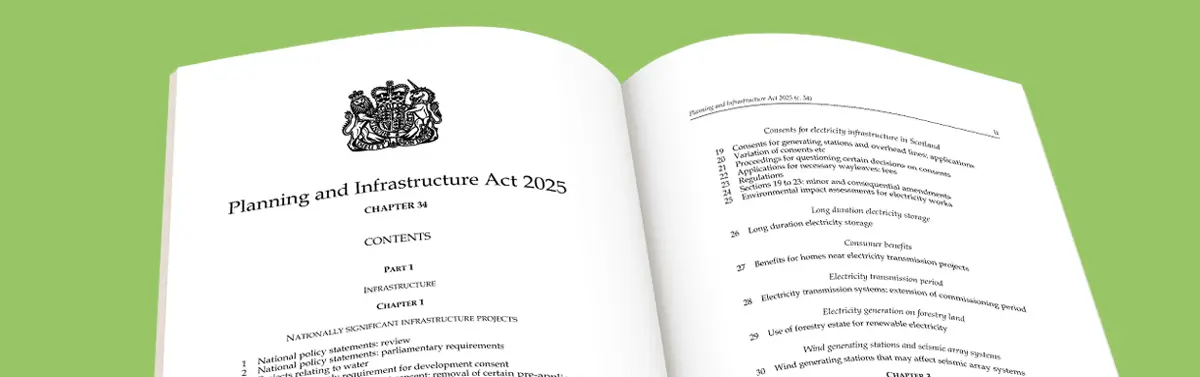
Draft national planning policy framework published 16th December and (ii) the Planning and Infrastructure Act (PIA)
gaining royal assent 18th December. The third part, (iii) English Devolution and Community Empowerment Bill is still progressing, currently in the House of Lord at
committee stage.
For context, the Government have committed to reforming the plan making system, and as part of this, universal strategic development plans are to be in place across the country before the end of the parliament. My colleague Bethan Haynes, explained the intention and challenges for SDSs, including how they are administered, as set out in the – then- Planning and Infrastructure Bill in her blog of March 2025
[1].
Before considering the latest proposed elements, it is worth considering the progress made. As Bethan reflected, the initial step is establishing the geographies of strategic planning authorities – including combined authorities and combined county authorities (noting that the Secretary of State can also create new strategic planning boards to prepare SDSs for specified combined areas).
For much of the country, the geography is already settled. More than half of the population is led by Mayors, and across at least 7 of the major cities, the preparation of SDSs is already underway
[2]. However, for much of the rest of the country the new strategic geographies are still to be resolved, including areas which are simultaneously undergoing local government re-organisation as the two tier county-district authorities are disbanded. In practical terms this remains one of the most important steps that need to be taken before universal SDS coverage.
The structures and mechanisms of this emerging layer of governance will be finalised through the English Devolution and Community Empowerment Bill (which has reached the committee stage in the House of Lords). Through this Bill, the Government will confirm the proposed new devolution framework for England, including that strategic authorities will be expected to be in place across the country by the end of the Parliament. These are the key decision-making bodies responsible for developing an SDS. Section 2.2.1 of the Devolution White Paper sets out that each strategic authority should typically include 1.5m or more people and cover ‘a sensible economic geography’ i.e. “travel-to-work patterns and local labour markets”. They should be contiguous; and the Government are seeking “to promote alignment between devolution boundaries and other public sector boundaries”, for example bodies responsible for Fire and NHS services as well as planning functions.
The Planning and Infrastructure Act is another of the three key moving parts of the SDS architecture, which gained royal assent on 18th December. Part 2, Chapter 2 of the Act sets out the process by which certain authorities should prepare SDSs; largely following the processes (including scope for intervention by the Secretary of State [SoS]) already set out for local plan-making.
As a follow up on Bethan’s blog, in this section we consider changes to the Bill as it progressed through the Houses. More clarity was provided on the priorities of an SDS’ strategic planning policies. The amendment discussed in May was accepted so that an SDS now “must prioritise development on brownfield land and urban densification it must also seek to increase sustainability and community building by minimising the distance of travel between residential and commercial areas”. There was also a clause inserted (52) to ensure that an SDS must list chalk streams in the strategy area, outline measures to protect them from environmental harm, and impose responsibility on strategic planning authorities to protect and enhance chalk stream environments.
Discussions through the Houses have also made clear that the Government is keen to avoid strategic plans to be published with the length or detail of the London Plan
[3] [Anyone who has come across the London Plan will appreciate this!]. This aim goes hand in hand with the new plan making system and introduction of NDMPs through the new NPPF, a conscious attempt to avoid unnecessarily complicated ‘layering’ of policies.
Finally, we have the proposed reforms to the NPPF– published on the 16th December- to help clarify some more elements of how this new spatial strategy system will work, by providing the type of policies that an SDS would be expected to consider as well as how these plans should be prepared and examined. Some helpful pointers:
PM1: Spatial development strategies
“[An SDS should] set a positive vision for future growth and change at a sub-regional scale and provide a clear spatial framework for investment and growth, including for new housing”
Setting out the aims of an SDS, the NPPF is clear that its “Content should be genuinely strategic in nature”. This is central to the avoidance of unnecessary duplication or complication, i.e. more detailed or locally specific issues should go into local plans or be picked up through National Decision Making Policies as “other parts of the development plan”.
This content includes:
a) Setting out a strategy for a sustainable pattern of growth covering a period of at least 20 years, including through the apportionment to local planning authorities in the strategy area of objectively assessed needs for housing and other uses that are best considered at a strategic scale for the duration of the plan period;
This 20 year period is a different timescale to the 15 years for which an LPA must consider housing needs.
b) Identifying broad locations for strategic development including new settlements, major urban extensions, major cross-boundary development and key locations with the potential for new homes and jobs; such broad locations should extend over any large site allocations in adopted local plans;
Setting strategic development locations will be a key priority for SDSs, the ability to plan over 20 years will allow for medium to large sites to be planned for in this way along with enabling infrastructure. However, our research on
planning and
development timelines has shown, that for the largest of sites for example new settlements, this time frame will remain challenging.
Indeed, the current NPPF is clear that “Where larger scale developments such as new settlements or significant extensions to existing villages and towns form part of the strategy for the area, policies should be set within a vision that looks further ahead (at least 30 years), to take into account the likely timescale for delivery”. If, as directed by PM1, SDS should identify ‘broad locations’ for growth – which includes New Settlements – they will surely need to be looking ahead at least 30 years?
c) Supporting economic growth by providing a spatial framework for strategic investments and giving spatial expression to strategic elements of Local Growth Plans and the National Industrial Strategy;
d) Identifying the general extent of areas established as Green Belt and broad locations where changes to Green Belt boundaries may need to be considered through local plan preparation, if necessary to meet the development needs of the strategy area;
e) Identifying broad locations for nature conservation and habitat enhancement, restoration and creation;
f) Setting out the type, extent and broad location of strategic infrastructure needed to enable development and serve existing communities, including transport, social and waste infrastructure, utilities provision, flood risk management schemes and, where considered appropriate, the provision of minerals. The spatial development strategy should also make provision for infrastructure that is committed to in the 10 Year Infrastructure Strategy, sectoral spatial plans and any planned strategic infrastructure identified in local transport plans;
The SDS will be expected to identify the broad locations for infrastructure investments, and other aspects (as above) with local plans covering the detail. The ‘general extent’ of Green Belt boundaries might be open to interpretation and will likely be contested locally in areas with Green Belt constraints, where the combined housing needs of an SDS area are high.
SDSs will be expected to be altered at least every 5 years to reflect changes to LPA housing requirements and replaced after no later than 10 years. It is less clear how new evidence of needs beyond housing will be considered in this manner. These elements are specifically referred to in the Consultation questions 7 and 8.
Beyond PM1, there are other elements that are relevant to SDS.
PM2: Local plans
Should “support the delivery of the [SDS] for their area”
PM10: Maintaining cooperation between plan-making authorities. States that…
“Where matters are already addressed by an adopted spatial development strategy, plan-making authorities within the strategy area do not need to revisit them when preparing their plans”
Included in this is that the ‘matters already addressed’ referred to in the policy wording includes housing targets i.e. SDSs will be required to set out each constituent LPA’s housing need figures against which their local plans and housing delivery test measurements will be assessed.
The policy also refers to using ‘available information’ a term carried over from the current NPPF. This, in many areas, is likely to be crucial, given the potential lag between an SDS and a local plan being prepared, as it avoids the pitfall of the uncertainty of ‘unmet need’ numbers.
A potential challenge to this new system, is how to deal with the unmet need in an SDS that cannot meet its own housing needs within its boundaries. For example an urban combined authoritythat might used to (under the duty to co-operate) share need with neighbouring local authorities, that form part ofthe same housing market area but are now in a different SDS. Essentially, how to deal with unmet need that remains at an SDS level across different SDS areas.
PM14: Examining spatial development strategies
“The strategy sets out a positive approach to delivering growth which, as a minimum, seeks to meet the area’s objectively assessed needs, and is based on effective joint working on cross-boundary strategic matters. A strategy which does not provide for objectively assessed needs should be considered an exception, and only where it is evidenced that stringent efforts have been taken to meet those needs through cooperation with other strategic planning authorities”
The explicit reference to a need for the SDS to be positive is helpful, with the emphasis on these plans meeting their needs except when there is evidence “that stringent efforts have been taken to meet those needs”. Positive planning means “meeting the development needs of an area” is described as a minimum, for both SDSs and local plans.
Under this framework, an SDS becomes the basis for the level of development in an area (including as PM10 notes, housing need). It is perhaps also telling that in question 8 of the accompanying consultation, the question of how to approach 5 year housing land supply issus where an SDS is still up t date might also be changed. Together, it shows that SDS are considered to address both the duty to cooperate issues and addressing broader land supply challenges.
Final thoughts
As was set out in Bethan’s original blog, strategic planning has the potential to overcome some of the most significant barriers to development that we have seen over the last decade and to unlock a genuine solution to cross-boundary issues like infrastructure and housing. The building blocks that have been put in place over the intervening 9 month period have started to take shape this week with PIA gaining royal assent and the draft NPPF in effect drawing out the likely rules of play. The ongoing challenge of local government reorganisation and strategic authorities will be key to ‘getting the geography right’ in some of the most politically sensitive areas, as well as the capacity and institution building necessary to get effective plans means that we are still a way off from universal coverage. Political crosswinds, economic challenges and the ongoing stasis in much of the economy will continue to challenge development in many areas. However for the strategic authorities that are already in a position to start preparing their SDS, there is the potential to provide effective integrated strategic plans that reflect local needs and cover the next twenty years of development.
| |
|
|
| |
 |
|
| |
|
|
| |
National policy consultation 2025
Our web resource brings together Lichfields' analysis of the Government’s Draft National Planning Policy Framework consultation and other proposed reforms affecting the development industry
|
|
| |
|
|
[2] Lichfields analysis, tracking public announcements of starting SDSs including evidence gathering. We also include Greater Manchester, although Places for Everyone remains a Joint Plan rather than SDS.
[3] As discussed by the Minister for Housing and Planning here: https://hansard.parliament.uk/Commons/2025-05-14/debates/486b1c25-d002-455e-9b19-05eb9485754a/PlanningAndInfrastructureBill(SeventhSitting)