This blog is based on the presentation I recently gave to the Landscape Institute Conference in Edinburgh.
Spoiler alert it wasn’t good news!
Planning policy in Scotland is set in the Development Plan and when it was adopted in February 2023, the 4th National Planning Framework (NPF4) became part of the development plan. Unlike its predecessors NPF4 policies are a consideration alongside Local Development Plan (LDP) policies for all planning applications. If there is conflict between local and national policies, it is the newer policies that take precedent - for most authorities, the national policies override the local polices.
The adoption of NPF4 has necessitated the development of new LDPs in all 34 local planning authorities in Scotland and these should be in place by May 2028.
This is important for new housing delivery because Policy 16 of NPF4 essentially prevents (except in limited circumstances) the bringing forward of housing sites that are not already allocated in an LDP. This would not be a problem if all LDPs were up to date and had sufficient allocations in them. However, they are not and so we are largely reliant on out-of-date LDPs and what is left of the land that they originally allocated. Furthermore, some of these LDPs never had enough housing land allocated in the first place and instead relied on a release policy to meet any shortfall. A release policy now superseded by NPF4 Policy 16.
New LDPs can’t come soon enough… we are in the midst of a housing emergency after all!
Here is the state of play:
-
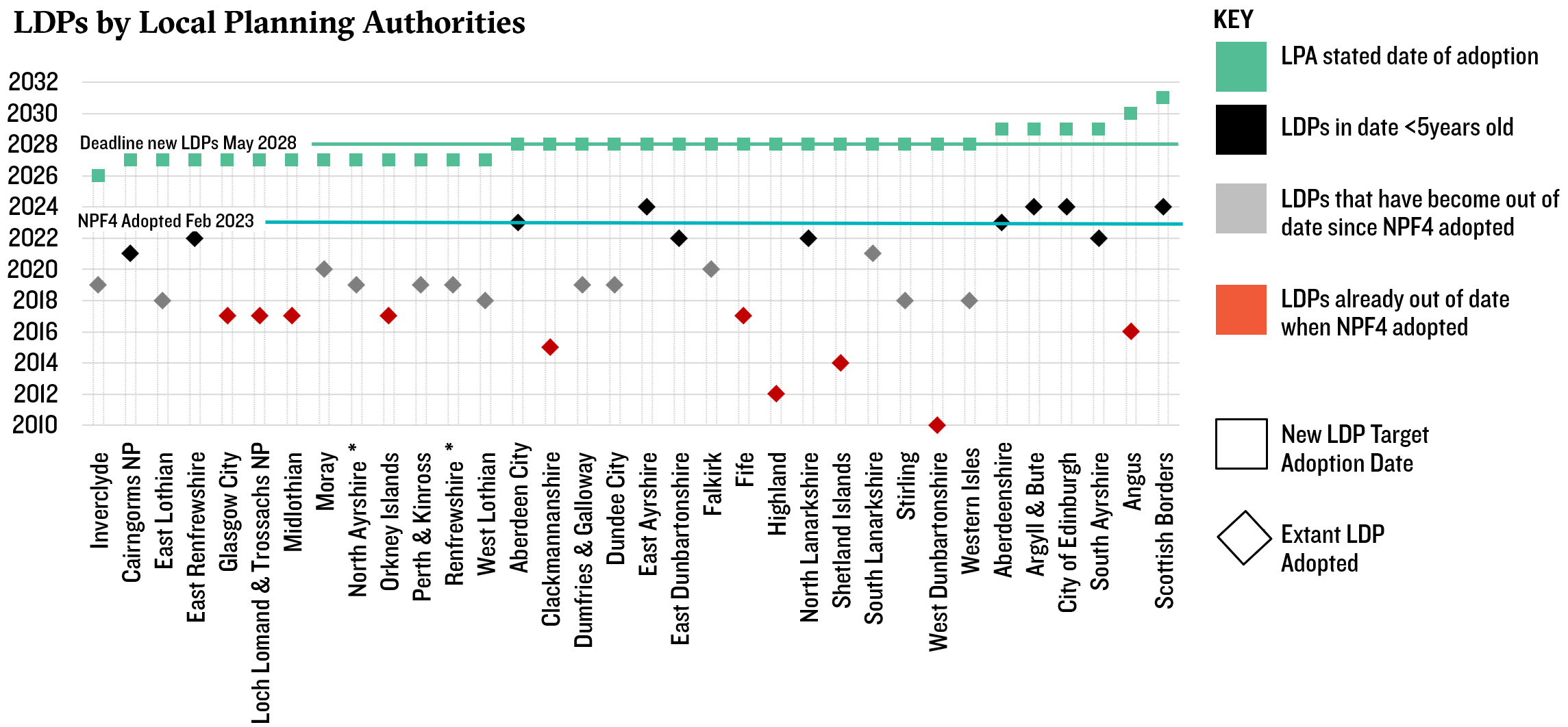
10 of 34 LDPs were already out of date when NPF4 was adopted in 2023
-
12 have become out of date since NPF4 was adopted
-
2 more will become out of date in 2026
-
10 will still be in date by the end of 2026
Based on published Development Plan Schemes 6 LPAs won’t have their new LDP in place by the May 2028 deadline. More recent reporting through the Scottish Government’s NPF4 delivery programme report
indicates that this position has worsened, with up to 14 authorities now anticipated to miss that deadline.
This matters for housing delivery. Sites allocated in out-of-date LDPs should have come forward by now. Where they have not, there are often viability, infrastructure, or market reasons why they haven’t. Under previous policy frameworks, there was greater scope for alternative sites to come forward to address shortfalls. Under NPF4, that flexibility is much more limited until new allocations are made through new LDPs.
The new plan-making process itself introduces an additional stage. Authorities must now submit an Evidence Report to the Scottish Government for assessment before progressing to the preparation of the plan. Of the 34 authorities, 22 had submitted Evidence Reports as of January 2026, but only 8 have been found sufficient to proceed to the next stage of plan preparation.
The following illustrates the authorities’ anticipated timescales for the adoption of new LDPs, where they are at in the process and their progress to date is highlighted by the coloured bars.
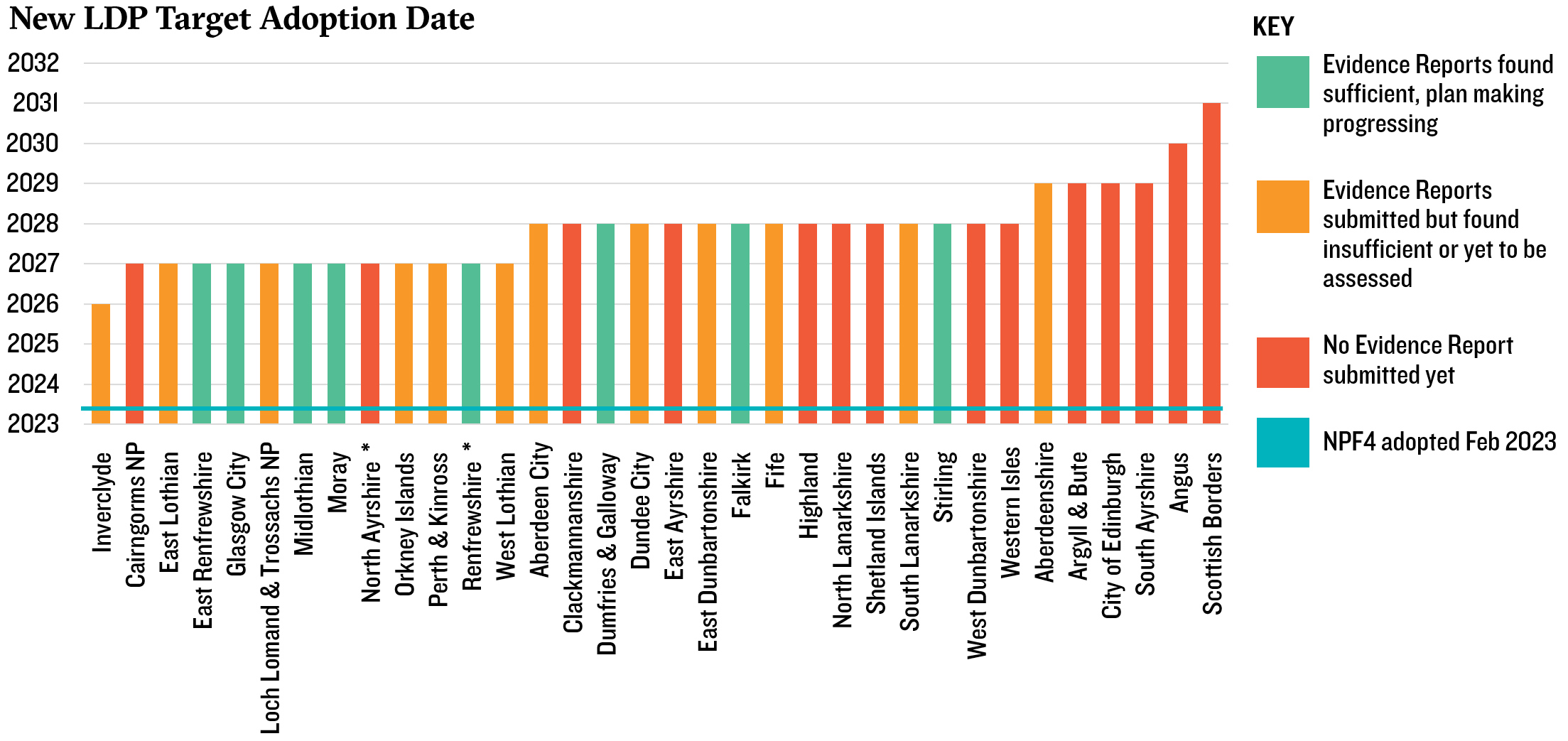
Taken together, this suggests that relatively few new LDPs — and therefore relatively few new housing allocations — are likely to be in place by May 2028.
So, is this having a negative effect or does all this not really matter that much?
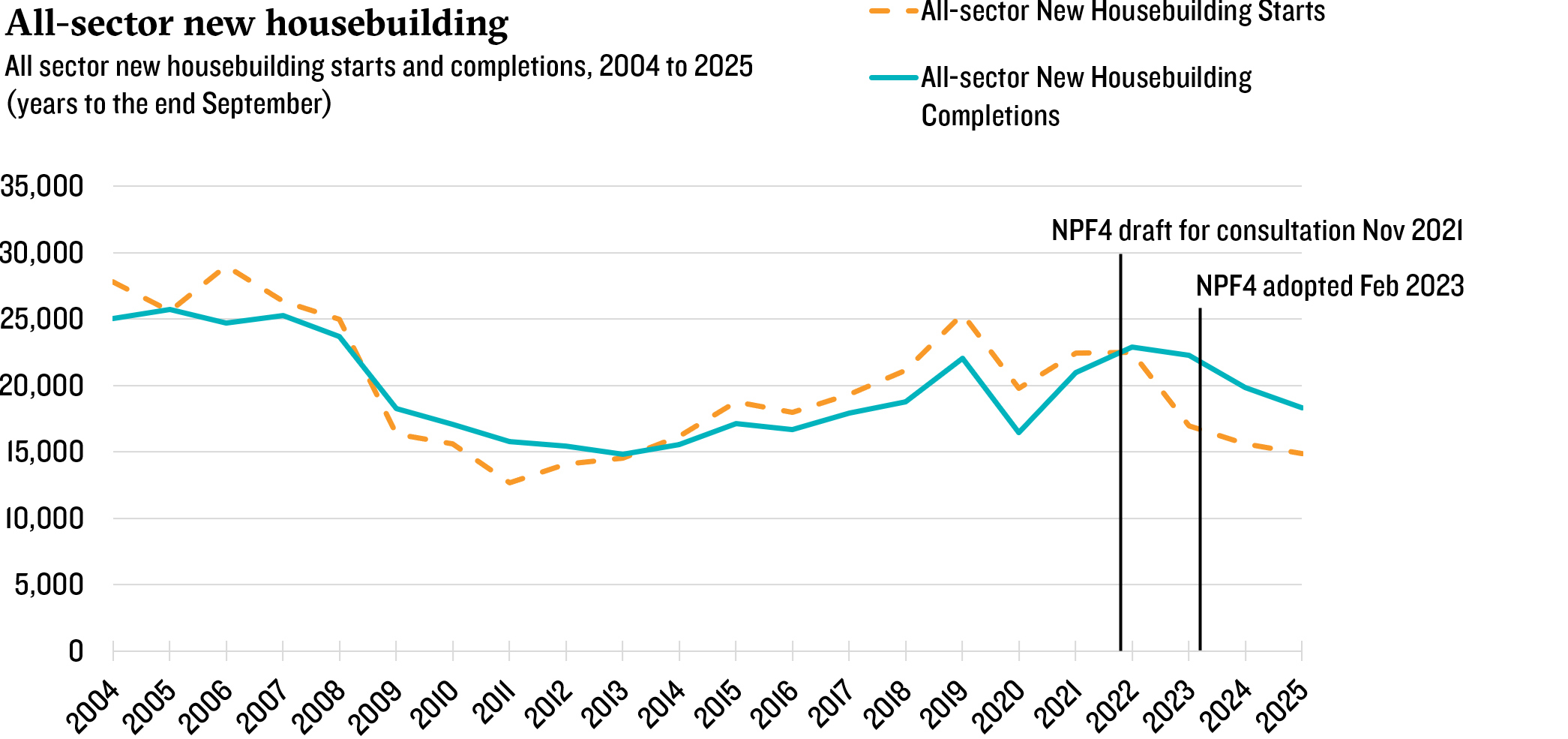
Scottish Government data on housing starts and completions usefully illustrates what has been happening in terms of new housing delivery.
Housing starts peaked in 2019/20. While the Covid-19 pandemic clearly influenced activity in 2020/21, the reduction in starts since the consultation and adoption of NPF4 is notable. Between 2023 and 2025, average housing starts were just over 16,000 per year, compared with an average of almost 20,000 over the preceding decade.
Year-to-date figures for September 2025 show fewer homes completed (down 8%) and fewer homes started (down 5%) compared with the previous year.
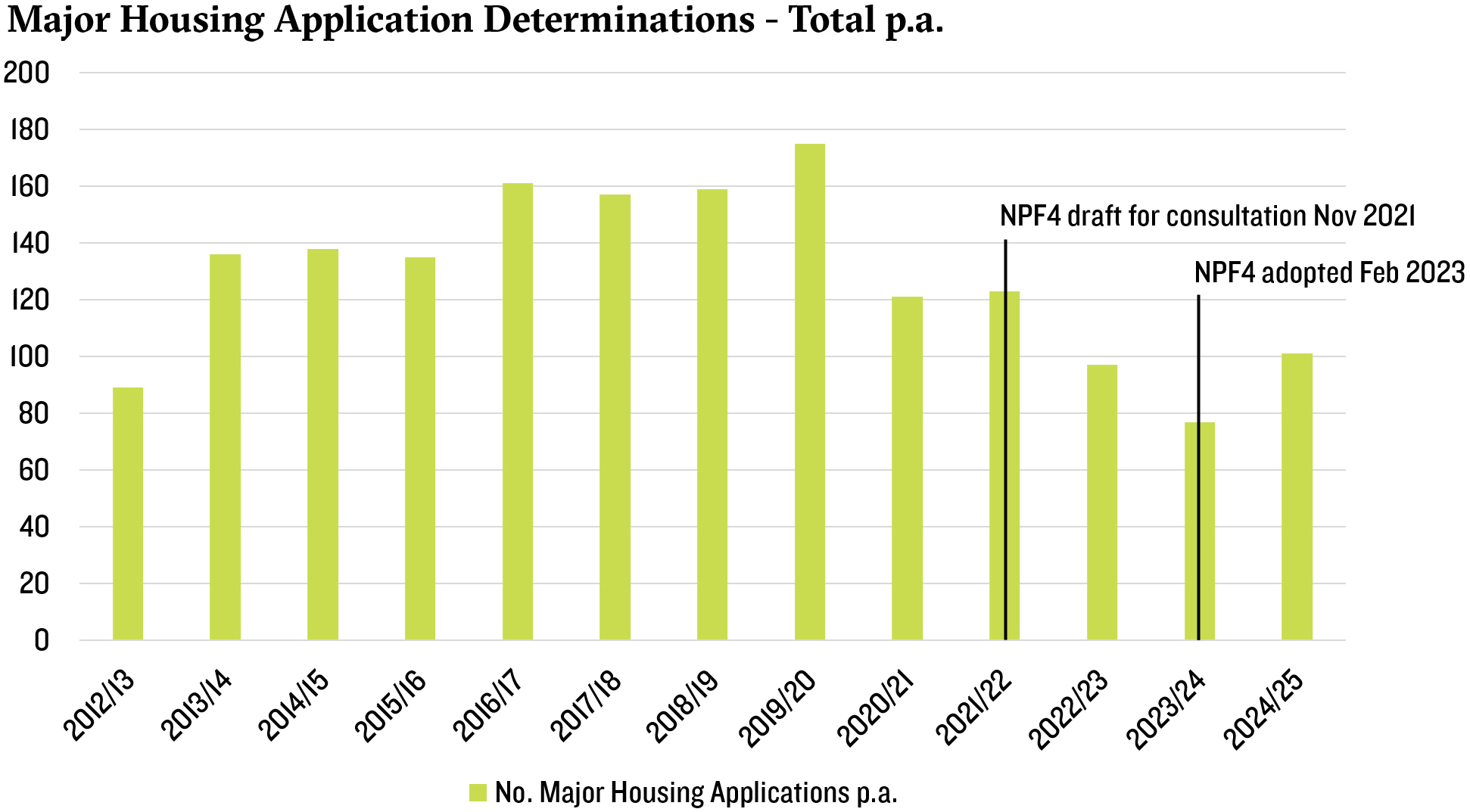
A similar pattern is visible in the number of major housing applications (50+ homes) being determined. From a peak in 2019/20, the average number of determinations between 2023 and 2025 having fallen to 89 from the previous ten-year average of 140. This is important because it indicates a reduction in the pipeline of consented, deliverable sites that will translate into starts and completions in future years.
This all matters because there is clearly a dwindling number of sites coming forward for new housing development and there is inevitably a time lag between new allocations and LDPs being adopted and new homes being built.
Lichfields’ award-winning research
into housing delivery found that, in England and Wales, sites of 50-99 new homes take on average 2.3 years to deliver their first new home, for sites of 100-499 new homes this increases to 3.2 years. When we looked at housing delivery in Edinburgh
over a 5-year period from 2016 to 2021 the timescales were similar.
When this is combined with the time required to prepare and determine a major planning application — determination is currently averaging around 44 weeks — it is reasonable to assume that a newly allocated site might take around 18 months to secure permission, followed by a further 2–3 years before first completions.
Based on this it is unlikely that there will be an uptick in planning applications for new homes before 2030 and therefore no uptick in delivery until 2032/33.
Ironically, NPF4 will become out of date in February 2033 and be up for review!
So where does that leave us…
-
There has been a reduction in permissions for larger housing sites since the adoption of NPF4
-
Housing starts are on a downward trend
-
Policy 16 significantly limits the development of non-allocated sites
-
The preparation of new LDPs is taking time, meaning there are limited opportunities for new allocations in the short term
-
There are limited transitional mechanisms to support new housing delivery while plans are being prepared
-
Even once new sites are allocated, there will be a considerable lag before homes are delivered
-
By the time these new allocations begin to deliver homes, NPF4 itself will be approaching ten years old and due for review
Will current planning policy deliver the homes we need and address the current housing emergency?
In short it is unlikely.
What is more likely is that Policy 16 will prevent the houses being built that the country needs now to address the housing emergency.
Scottish Government are putting in place measures to tackle the affordable housing element of the problem – we have the Housing Emergency Action Plan and the just announced new agency More Homes Scotland that will come into force if the SNP are still in power after the May elections. But interim measures to stop planning policy being a blocker of All Tenure Starts and Completions is also urgently needed.
So, for the near future our housing land supply is that was allocated by current plans (22 of which are out of date) and no more, this can only stifle delivery.
Footnotes