2026 is set to mark the beginning of Oxford Street’s potential transformation, with plans to pedestrianise part of Europe’s busiest shopping street passing a significant milestone last week - via the enactment of the Oxford Street Development Corporation (1st January 2026).
Against a backdrop of high national retail vacancy rates and a widely reported
Boxing Day sales slump, this brings renewed faith in enhancing Oxford Street’s vitality through implementation of a decades-touted lifeline for the congested street. Although clearly one of the key shopping destinations in London, evidence that improving the pedestrian experience will generate more tourist and shopping trips is cause for optimism. If successful, pulling the Mayoral Development Corporation lever may broaden support for similar models within London to broaden the Capital’s growth agenda, and possibly set a benchmark outside of London for the enhancement of high streets.
Oxford Street Transformation – the proposals
The pedestrianisation of Oxford Street has
its history in early traffic-free days between 2005 and 2012, with proposals to permanently expand the scheme to varying spatial extents gaining significant public backing in the subsequent years. This public support was consistently co-opted by several cohorts of Mayoral candidates, culminating in the 2016 election of Sadiq Khan, who consulted on the first concrete plans for implementation in 2017. Westminster City Council initially blocked the proposals before proposing a series of scaled-back schemes in 2021 and 2023 to placate resident backlash. The 2023 proposals included public realm improvements and pavement widening, but only proposed pedestrianising minor side streets.
The elections of 2024 created conditions for the revival of Oxford Street’s pedestrianisation as Mayor Sadiq Khan, re-elected, was able to draw on central government support to establish the Mayoral Development Corporation (MDC), which needed to be sanctioned by the Secretary of State.
Extensive consultation was completed, with
engagement in May 2025 returning high levels of public support: 69% supported proposals to establish an MDC, and 66% were in support of pedestrianisation in principle. Westminster City Council expressed some reservations but is now working proactively with the MDC.
The
established MDC is the Oxford Street Development Corporation (OSDC) which
spatially covers Oxford Street and immediate surrounding side streets, extending from Marble Arch to St Giles Square, with a northern extension to Mortimer Street to the east. The OSDC is proposed to be chaired by Scott Parsons, and it will act as planning authority for the area, developing a new local plan and taking responsibility for planning decisions at all scales.
Oxford Street Development Corporation Boundary
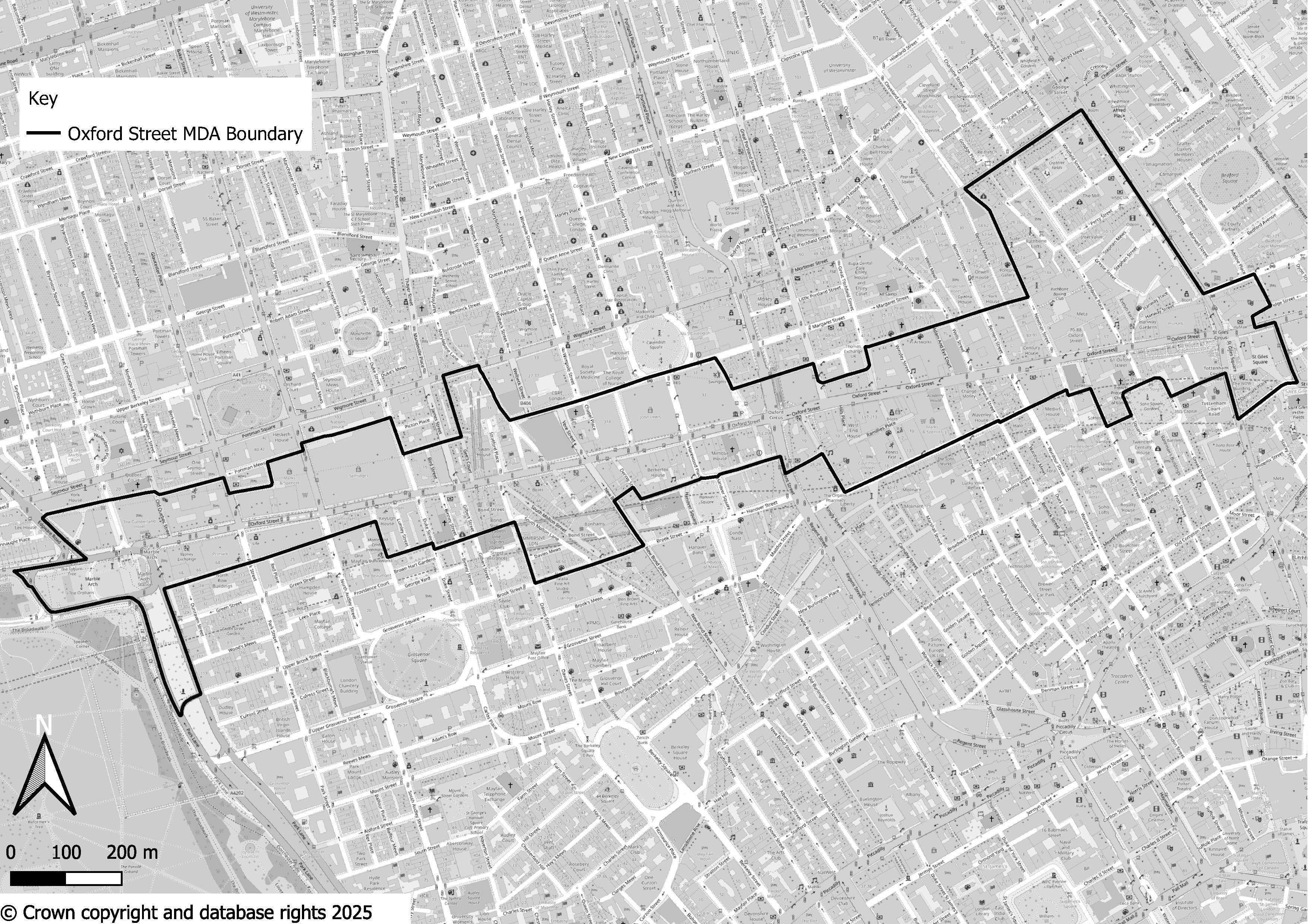
Source: London Assembly
Pedestrianisation is at the core of the transformation, proposed (initially) along ‘Oxford Street West’ between Orchard Street and Great Portland Street. Traffic will be closed to all vehicles and cycles, bus routes will be diverted, and some north-south streets will be made one-way. Transport for London is
consulting on highways proposals until 16th January.
Oxford Street: Challenges and Opportunities
The establishment of the OSDC lends certainty that action will follow, which is cause for optimism. Oxford Street has not been immune to economic pressures on England’s shopping streets, and it suffered a stalled recovery from the COVID-19 pandemic with
vacancy rates climbing from 12.25% in 2017 to 14.5% in 2022.
Visitor numbers remained stubbornly low, at 52% of the pre-pandemic levels by 2022, and
the American candy shop scandal possibly marked the lowest point of the iconic street, prompting mournful predictions of its extinction. The quality of the pedestrian experience has also suffered, with media attention focusing on
phone snatching amongst reports of overcrowding and pickpocketing. Calls for drastic action have only compounded, which may have cemented the creation of the OSDC, but this also gifts it a wide-ranging brief.
Recently there have been signs that Oxford Street is bouncing back. The arrival of Elizabeth Line stations has boosted demand for retail space, particularly at its eastern end.
CoStar has reported an eight-year low in retail availability, and prime rents are also on the rise following drops of 30% in previous years. Footfall is however a mixed picture. Compared to historic levels, Oxford Street is
lagging behind: in November 2024, it had only 57% of 2006 footfall levels, compared to 98% for Bond Street, and 83% on Regent Street. It still however boasts the highest footfall of
any shopping street in Europe, and overcrowding of the street is evident to anyone who visits at peak times.
Evidence
from the GLA suggests that high footfall has conversely limited expenditure by creating an environment inconducive to dwelling, browsing, and spending. Oxford Street is operating at capacity, and it is expected that creating a slower-paced environment will improve the footfall to expenditure conversion rate, as well as accommodating further footfall. The proposals have received
strong support from the London Chamber of Commerce and Oxford Street operators, and
GLA Economics estimates that pedestrianisation will increase the GVA by almost £82 million per year, supporting a further 781 jobs.
Positive reporting from September 2025’s traffic-free day included 67% of stores reporting higher sales, alongside more than 75% of visitors having an improved experience of Oxford Street. Half of these respondents attributed this to increased pedestrian space.
Tools for Revitalisation
Increasing footfall and importantly, expenditure, to
revitalise town centres can be achieved by turning a variety of dials, including diversification by office or
residential development. Like many other shopping streets, Oxford Street is also burdened by a weighty stock of large units which carry risks of long refurbishment timescales and often require
bespoke repurposing solutions. Topshop’s departure left a four-year vacancy before IKEA’s delayed opening, but Nike punctuated its two-year refurbishment of the flagship NikeTown by temporarily occupying the former Microsoft store at Oxford Circus. Both demonstrate the importance of adapting to a new retail climate, where experiential, showroom, and events-based enticements are of increasing importance.
For Oxford Street, pedestrianisation proposals can be complemented by diversification of activities to encourage longer dwell time. Nearby Outernet, an LED art installation opposite Tottenham Court Road station demonstrates the concept in action, and Oxford Street itself already benefits from a calendar of live
performances within stores and pop-ups and emerging operator tactics to prolong visits such as John Lewis’
new member’s lounge.
London’s
tourist numbers are beginning to recover from the pandemic, with the Capital attracting 20.9 million overnight visitors in 2024, close to the 21.7 million of 2019. Capturing tourist as well as Londoner interest will therefore be essential to Oxford Street’s future success. The last traffic-free day in September 2025 illustrated how live music, exhibits, and food stands could become regular fixtures post-pedestrianisation. By complementing its existing retail allure, continued diversification will help to maintain Londoner and tourist favour for Oxford Street, which may then foot the bill for its new infrastructure thanks to
new tourist tax powers.
Mayoral Development Corporations
MDCs establish a statutory body for the delivery of regeneration schemes, often acting as planning authorities and benefitting from a ringfenced budget exempt from the usual pressures of Local Authority spending. MDCs can be established by Metropolitan Mayors across England and have been employed within a range of contexts; including its first use in 2011 at the Queen Elizabeth Olympic Park. More recently, MDCs have been used to deliver town centre improvements in Stockport and help re-industrialise the Tees Valley.
Not all existing DCs have received positive press coverage, with the Old Oak & Park Royal DC
facing criticism for making slow progress, but the high-profile implementation at Oxford Street may help to encourage further uptake in other key town centres. As explored in Lichfield’s earlier blogs, this would also align with the Government’s
ambitions for devolution, and may complement emerging regional initiatives such as the
High Streets Commission or some of the more community-based solutions which have been put forward in the last 2 years, such as
high street rental auctions. The evolution of MDCs may therefore represent another available tool in the renewal of politically-driven Mayoral and/or local entrepreneurial initiatives.
The success of the scheme may be further aided by Government pressure to evidence the efficacy of the DC model. Considering the New Towns Taskforce’s
recent recommendation to revive Development Corporations for this purpose, securing public and political support for similar models will be essential to the Government’s growth ambitions, beyond the beacon that may be lit by an Oxford Street renaissance.
Conclusion
Once implemented, Oxford Street will join a venerable list of pedestrianised shopping streets, with the long-term success of Vienna’s Kärtner Strasse (pedestrianised 1974), Dublin’s Grafton Street (1982), Madrid’s Calle Preciados (1973) and Milan’s Corso Vittorio Emanuele II (mid-1980s) evident from their
lofty positions in footfall rankings, embedded value to city economies, and consistent tourist appeal.
2026 signals the renewal of hope that Oxford Street will not fall victim to its popularity, with the creation of the OSDC bringing significant opportunities for renewal - beyond pedestrianisation. Following years of stymied schemes, the issue has been promoted to city-scale importance with central Government backing. It also positions a spotlight on the principle of the MDC, with any reputational fallout having implications for the delivery of broader Government growth ambitions.
Further reading
Image credit: Intrepid via unsplash