The legislation for the new plan-making system is now largely in force and initial guidance has been published.
While the headline change of the new plan-making system is the 30-month target for plan adoption
[1], the reforms also aim to improve the transparency and consistency of the preparation process. This blog covers the latter aspect of these reforms: the three gateways an authority must pass through on its way to adoption and, in more detail, the timetable it must maintain to keep progress visible
[2].
The new timetables, which replace Local Development Schemes, will be one of the first visible changes brought by the new process now that regulations for the new system are largely in effect. The ability of Local Planning Authorities (LPAs) to keep them updated in a timely manner will therefore be a leading indicator of the ability of the system to make plan-making faster, clearer, and easier to monitor.
The 30-month plan-making process and the gateways
The new system features three gateways
[3], which act as both check valves for plan-making progress – in the case of Gateways 1 and 2, which cannot be repeated (unless the whole process is restarted)
[4] – and opportunities for LPAs to receive two rounds of advice from an appointed assessor on the state of their plan, which should in theory expedite the examination process.
-
Gateway 1 is a ‘self-assessment summary’ of whether the tasks required during the 4-month notice period have been undertaken – passing through Gateway 1 is the start of the 30-month process.
-
Gateway 2 is the seeking of observations and advice from a Planning Inspectorate appointed assessor on aspects of the proposed plan, having consulted on content and the draft vision.
-
Gateway 3 is when a Planning Inspectorate gateway assessor provides observations and advice, and decides whether the plan has met the legal, prescribed requirements, and is ready to be submitted for examination.
“Getting ready”
The Government’s ‘30-month overview’ guidance includes the below diagram:
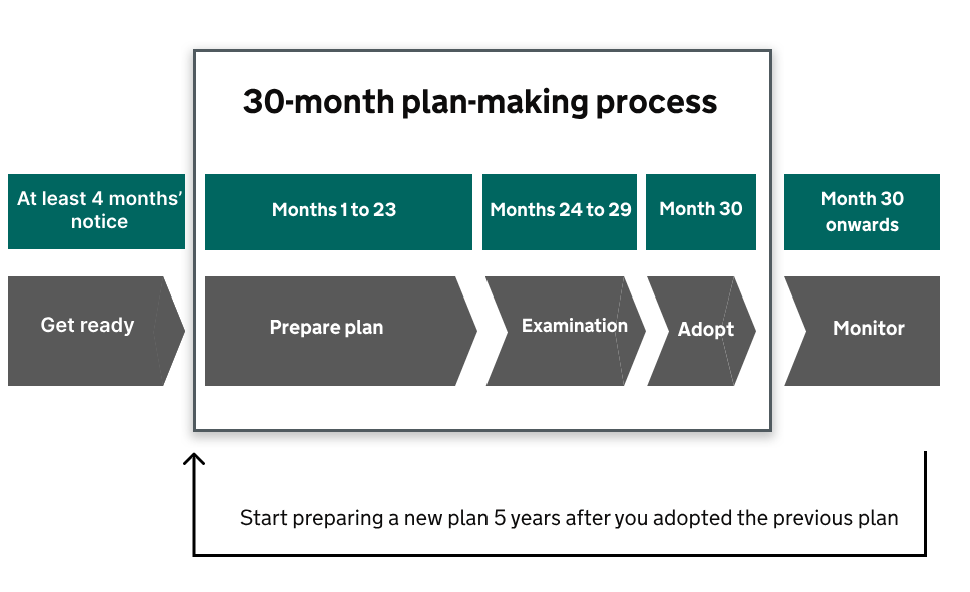
30-month local plan process: an overview, MHCLG, 2026
Before an LPA can progress to the 30-month plan-making process, it must first “get ready”. This stage, which leads to Gateway 1, must be at least four months long.
Recommended progress by Gateway 1 is detailed in the guidance
[5] with the following headings, which reflect Regulation 21 of the Local Planning Regulations. The self-assessment summary template
[6] which LPAs should fill out in Gateway 1 also uses these headings:
-
Preparing and publishing a local plan timetable
-
Establishing project management and governance
-
Consulting and engaging on the plan
-
Scoping the anticipated content of the plan
-
Progressing the Strategic Environmental Assessment (SEA)
This initial stage has been allowed for in terms of the deadlines provided to the first LPAs to commence the new system, the 39 which are required to start preparing their plan by 30 June 2026. Guidance states that “these LPAs must publish a notice of intention to commence plan-making by 30 June 2026 and to publish a Gateway 1 self-assessment by 31 October 2026”
[7].
Accordingly, there can be no slippage from the 30 June notice of intention to commence, because this must take place at least four months before the Gateway 1 assessment. Working backwards from 31 October and considering the necessary tasks ahead of 31 October is also a factor in meeting both deadlines.
As the system beds in, we will learn whether LPAs will be able demonstrate progress on these five key matters within the minimum of 4 months, or if we will see LPAs mobilising for plan making earlier, which could see the first notices of intention and timetables published very soon.
In with the timetable and out with the LDS
While the speed of plan making is yet to be seen under the new system, an authority’s timeline to completion will have to be reported on in greater detail in the replacement for Local Development Schemes (LDSs). LDSs typically report the intended dates for Regulation 18 and 19 consultations, submission to the Secretary of State and adoption.
In contrast, the new timetables will cover no less than ten milestones in the preparation process, with up to six more where stages have to be repeated or plans revoked
[8]. The ten steps in the local plan-making process which must be timetabled (along with the publishing of the timetable itself) are set out in the diagram below:
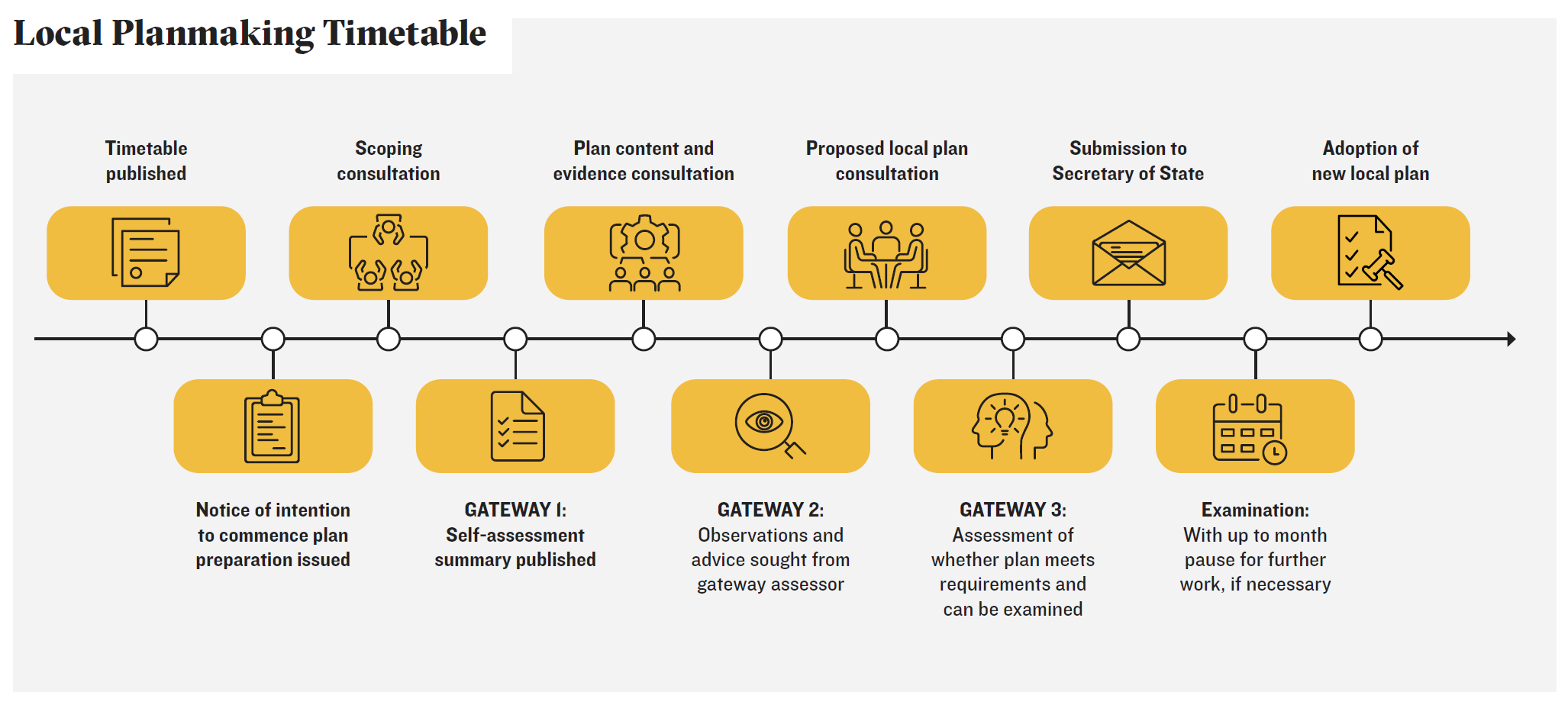
Lichfields’ interpretation of the Local Planning Regulations, 2026.
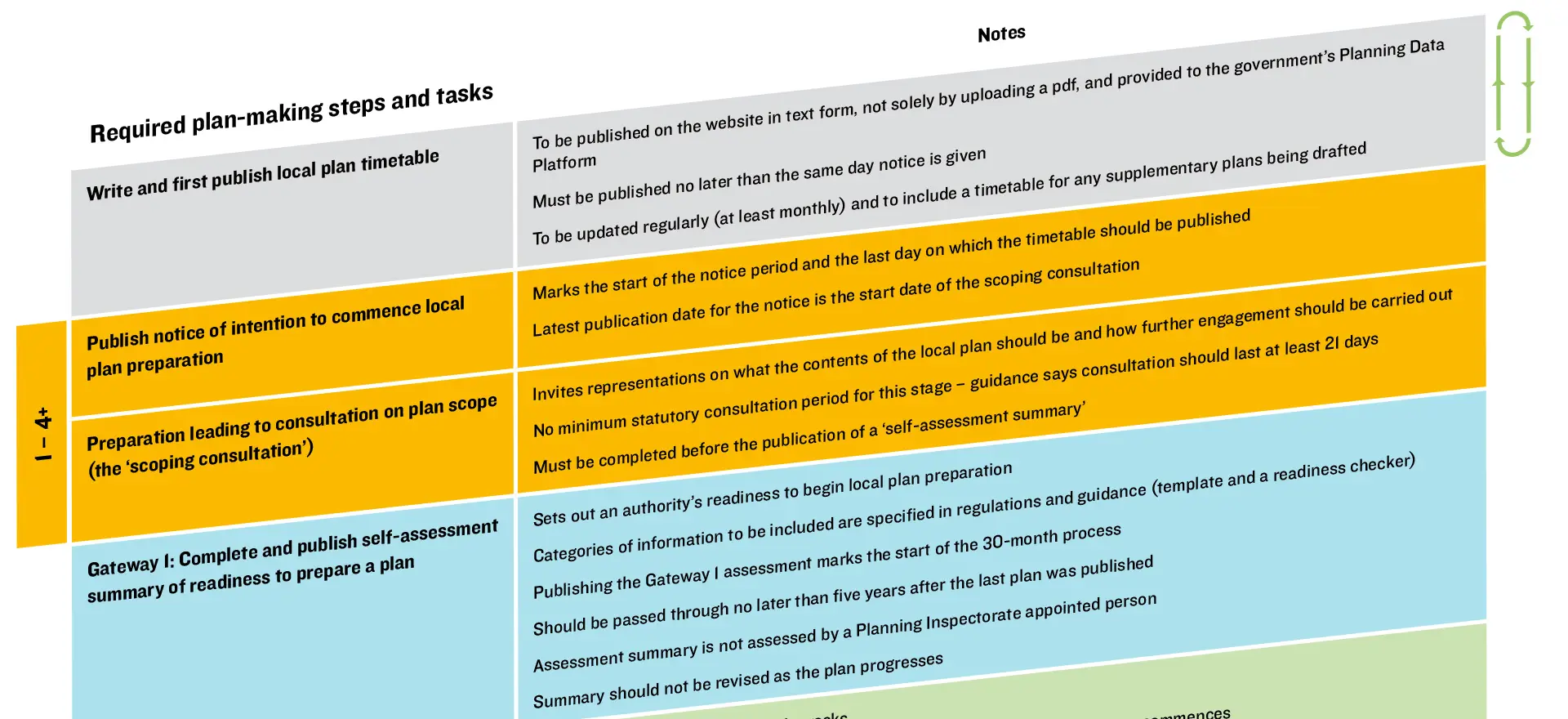
A timetable must be first published, at the latest, on the day the notice of intention to commence a local plan is published (or the day a notice to commence a supplementary plan is published, if this is sooner).
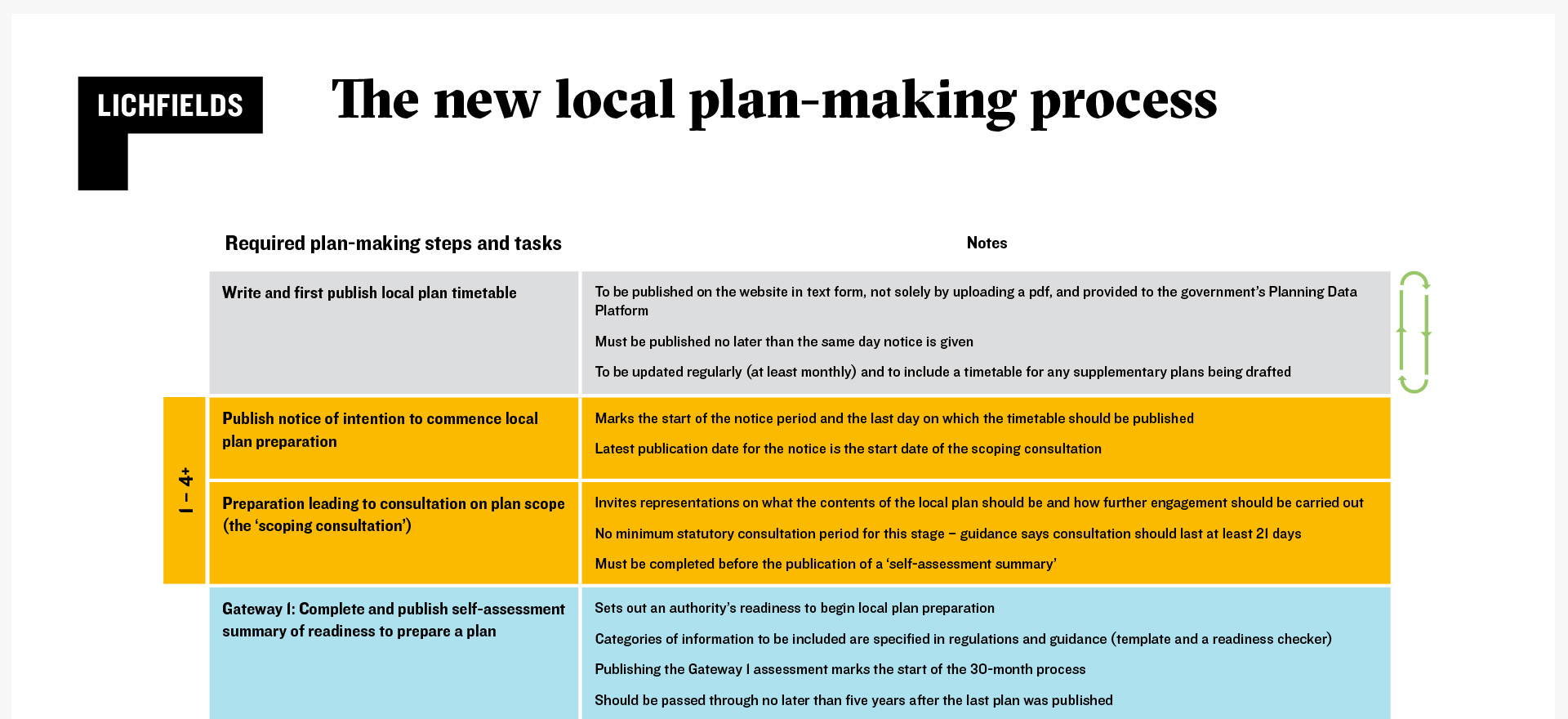
The timetable must additionally show:
-
The dates of any additional consultation proposed; and/or
-
For each supplementary plan intended to be prepared, the dates of the notice of intention to commence preparation, the notice of consultation and when representations must be received by, intended submission for examination and intended consideration of adoption.
The upshot is that the length of time between milestones – and dates – on the timetable should be shorter than in LDSs, meaning fewer long gaps between events where the state of plan-preparation to observers is unclear. Whether the gaps between actions turn out to be long or short, the progress made is arguably clearer than at present, due to the number of milestones.
This timescale uncertainty should be further reduced by an obligation for LPAs to update their timetables much more frequently than before. LPAs were required to revise their LDS only “at such time as they consider[ed] appropriate” or following a directive from the Secretary of State or Mayor of London
[9], meaning that authorities’ LDSs were often years old. This left some timetables practically meaningless, as the pace of plan-making had drifted from the pencilled-in dates over the years.
In contrast, the new legislation requires LPAs undertaking a local plan or review to check that their timetables are up to date every month and to revise it if the timeline has changed
[10].
There are then further maintenance requirements. LPAs must revise their timetable:
-
On the day that a relevant plan preparation stage happens
[11], to note the date this occurred;
-
As soon as practicably possible after deciding to carry out an additional consultation, to note its start and end dates; and
-
As soon as practicably possible after repeating Gateway 3, pausing a local plan examination (to set out the pause period) or withdrawing or revoking a local plan
Therefore, a timetable should never be more than a month out of date, and often less than this following a significant event.
In practice, however, the timeliness of these dates will depend not only on legislation but on LPA resourcing. As noted above, historically, maintenance of LDSs has varied. It remains to be seen whether the explicit duty to revise a timetable every month will prove effective; it is perhaps notable that the Secretary of State’s directive for all LPAs to update their LDS by March 2025 was later bolstered with a resourcing incentive: an up-to-date LDS was a condition of authorities receiving additional Local Plans Delivery Funding
[12]. To meet the new, stricter requirements for timetable maintenance, LPAs may need to streamline their review and publication processes, reorganising available resources accordingly.
When authorities provide a timetable, however, it will be in a much more accessible format than in an LDS. Since an LDS also had to detail which plans an LPA was making, in addition to when, the timetable itself was often found in the middle of a long PDF or Word document. The dates themselves also came in inconsistent format, sometimes by month or quarter, making comparisons across authorities difficult.
In contrast, the government has set out an approved data standard for timetables
[13]. LPAs will have to provide two datasets, one on their plan and the other on their plan timetable. The plan data will have to include details including a unique reference, its start and end date, and the plan’s required housing figure. The plan timetable will state the event date, entry date, and actual date (when it occurs) of the minimum ten stages described above
[14].
Both datasets will have to be published on the LPA’s webpage as tabular data
[15] and provided to the government’s Planning Data Platform for collation. These requirements will allow the state of plan-making in an LPA – and in England as a whole – to be much more easily seen and monitored.
With the regulations for the new plan-making system now largely in effect, the new timetables will be one of the first visible changes brought by the new process. The ability of LPAs to keep to these timetables, provided that the timetables themselves are up-to-date, will be an early indicator of the achievability of the 30-month target.
Taking a positive view, the extensive guidance, new templates and timetable structure should support the plan-making process and encourage frequent reporting, such that the greater detail, frequency and accessibility of plan-making timetables will be a welcome improvement for all participants in the local plan-making process.
Footnotes
[1] Albeit there are legally required procedures to carry out before the start of this 30-month period, as covered later in the blog.
[4] Gateway 3 can be repeated, though only if an assessor advises that one or more of the prescribed Gateway 3 requirements have not been met by the plan – see Reg 33.
[11] Publishing a self-assessment summary, observations or advice received in Gateway 2 and Gateway 3, and publishing recommendations and reasons in examination.