Environmental Outcomes Reports (EORs) are one of the most significant reforms to environmental assessment in recent years. Introduced through the Levelling-up and Regeneration Act (LURA), EORs are intended to replace the existing Environmental Impact Assessment (EIA) and Strategic Environmental Assessment (SEA) regimes, which have shaped planning decisions since 1988.
The government’s aim is to create a more streamlined, outcomes-focused system that better aligns environmental assessment with national priorities. For planners, developers and environmental practitioners, this transition presents both opportunity and uncertainty. A well‑designed EOR framework could support more consistent decision‑making, strengthen the link between planning and wider environmental ambitions and help demonstrate the environmental benefits of developments more clearly. However, the success of the reform will depend on the effectiveness of implementation, its integration with existing environmental requirements and the sector’s ability to navigate the change confidently.
What are EORs?
EORs are the government’s proposed replacement for the long-standing EIA and SEA regimes. EORs will apply in England only, with no indication to date that equivalent systems are being developed in Wales, Scotland or Northern Ireland.
We understand that EORs will be structured around nationally defined environmental ‘outcomes’, covering technical topics including biodiversity; air quality; landscape and seascape; geodiversity, soil and sediment; noise and vibration; water; waste and cultural heritage and archaeology. This represents a shift from identifying and mitigating impacts towards a more strategic, measurable and performance‑based approach focused on outcomes.
The previous government launched a consultation on EORs in 2023, following ascent of the LURA; and a consultation response
[1] and roadmap for reform
[2] were published in March this year by the current government. The consultation response confirmed the intention to bring forward the necessary secondary legislation to introduce the new system. While this provides reassurance that the reform is moving forward, it offered relatively limited detail on what EORs will look like in practice.
Why are EORs important?
Although only a small proportion of planning applications require EIA, these represent the largest, most complex and strategically significant schemes. Uncertainty over how they will be assessed going forward could have implications for the delivery of housing, infrastructure and regeneration projects. The SEA regime also plays a key role in shaping local plans, meaning changes to the system could have wider impacts on local plan preparation and delivery. Against this backdrop, developers, consultants and local planning authorities (LPAs) will need clear, workable guidance and a well-managed transition to maintain confidence and support effective decision-making.
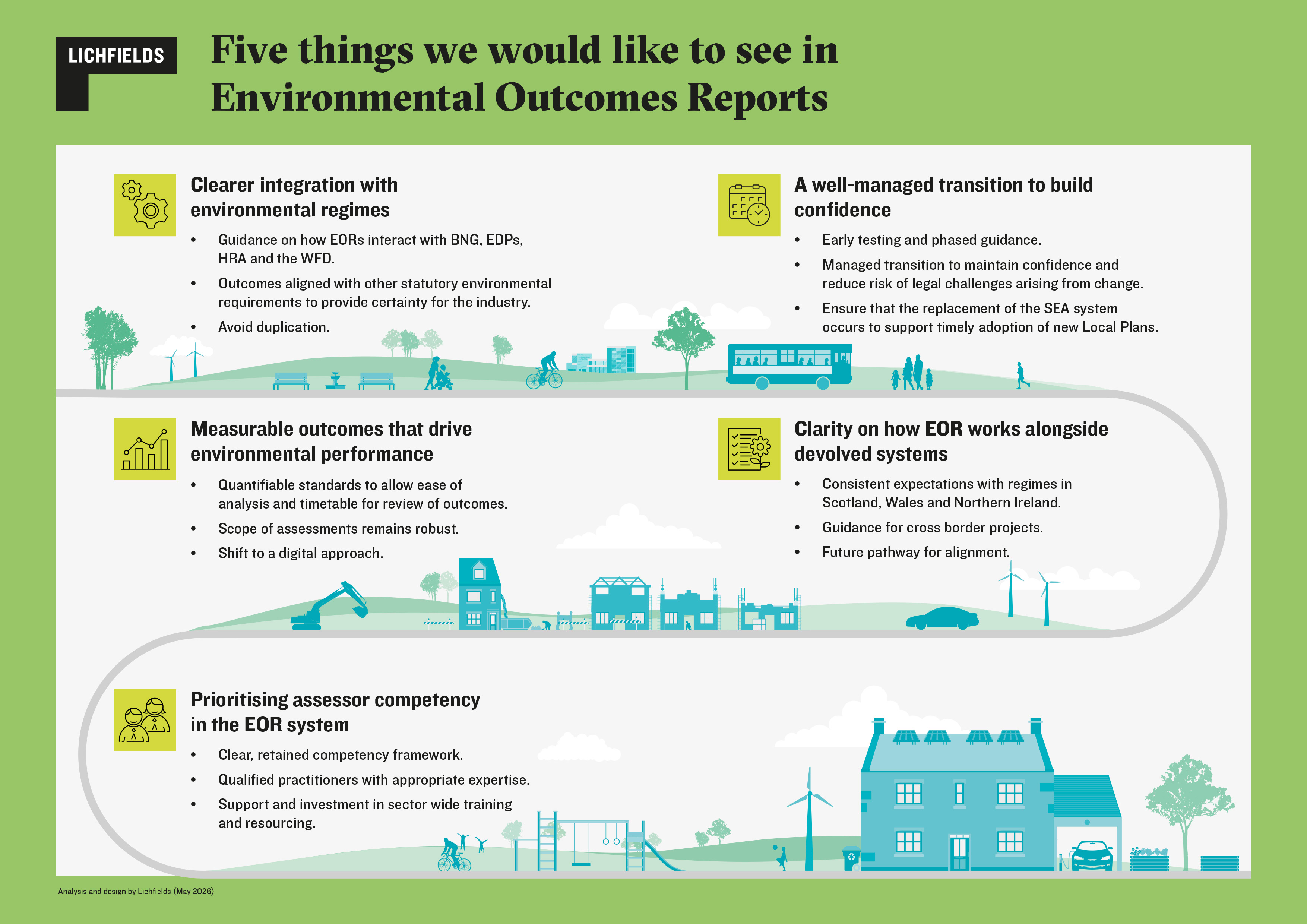
In response to these issues, we set out below five key factors that we believe are crucial to the success of EORs. These focus on what is needed to embed EORs within the planning system and ensure they work effectively in practice.
1. Clearer integration with environmental regimes
The government’s roadmap emphasises the need for the new EOR system to align with national environmental priorities. As EORs develop, there is a real opportunity to improve coordination with existing regimes, including Biodiversity Net Gain (BNG), Environmental Delivery Plans (EDPs), Habitats Regulations Directive (HRs) and the Water Framework Directive (WFD). The sector needs confidence that EOR outcomes will complement, rather than conflict with, other statutory requirements, helping to reduce duplication and create a more joined-up system. Clearer guidance on how these regimes will interact will be important.
2. A well‑managed transition to build confidence
Confidence in the new regime will depend not only on the substance of the reforms, but also on how they are introduced. Given the maturity of the existing EIA and SEA systems, the sector will need reassurance that the transition to EORs is carefully managed, with sufficient time to adapt and reduce the risk of legal uncertainty during the change. The government has indicated that the new regime will be brought forward by the end of 2027. However, many respondents to the consultation called for a transition period of at least two years, supported by pilots and pathfinders. This would help provide certainty for live applications and ensure that development pipelines are not disrupted during implementation. Early testing with live projects, alongside phased and iterative guidance, will therefore be crucial. Ongoing consultation will also play an important role in supporting implementation and maintaining confidence in decision-making.
For SEAs, the changes to this regime will be particularly significant for plan-making authorities, where timing and legal robustness are critical to avoiding delays in plan adoption and ensuring continued delivery of development strategies. Clear alignment between EORs and plan-making processes will therefore be essential.
3. Measurable outcomes that drive environmental performance
A key test for the new EOR regime will be whether it delivers environmental outcomes that are both clear and measurable. This will require quantifiable standards to support analysis and provide a clear timetable for reviewing outcomes. If implemented effectively, EORs should allow more consistent comparisons between projects and provide a stronger basis for monitoring environmental performance and linking outcomes to tangible improvements. A shift to a more digital approach also has the potential to improve the accessibility, consistency and usability of environmental information across the planning process.
At the same time, the scope and robustness of assessment will remain central to maintaining confidence in the new system; will the robustness of analysing climate change and human health be diluted if incorporated into broader technical assessments? While greater integration may help streamline processes, there will need to be clear assurance that these topics continue to be assessed rigorously and transparently. Overall, the new system must ensure that the new regime maintains environmental protections equivalent to those delivered through the current EIA system.
4. Clarity on how EORs work alongside devolved systems
Clarity on how EORs will operate alongside devolved planning and environmental regimes will also be important. For developers, consultants and LPAs working across different jurisdictions, there will need to be confidence that expectations remain broadly consistent between England, Scotland, Wales and Northern Ireland, particularly for cross-border projects. Clear guidance on how the different systems will interact, together with a longer-term pathway for alignment where appropriate, would help reduce uncertainty and support more effective development delivery across the UK.
5. Prioritising assessor competency
The transition from EIAs and SEAs to EORs will require developers, consultants and LPAs to adjust established processes, upskill teams and become familiar with new expectations. Ensuring consistency and quality throughout this change will depend on a clear and retained competency framework, underpinned by practitioners with appropriate technical expertise. Alongside this, sustained investment in sector-wide training and resourcing will be important to support effective implementation and maintain confidence in assessment standards.
Conclusion
EORs have the potential to support more consistent decision-making, strengthen the link between planning and wider environmental ambitions, and help demonstrate the environmental benefits of development more clearly.
However, the success of the reform will depend on the effectiveness of implementation, its integration with existing environmental requirements, and the sector’s ability to navigate the change confidently. The sector is ready to engage with reform, but success will hinge on providing the right guidance and transitional support to ensure the new system can be implemented effectively, supports timely delivery of development and contributes to wider government priorities alongside improved environmental outcomes.