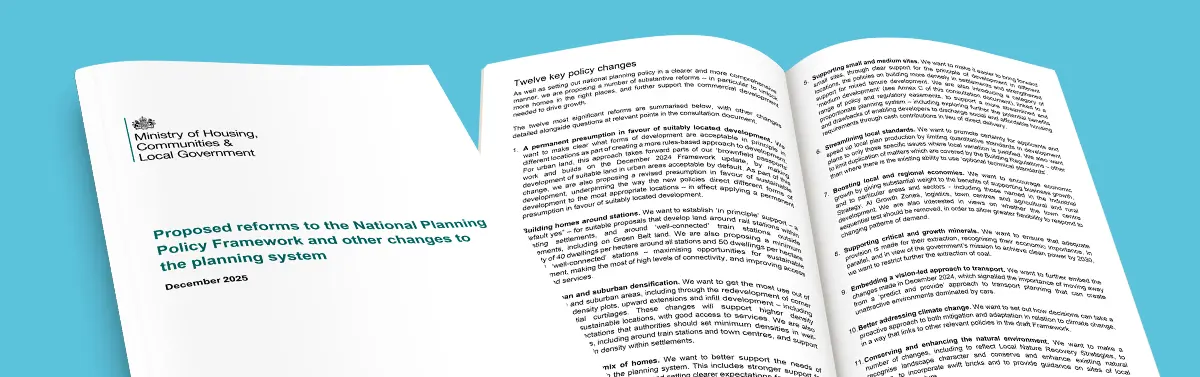
The Housing and Planning Minister introduced the December 2025 national (England) policy consultations as
“details of the next phase of this Government’s planning reforms”[1] acknowledging the various changes proposed to the planning system since their term began, combined with the legacies of the Conservative Government that this current Government intends to introduce.
The Government has published for consultation a draft National Planning Policy Framework (NPPF)
[2] of just over 100 pages, which clearly indicates which policies are for decision-making (DM) and which are for plan-making (PM). The proposed format and purpose of the new style NPPF are discussed in this blog.
The proposed NPPF is the focus of the consultation, but the consultation document include other potential policy and legislation and advise of further consultation to come.
The Minister also emphasised the “comprehensive package of support for small and medium-sized house builders”; this policy intent features in several of the proposals and announcements. Medium development, for the purpose of the NPPF, is to be, “for housing, development where 10-49 homes (inclusive) will be provided, and the site has an area of up to 2.5 hectares”.
The Viability section of the Planning Practice Guidance has been revised,
[3] taking immediate effect, and standardised inputs are proposed.
The Government has decided to exempt smaller developments up to 0.2 hectares from biodiversity net gain, albeit this will require a change to legislation and therefore is not imminent. Further BNG related proposals were also announced.
It has also committed to the introduction of section 73B of the Town and Country Planning Act 1990 ‘Applications for permission not substantially different from existing permission’.
Scope of the consultation
The consultation document ‘Proposed reforms to the National Planning Policy Framework and other changes to the planning system’
[4] looks mainly to the NPPF, but also beyond. The consultation:
-
asks questions about draft NPPF’s structure and content and the proposed weight to be applied, and whether the proposed transitional arrangements will work;
-
seeks to emphasise the difference between national policy and guidance, with discussion on the merits of moving ‘key aspects’ of guidance into NPPF annexes;
-
sets out future policy and legislation on data centres and consultation questions on the consenting routes that are and could be made available for co-located energy infrastructure;
-
linked to the above, asks whether renewable energy thresholds for the DCO route should be increased for all types of renewable energy co-location projects or just those ‘co-locating’ with data centres;
-
consults on an updated set of proposals intended to support small and medium enterprises (SMEs), following consultation responses to the reforming site thresholds working paper, through the implementation of a new medium category of development within the NPPF
[5];
-
notes that the ‘medium’ category of development is proposed to apply beyond the NPPF, to legislation and policy related to Biodiversity Net Gain (BNG), the proposed national scheme of delegation and to build out rates; and
-
proposes cancellation of certain ministerial statements and policies
In the remainder of this blog we identify and discuss the proposed approach to the new NPPF document and then provide an overview of the other elements of the Government consultation and announcements.
Draft National Planning Policy Framework
New style NPPF
Some of the thematic chapters have been renamed and the themes moved around; the only wholly new theme is ‘Pollution, public protection and security’. This includes a plan-making policy for clean and safe places and DM policies including those on ground conditions, living conditions, agent of change, public safety and land operations for defence.
However, there are many proposed changes and additions to content across all sectors – this consultation is far more than presentational. Indeed, the Government acknowledges that their proposals amount to the biggest change to the NPPF since its publication.
The
Lichfields national policy consultation 2025 page provides blogs that hone in on the detail of changes to specific policy provisions likely to be of particular interest to our clients, with more analysis to follow in the New Year.
The Government has identified the plan-making chapter as “substantially revised” to reflect the new plan-making system and “should be read as a new set of national policies” (plans in the current system will refer to the current NPPF even after (if) the proposed NPPF is published).
The consultation advises that “Some revisions are also being proposed to policies for decision-making to reinforce the importance of taking a positive, proportionate and timely approach to dealing with applications”.
Separating PM and DM policies is intended to make the NPPF accessible, provide national policies that are not repeated locally and to make policies more “rules-based” in order to support “timely and consistent” planning.
Chapter 1 of the NPPF explains how to use it, noting:
-
National decision making policies (NDMPs) should be read as a whole with their footnotes and annexes;
-
Some policies advise weight to be applied (see below) and where permission should be refused;
-
Plan-making policies should not be used when determining development proposals; and
-
Boxed text provides context and is not national policy.
It is of critical importance to the purpose of the proposed policies that “plans prepared against the new Framework should not repeat, duplicate or modify policies covered by the Framework”.
The consultation document on the proposed reforms and the Housing and Planning Minister’s Written Ministerial Statement identify 12 key policy changes, with the Chief Planner
[6] identifying a further key change regarding developer contributions (6. below) - which is important and links to the attempts to boost SME delivery of housing. The headings are as follows and there is a summary of each point in the consultation (with the exception of 6.):
-
A permanent presumption in favour of suitably located development
-
Establishing ‘in principle’ support for suitable proposals that develop land around rail stations
-
Driving urban and suburban densification
-
Securing a diverse mix of homes
-
Supporting small and medium sites, including policy easements for a new category of ‘medium development’
-
Changes to increase upfront certainty on the contributions expected from development, which will reduce time-consuming negotiation at application stage
-
Streamlining local standards
-
Boosting local and regional economies
-
Supporting critical and growth minerals
-
Embedding a vision-led approach to transport
-
Better addressing climate change
-
Conserving and enhancing the natural environment
-
Taking a more positive approach to the use of heritage assets
Planning Policy for Traveller Sites is to be incorporated into the NPPF while “the government’s aims in respect to traveller sites remain unchanged”.
Implementation and transition
As noted above, the NPPF would be a material consideration from the day it is published. The consultation notes that inconsistencies with development plans will fall away over time as new development plans are adopted that do not duplicate, replicate or modify NPPF policies.
For decision-making, due weight should be given to development plan policies in relation to their consistency with the Framework. Where development plan policies are NPPF consistent, the weight to be applied as expressed by the NPPF would need to be considered.
The consultation says:
“Where there is inconsistency between policies in the Framework and development plan policies […] we are proposing that development plan policies should be afforded very little weight where inconsistency arises, except where they have been examined and adopted against the new Framework. This would:
-
Give clarity on how inconsistency should be managed in decision-making; and
-
Ensure government priorities which are reflected in policies of the Framework have effect as quickly as possible and are not hindered by policies that have not been produced in accordance with this Framework”.
In his letter to ‘Stakeholders’
[7], but not his letter to Council leaders
[8], the Housing Secretary said:
“the government is proposing that the new national decision-making policies effectively override conflicting policies in local plans from day one”.
The transitional arrangements for plan-making are that plans coming forward in the new plan-making system and spatial development strategies would be consistent with the draft NPPF in its final form. Plans in the current system would accord with the current NPPF. Neighbourhood Plans not submitted by the time of publication of the final Framework would proceed under the new NPPF.
Potential for statutory national development management policies in due course
Statutory ‘National Development Management Policies’ (SNDMPs) as provided for by the Levelling Up and Regeneration Act 2023 and discussed
here are an alternative to the non-statutory NDMPs currently proposed. The Government has determined not to apply decision making policies on a statutory basis thus far and considers that the core aims of SNDMPs can be secured within the current legal framework. The consultation notes that this decision will be kept under review and the Government will return to it if the proposed policies do not produce the desired outcomes of supporting more effective decisions and reducing generic or alternate policies in development plans.
In Parliament the Minister explained:
“There has been a long debate—I can see Members who served on the Bill Committee—about what a conflict between statutory NDMPs and a local development plan would mean in practice. We were concerned about the chilling effect that might have on the system as a whole, so we have decided to proceed, as I have said, with agile changes to national policy”.
The Secretary of State wrote to Council leaders saying:
“Our view is that the risks of disruption to the planning system outweigh the potential benefits, especially given the significant weight afforded to planning policy. We will, however, keep this decision under review should our changes not achieve the expected effect”.
The matter is live enough that there is a consultation question asking for views on how SNDMPs “could be introduced in the most effective manner, should a future decision be made to progress these?”.
Streamlined weight
One of the key proposed differences to the December 2024 NPPF is the use of ‘substantial’ throughout the document when positive weighting should be applied to a particular factor. The current NPPF uses several terms such as ‘great’, ‘significant’ and ‘substantial to describe weighting. The revised NPPF document now refers to ‘substantial’ only.
The role of guidance and the importation (elevation?) of guidance
The draft NPPF and associated consultation seem to try to re-differentiate between policy and guidance.
The Government is proposing adding more annexes to the draft Framework, which would transfer “key aspects of Planning Practice Guidance which are considered essential for the operability of the Frameworks policies”. The proposed annexes relate to the standard method for calculating Local Housing Need, identifying grey belt land, additional flood zone and flood risk vulnerability tables and standardised inputs into viability assessment.
Para 13 of the draft NPPF says:
“National planning policy is supported by a suite of planning practice guidance, the purpose of which is to support the implementation of national planning policy. The government intends this to play an important but supporting role to national planning policy and its status should be regarded in that light”.
Furthermore, the Chapter 1 itself is not to be considered “substantive policy”.
Defining – medium sites and more
Reflecting national policy covering a wider range of matters and the intention to drive economic growth beyond housing, there are many new definitions
[9] in the draft NPPF, as well as many proposed amendments to existing definitions. The suitability of these definitions should be carefully considered.
As noted above, the definition of medium development applies to residential only. This is solely a proposed policy change; the Town and Country Planning (Development Management Procedure) (England) Order 2015 will not be amended as the major application time limits and requirement for a design and access statement will continue to apply.
It is the streamlining and ‘easements’ beyond the NPPF intended to apply to medium sites that would require changes to other legislation, if they proceed.
Policy DM2: ‘Information requirements’ says validation checklists should reflect the information requirements annexed to the draft and further information should only be requested if it relates to further assessment required by a development plan policy. This is intended to replace current NPPF paragraph 45. There is no indication that the current legal requirements relating to validation checklists are to be removed. The intention is to reduce the amount of information that applications for medium development and smaller should submit.
Other elements of the consultation and further announcements
Viability and developer contributions
Planning Practice Guidance on Viability
[10] has been updated in order to respond to recommendations made by the National Audit Office and Public Accounts Committee
[11]. The changes to guidance have immediate effect.
Among other things, the updated Planning Practice Guidance confirms that where development takes place on land in the Green Belt and is subject to the ‘Golden Rules’ set out in paragraph 156 of the current NPPF, site specific viability assessment should not be undertaken for the purpose of reducing developer contributions, including affordable housing.
As noted above, the Government is considering transferring “key aspects of Planning Practice Guidance which are considered essential for the operability of the Frameworks policies” to NPPF annexes.
Annex B of the consultation document ‘Viability: Standardised inputs in viability assessment’ is a potential Annex to the draft NPPF. It includes questions relating to growth testing, developer returns, benchmark land values and residual land value.
Draft Policy DM5, on development viability, seeks to reduce cases of site-specific viability assessments by clarifying when it may be appropriate at the decision-making stage. The policy requires any viability assessment accompanying an application to explain divergence from the plan’s viability evidence. Policy DM5 states:
“All viability assessments should reflect the recommended approach in planning practice guidance, utilising the standardised inputs set out in [Annex X – to be added subject to the outcome of this consultation], and should be made publicly available”.
Draft Policy GB8, relating to The Golden Rules for major housing development on Green Belt land, notes that there are only three circumstances in which a site-specific viability assessment may be justified to allow the contributions expected by policy GB8 to be adjusted, including for a development which is of a wholly different type to that assumed in the viability assessment that informed the development plan.
Draft Policy DM5 is expected to work alongside draft Policy PM12. This Policy sets out that development plans should set out contributions expected from development to support the delivery of the plan. The aim of this is to provide greater certainty at the plan-making stage regarding what contributions should be expected from developers so there is less negotiation at the decision-making stage.
A Lichfields blog considering the new viability guidance and the consultation on standardised inputs will be published soon.
Amending planning permissions and revisiting viability – s73B in the wings
In his letter to Council Leaders, the Secretary of State says that the Government is committed to implementing Section 73B of the Town and Country Planning Act 1990, which is not yet in force. Section 73B, a new route to vary an existing, express, original planning permission when making non-substantial changes, including to the description of development. This new route would only be permitted if the local planning authority (LPA) is satisfied that the changes will not create a substantially different permission. Section 73B is explained in
this 2022 blog, reflecting how long it has been considered a necessary provision.
In the October Written Ministerial Statement
[12] trailing the temporary emergency support to drive up housebuilding in London, the Secretary of State said that, alongside the implementation of that policy and legislation,
“the Government intends to clarify the use of Section 73 of the Town and Country Planning Act 1990 so that an application under this section to vary a condition of a planning permission should no longer be used as an alternative means of reconsidering fundamental questions of scheme viability or planning obligations”. It would update planning practice guidance accordingly.
The consultation document addresses this point and not in the stringent terms of the Statement. We have pasted it in full, because it is all important, particularly for the delivery of stalled housing sites:
“We are taking steps today to remind the planning inspectorate, local planning authorities and developers that, as a general rule, attempts to revisit fundamental issues of viability or planning obligations through Section 73 applications should be scrutinised carefully, and the applicant should provide a robust justification for any changes proposed for planning obligations associated with the original permission beyond those linked to the specific variation of condition being sought. Where developers submit a Section 73 application that seeks to reduce affordable housing provision based on a new viability assessment, the decision-maker should have regard to the harm that such a reduction may cause and give this appropriate weight in the overall planning balance, alongside the wider merits of the scheme”.
The consultation goes on to note the “practical constraints” of using the s106A route, which is either by agreement or via application five years after the agreement is entered into.
The Government says:
“Alongside ongoing work relating to the implementation of Section 73B of the Levelling-Up and Regeneration Act 2023, the government intends to undertake a wider review of the statutory framework for modifying or discharging existing planning obligations. We would therefore welcome views on the efficacy and use of section 106A and section 73, to inform ongoing work to ensure there is an appropriate route that provides confidence to both authorities and developers”.
The Secretary of State said in his letters to Council leaders and Stakeholders
[13]:
“Section 73B should become the key mechanism for dealing with legitimate variations in a pragmatic way in response to changing circumstances over time, but it is not intended to allow developers more easily to reduce planning obligations already entered into, including for affordable housing, and Section 73B(5) will affect the extent to which that can be done”.
Section 73B(5) says:
“Planning permission may be granted in accordance with this section only if the local planning authority is satisfied that its effect will not be substantially different from that of the existing permission”.
Therefore, the approach to reviewing scheme viability when an amendment to a scheme is sought will remain a matter of judgement. However, the Government is seemingly trying to push applications for amendments to follow the s73B route, which is narrower than the s73 route. This is because s73B includes the term
“substantially different” where there is no such equivalent control on s73, as confirmed by the Armstrong judgment
[14].
This is reflected in the Housing and Planning Minister’s comment to the House of Commons:
“We want to ensure that we have a viability system that is working effectively, that is fair and that deals with the constraints that prevent development from coming forward, rather than being, as the National Audit Office and others have drawn attention to, abused by some developers to reduce rates of affordable housing and other obligations in section 106 agreements”.
The Government intends to publish guidance “on the appropriate use of the three routes to vary permissions – s73B, s73 and s96A (which enables non-material changes to be made to planning permissions)”.
Reforming Residential Site Thresholds
Annex C of the consultation provides an update and the latest government intentions regarding the proposed ‘medium development’ category.
The Government is proposing that ‘medium development’, for the purpose of the NPPF, is defined as, “for housing, development where 10-49 homes (inclusive) will be provided, and the site has an area of up to 2.5 hectares”.
The working paper consulted on an area of up to 1 hectare, which respondents considered overly restrictive. The consultation asks whether the homes and area thresholds are appropriate. It also asks “easements” for medium sites relating to information to be submitted with planning applications, development expectations and commuted sums rather than on site affordable housing are appropriate.
The Government also wants to understand if there is a risk of sites being artificially broken up to ‘game’ the system in order to benefit from the proposed 'easements.
The consultation also asks about the ‘easements’ beyond the NPPF in terms of BNG requirements, national scheme of delegation and build out transparency measures – and potentially extended building safety levy exemptions.
Lichfields will explore this in more detail in a future blog.
Build out rates
In the Commons, the Housing and Planning Minister was challenged several times regarding the outcome of the build out rates consultation. He said that the Government would
“come forward in due course with a response to proposals around build-out measures”[15]He also said “I am afraid that it remains the case that we have to oversupply consents into the system to drive up the number of houses delivered”.
The draft policies relating to housing mix, delivery on large sites and lifting certain requirements on small and medium sized residential development proposals are also intended to improve build out rates.
Housing Delivery Test
So far, there new Housing Delivery Test measurement has not been published, the 2023 measurement having been added a year ago. Draft national policy says that until new Housing Delivery Test results are published, the previously published result should be used, whereas current guidance describes it as an annual measurement.
Biodiversity net gain
Further to the May 2025 consultation ‘Improving the implementation of biodiversity net gain for minor, medium and brownfield development’, analysed
here, the Government has decided to exempt smaller developments up to 0.2 hectares from biodiversity net gain. This will require a change to legislation.
The Government will also “introduce a suite of other simplified requirements to improve the implementation of BNG on small and medium sites that are not exempted. Defra will also consult rapidly on an additional targeted exemption for brownfield residential development, testing the definition of land to which it should apply and a range of site sizes up to 2.5 hectares”.
The response to the consultation has not been published. Defra
[16] anticipates that this will be published in the New Year, together with the consultation response on implementing BNG for nationally significant infrastructure projects (NSIPs), which will go live in May 2026.
Opting in and out of NSIPs and questions on data centres and energy generation
The consultation says the Infrastructure Planning (Business or Commercial Projects) (Amendment) Regulations 2025 will come into force in January. This will mean that data centre projects can be directed, following the submission of a request by the applicant by the Secretary of State, into the national significant infrastructure project (NSIP) regime, rather than seek a planning permission. This will create an alternative consenting option for hyper-scale data centre facilities. It will also address the current confusion around those data centres with a large energy generation requirement (ie above 50MW) whose energy infrastructure arguably already fall within the NSIP regime, caught by the definition of NSIP generating stations in the Planning Act 2008. Enabling data centres to 'opt-in' will ensure that such critically needed infrastructure can be pursued as a single submission.
More good news for data centre developers is that the Planning and Infrastructure Act 2025 provides for the Secretary of State to be able to direct schemes out of the NSIP regime for determination under the Town and Country Planning Act 1990. The Government says it is going to commence this power “at the earliest opportunity”.
The Government asks whether these flexibilities are sufficient or whether more is required, including how ‘co-located energy infrastructure’ should be defined and “whether increasing the Planning Act 2008 threshold for renewable energy generation projects co-located with a data centre would help speed up the consenting process for data centres and their supporting infrastructure”.
Our analysis of the amendments to the NSIP process, as provided for by the Planning and Infrastructure Act is
here.
Allocation of £8 million of the planning capacity funding
The Government has said that £8 million of the £48 million planning capacity funding
[17] announced at the Budget will be made available
[18] to LPAs over this financial year to support post outline development management decisions. The intention is to speed up the delivery of reserved matters and discharge of conditions decisions where outline permission has already been granted. Funding will be allocated to LPAs with decisions pending for more than 1,000 residential units, spread over at least 10 applications submitted between April 2022 and March 2025. £3 million of this funding will go to the GLA for London boroughs to assist the implementation of the proposed emergency measures. LPAs within AI Growth Zones and the Oxford-to-Cambridge Growth Corridor are also singled out to receive some of the remaining £5 million funding from this allocation. Therefore, the focus is very much on speeding up residential planning determinations. LPAs can submit applications to MHCLG in January 2026, with payments commencing from the 16th February.
The Government has announced further consultations to come including:
-
A BNG exemption for brownfield residential development, testing appropriate definitions of ‘brownfield’ and a range of potential exemption sizes up to 2.5 hectares (in addition to small sites, announced already) (‘new year’ and ‘rapidly’ 2026)
-
Draft regulations relating to the proposed national scheme of delegation (early 2026)
-
National Planning Policy for Waste (early 2026)
-
Consulting on fees for Permission in Principle applications for medium development, alongside consulting on the localised planning fees
Comment
This wide-ranging blog provides a broad overview of the proposed new NPPF and the accompanying government announcements. Our colleagues’ blogs provide in-depth analysis of specific policy changes and there is further analysis of the Planning and Infrastructure Act 2025.
Key take-aways from this overview are:
-
The Government is progressing with non-statutory national decision-making policies (NDMPs) but is not wedded to them and statutory NDMPs could be brought into effect at a later date if the NDMPs prove to be not effective on a non-statutory basis.
-
Small and medium sites are considered key to housing delivery and should benefit from ‘easements’ in law and policy, recognising viability matters including the cost of bringing planning applications forward and the developer contributions sought affect that delivery.
-
The Government considers flexibility and agility are key when introducing huge policy changes against a complicated political and economic backdrop.
-
These measures have an urgent feel about them but will still take some time to be introduced.
-
It would be a shame if, having waited more than three years for section 73B to come in, its main focus is on seeking to limit the ability of developers to amend schemes.
The consultation (all its various elements) closes on 10 March 2026
| |
|
|
| |
 |
|
| |
|
|
| |
National policy consultation 2025
Our web resource brings together Lichfields' analysis of the Government’s Draft National Planning Policy Framework consultation and other proposed reforms affecting the development industry
|
|
| |
|
|
[2] Draft National Planning Policy Framework Plan-making and national decision-making policies, December 2025
[3] Viability planning practice guidance, publication history
[4] Proposed reforms to the National Planning Policy Framework and other changes to the planning system, December 2025
[5] While described as a medium category of development, it appears to apply only to housing development
[6] Chief Planner Newsletter, 16 December 2025
[7] Letter from the Secretary of State to stakeholders: Next phase of reforms to accelerate growth and housebuilding, 16 December 2025
[8] Letter from the Secretary of State to local authority leaders and metro mayors: Next phase of reforms to accelerate growth and housebuilding, 16 December 2025
[9] New definitions: Military affordable housing, Community-based specialist accommodation, Community facilities, Connectivity, Contamination, Critical and growth minerals, Ecosystem services, Electricity network infrastructure, Gypsies and travellers, Habitats and Species of Principal Importance, Large-scale shared living accommodation, Local Nature Recovery Strategies, Local Nature Reserves, Local Wildlife Sites, Masterplan, Mayoral Development Orders, Medium development, Minerals and waste plans, Natural capital, Nature based solutions, Net developable area, Pitches and Plots, Policies Map, Protected landscapes, Public service infrastructure, Sectoral spatial plans, Settlement, Significant observed adverse effect level, Travellers, Travelling showpeople, Wheeling.
[10] https://www.gov.uk/guidance/viability
[11] Improving local areas through developer funding
[12] Written Ministerial Statement, Housing Delivery, 23 October 2025
[13] https://assets.publishing.service.gov.uk/media/694186931ec67214e98f302b/NPPF_PIB_Supply_Package_Letter_-_SoS_to_Stakeholders.pdfhttps://assets.publishing.service.gov.uk/media/694184dc58a21370f58f3028/NPPF_PIB_Supply_Package_Letter_-_SoS_to_LAs.pdf
[14] See this Simonicity blog for analysis of the Armstrong judgment
[15] Draft policy HO13 of the NPPF ‘HO13: Build out of residential and mixed-use development’ seeks to avoid “unnecessary delay” to the delivery of housing. It says “Consideration should be given to whether to impose a planning condition requiring that development begins within a timescale shorter than the relevant statutory default period, where this would expedite the development without threatening its implementation or viability” while also encouraging a flexible “consenting framework” to “respond positively to changing circumstances as phases are brought forward”
[16] Defra Environment Blog, Planning reforms: delivering homes, supporting farmers, and protecting nature
[17] Referred to in the press release associated with these announcements