Having just settled into a rhythm applying and understanding the nuances of grey belt planning policy, we were dealt a curve ball on the 13 November 2025 with the very different interpretation of the interplay of National Planning Policy Framework (NPPF) footnote 7 with the NPPF definition of grey belt in the Land at Boscobel Lane, Bishops Wood, Staffordshire (APP/C3430/W/25/3363067) appeal decision.
In effect, this appeal grappled with the nuanced interpretation of the grey belt definition based on whether the land (red line boundary) or the proposed development (the scheme with any necessary mitigation embedded) is the basis on which the grey belt definition applies; and the meaning of ‘restricting development’ in the context of footnote 7. Ultimately, the Council contended, and the appeal inspector agreed, that the presence of a Grade II listed Church (St John’s Church) opposite the site provided a strong reason for restricting the development of the site, i.e. the church’s setting and its significance impacting the developable area, and as such the site was not grey belt.
However, this new interpretation did not seem to hold muster with the Secretary of State (SoS) who less than two weeks later on the 26 November 2025 reverted to type in assessing the same issue in the Land adjacent to A4155 Marlow Road and Westhorpe Farm Lane (‘Marlow Film Studios’) decision (APP/K0425/W/24/3351904). In this case, there was heritage harm (less than substantial harm to two Listed Buildings and a Conservation Area), but the heritage balancing exercise was favourable to the proposal. The SoS found that the application of policies in footnote 7 of the NPPF would not therefore provide a strong reason for refusing or restricting development.
What does the NPPF consultation say?
Barely three weeks after that SoS decision, on 16 December 2025, we received a consultation draft NPPF which proposes to put the issue to bed once and for all, by removing completely any reference to the so called ‘footnote 7’ assessment on whether the application of NPPF policies that protect areas or assets of particular importance provides a strong reason for refusing or restricting development.
Grey belt is proposed to be redefined in the Glossary to the NPPF as: “For the purposes of plan-making and decision-making, ‘grey belt’ is defined as land in the Green Belt comprising previously developed land and/or any other land that, in either case, does not strongly contribute to any of purposes (a), (b), or (d) in policy GB2.”
The considerations pertinent to informing judgements on whether land meets the grey belt definition and might ultimately be grey belt development
[1] is, as proposed, only the contribution that assessment areas make to Green Belt purposes (a), (b), and (d). These are now proposed to be set out in the NPPF itself, at Annex E on Green Belt Assessments, rather than in Planning Practice Guidance, the substance of which is unchanged.
The Government’s rationale for this proposed NPPF reform is explained in the accompanying
consultation document as follows:
“A change is proposed to the definition of ‘grey belt’ to remove reference to other ‘Footnote 7’ areas. This reference was originally included to ensure that our grey belt policy reforms did not undermine the protection given to these areas. However, this reference meant that grey belt can only be provisionally identified before considering the impact of specific development proposals, which could make it more difficult to accurately identify grey belt. It could also apply additional layers of protection to these areas within a Green Belt context, which is unnecessary.
Our revised definition seeks to enable grey belt to be identified with greater certainty, whilst continuing to ensure that these areas receive the same level of protection as elsewhere in the Framework.”
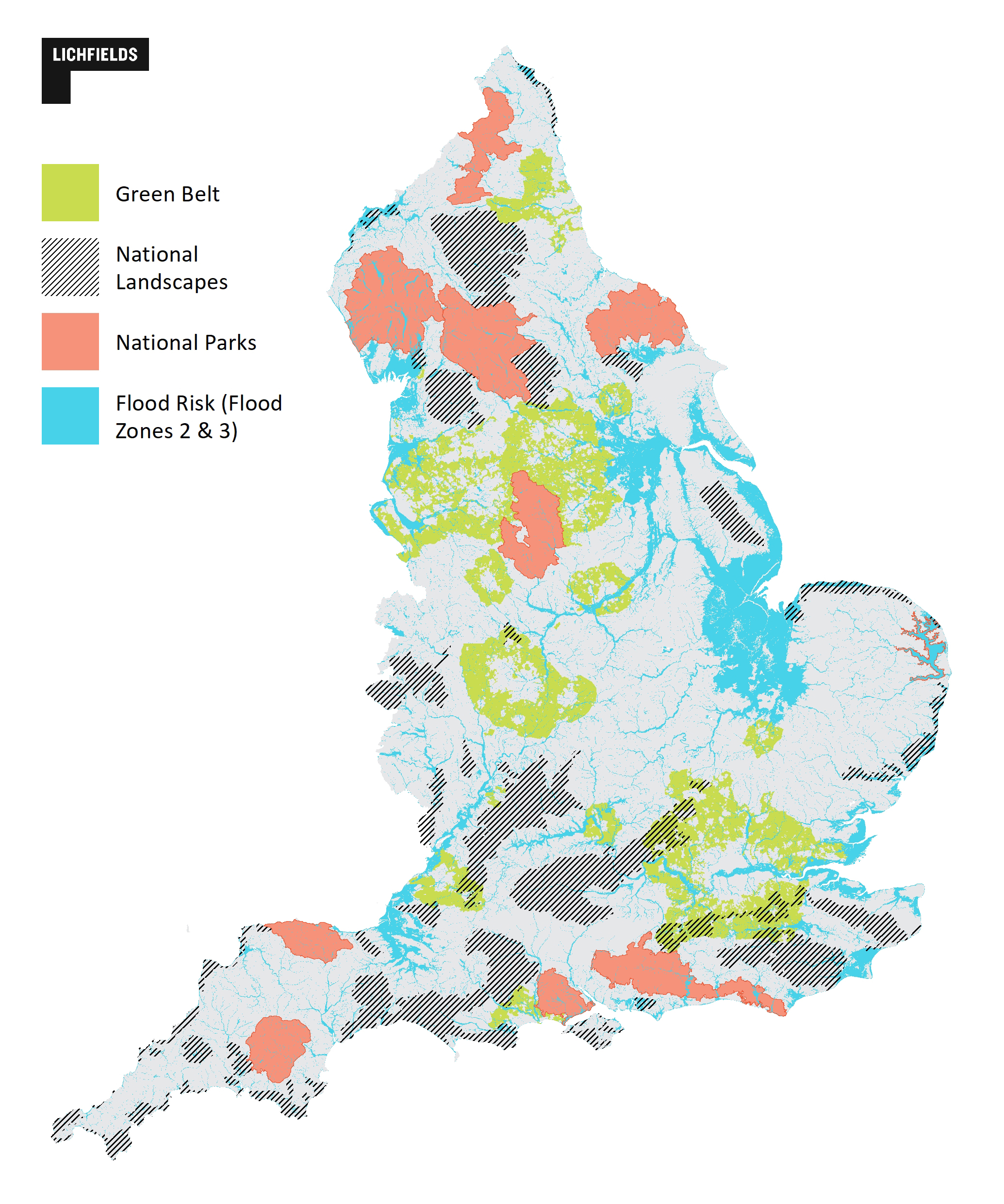
To provide some idea of the significance of the proposed ‘footnote 7’ deletion, the map below identifies, by way of example, the extent to which just three of the ‘footnote 7’ national protection policy designations – i.e. National Landscapes, National Parks (incl the Broads Authority) and flood zones 2 and 3 - fall within Green Belt land. This identifies the extent of the land areas affected by this proposed change to grey belt policy, highlighting the greatest significance is for the large areas of London’s Green Belt, where demand for new homes and economic development is at its greatest, also lying within a National Landscape.
Sources: National Landscapes & National Parks: Natural England (2025), Green Belt: MHCLG (2025), Flood Zones: Environment Agency (2025)
There are also two (non-footnote 7 related) new elements to the green/grey belt topic as proposed which are worthy of reference.
First, the national decision-making policy (‘NDMP’) GB8 on The Golden Rules, as proposed, introduces provisions (at Part 3) for circumstances in which a site-specific viability assessments may be justified to allow the contributions expected by this policy to be adjusted. These circumstances are where a development proposal is:
- On previously developed land;
- For a multi-phase, strategic site; or
- For a development model which is of a wholly different type to that assumed in the viability assessment that informed the development plan.
GB8 Part 3 is therefore a pragmatic policy response to an expansion of the application of the Golden Rules to ensure the delivery of otherwise acceptable major housing development in the Green Belt is not constrained by viability but only in those three specific site or development circumstances, recognising the higher costs associated with development in those circumstances.
Second, the NDMP S5 dealing with the principle of development outside settlements is, subject to certain criteria, positive about development of housing and mixed-use development which would be within a reasonable walking distance of a railway station (Part h). S5 is agnostic of whether the land is green or grey belt, see more in our
accompanying blog.
Concluding thoughts
Ultimately, while ‘footnote 7’ is proposed to be removed from the grey belt definition, the assessment of land and development proposals against footnote 7 considerations, be they flood risk, designated heritage assets, National Landscape etc, will continue to be considered in the usual plan-making and development management contexts and, for the latter, also in the overall planning balance. In some cases, these issues may prove determinative in the planning outcome, but it is just not determinative on whether the site is, or is not, grey belt.
We consider this to be a sensible clarification of grey belt policy, removing an unnecessary layer within the policy test, to overcome the above examples of different interpretations on the application of ‘footnote 7’ at the decision-taking stage, without affecting the level of protection provided within those other NPPF policy considerations.
| |
|
|
| |
 |
|
| |
|
|
| |
National policy consultation 2025
Our web resource brings together Lichfields' analysis of the Government’s Draft National Planning Policy Framework consultation and other proposed reforms affecting the development industry
|
|
| |
|
|