This month, the London Plan turned five years old. As most of us look ahead to the next iteration of this Spatial Development Strategy (‘SDS’) - the first under this Government’s direction of being “genuinely strategic” - we consider what this anniversary, the new Local Plans system and the new London Plan could mean for London boroughs and those looking to build new homes across London.
It is now well documented that the Mayor recognises the scale of the housing crisis in London and he has indicated that the new, slimline, London Plan is expected to seek to meet the London’s housing need in full. We watch this space with interest, to see how that will be achieved. The aim is to have a new London Plan in place by 2027/28, but there is plenty of time to influence what that will contain.
In the intervening period, there are other potential opportunities that will arise for bringing forward new homes:
-
In certain boroughs, the Five Year Housing Land Supply (‘5YHLS’) requirement will increase dramatically;
-
There may be trouble ahead for those boroughs who seek to adopt lower housing targets; and
-
There are many new opportunities to influence emerging local plans or to ensure they keep on the straight and narrow.
We consider these in this blog.
The timeline
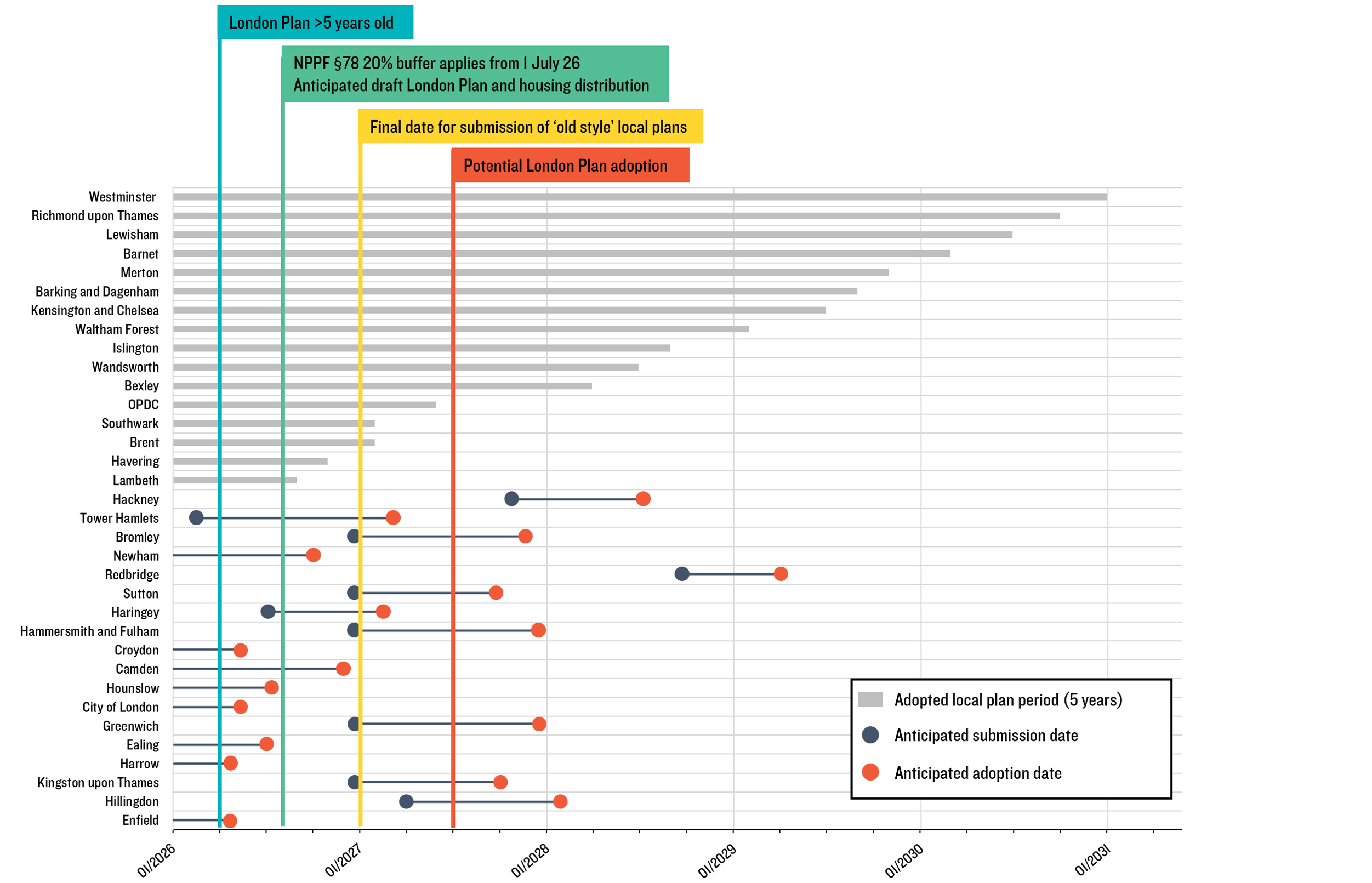
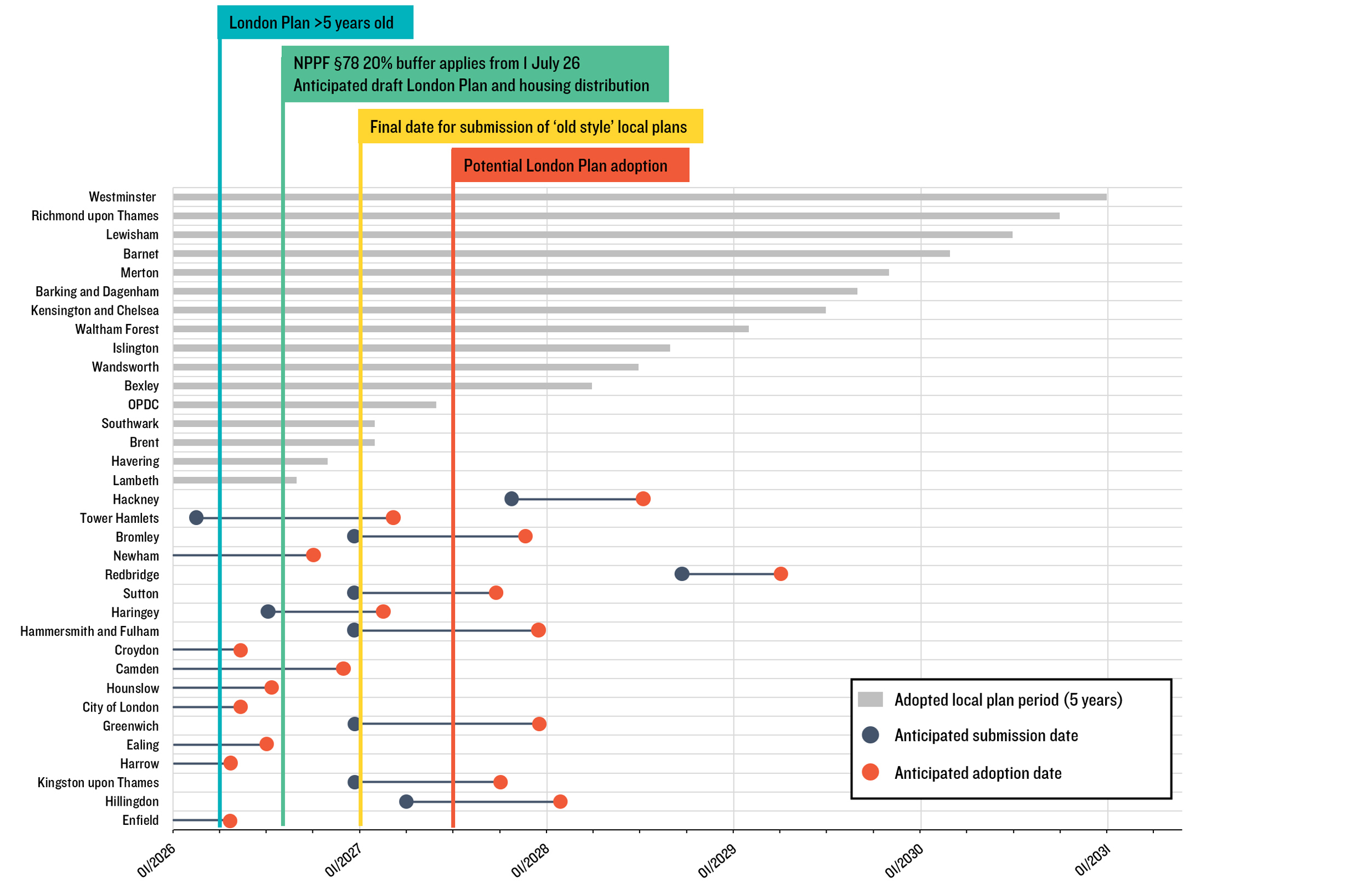
Over the next year, there will be changing circumstances at a local, London and national level which will significantly influence the housing position in London (in terms of planning). We have therefore analysed the local plan position for each London borough and in Figure 1 identify what their local plan trajectory is expected to be against key upcoming milestones. These milestones are:
-
March 2026 - London Plan becomes 5 years old and the basis of calculating the 5YHLS changes to be in line with standard method.
-
1 July 2026 - NPPF 2024 §78c requires a 20% buffer to be applied where a borough has a housing requirement adopted in the last five years whose annual average housing requirement is 80% of less than the LHN (unless a 20% buffer is already applied).
-
summer 2026 - anticipated publication of draft London Plan (including its proposed housing distribution, although this will have limited weight).
-
2027/ early 2028 - GLA’s published target adoption date.
Overall findings are that 11 no. of Local Plans are in place that will run through this period. 10 no. of local plans are currently underway and due to be adopted before the London Plan is adopted and the remainder of plans will be adopted after the new London Plan. We explore the implications of this in more detail below.
The anniversary for 5YHLS
Colleagues have previously analysed the importance of this anniversary
[1] and the window of opportunity it creates when measuring the 5YHLS.
Now that the London Plan is five years old, the 5YHLS measurement for decision-making depends on the status of individual Local Plans
[2]. If a London borough’s local plan is already five years old, then this reverts to the standard method which is, almost uniformly, higher than the current London Plan targets.
This means that the following boroughs all revert to using the standard method LHN, which is higher than their London Plan target (until they adopt a new Local Plan), creating potential opportunities for speculative planning applications
[3]:
-
Bromley; Camden; City of London; Croydon; Ealing; Enfield; Hackney; Hammersmith and Fulham; Haringey; Harrow; Hillingdon; Hounslow; Kingston upon Thames; Redbridge; and Sutton
July 2026 – 20% buffer
A new 20% buffer was introduced by the Government in the 2024 NPPF (§78c) to help address shortfalls between recent local plans and the new standard method. This new buffer to the 5YHLS calculation will apply to seven London boroughs where their housing target is 80% or less than the LHN and a 20% buffer is not already applied by virtue of the 2023 Housing Delivery Test results:
Combined with the 2023 HDT results, of the boroughs with a plan adopted in the past five years, we anticipate that all will have a 20% buffer applied.
For these boroughs, there could be greater scope to demonstrate an unmet housing need – creating the future opportunity for the broader presumption in favour of development in the draft NPPF to be applied.
Emerging Local Plans
The Government has announced that local planning authorities can submit plans under the existing system until 31 December 2026
[4]. While we move to a faster and more streamlined plan-making system with great anticipation, this deadline is having a bearing on boroughs with local plans in preparation.
We expect the following boroughs to try and submit plans for examination before this deadline:
Failure to achieve this deadline will mean that boroughs then need to transition to the new Local Plans system promptly, including repeating relevant plan-making steps, so the stakes are high for them to achieve this. This will further delay having an adopted plan in place, when we are meant to be working with a ‘plan based’ system.
To understand the cumulative effect of the transition to the new Local Plans system and layering the timeline for the preparation of the new London Plan, we have reviewed some case study boroughs in more detail:
Hillingdon
Hillingdon’s original ambition was to submit a local plan under the existing plan-making regime, by December 2026. However, in a Cabinet Report
[5] officers recommended delaying this process and instead progressing under the new plan-making system.
This approach was, partially, based on Hillingdon’s LHN more than doubling from the London Plan target, and a recognition that the plan was being prepared in advance of the Mayor’s apportionment of London’s LHN to each individual borough. This apportionment could require substantial revisions and further consultation – they considered it is prudent to delay publication of the draft plan, so that the apportioned targets can be considered.
The indicative timetable now proposes submission in September 2027 and adoption in April 2028 which would tie in closely with the London Plan.
Camden
In the alternative, LB Camden submitted its plan for examination in October 2025. However, its proposed housing target is 11,550 additional homes from 2026/27 to 2040/41 – an average of just 770 homes per annum (74% of the annual London Plan target, 1,038 dpa between 2019-29).
This drop in housing requirement was challenged by the GLA
[6]. The GLA note that the “current London Plan does not meet London’s identified need and therefore the overall amount of housing required annually should not be expected to reduce.”
The GLA also state that the text at paragraph 4.1.11 of the London Plan
[7] is
“now considered to be out of date”, in the context of working towards delivering 88,000 homes per annum. The GLA stated that boroughs
“should seek, as a minimum, to roll over the current London Plan target beyond 2028/29, including any shortfall accrued to date, and to continue to take proactive measures to increase housing supply.”
The GLA’s position here demonstrates that it is seeking to try and boost housing supply through local plans now – in anticipation of increases in the next London Plan.
While Camden’s position was ultimately agreed in the statement of common ground between the GLA and Camden it could result in a Local Plan being adopted with a materially lower housing target than the current position. This will be superseded by the targets in the next London Plan when it is adopted, but it will effectively ‘bake in’ a housing strategy and site allocations at this lower level for the duration of the plan.
It is also notable that 25 boroughs
[8] responded to Camden’s duty to co-operate request and all confirmed that they are not in a position to help Camden identify a 5YHLS.
What this all means for local plan preparation?
The cyclical lag between local plans, the London Plan and, now, the application of the new standard method, continues to create a complex picture of the housing requirement across the capital.
It is expected that the Mayor will redistribute the 86,000 homes per annum LHN for London across boroughs, so that this is met in full. However, achieving this will be reliant on having local plans that are prepared with sufficient allocations and ambition to match this requirement. The current picture is that most local plans will be based on out-of-date housing targets, including those that are continuing to be prepared.
Our analysis of borough’s local plan timetables (Figure 1) indicates that:
-
there is a group c.11 boroughs with adopted local plans that will remain less than five years old through to 2029-31.
-
there are c.15 boroughs in the preparation of a local plan now, five of which are seeking to submit ahead of the 31 December 2026 deadline for the current plan-making system. Concerningly, a number of these boroughs are seeking to adopt targets beyond 2029, which will be below the current London Plan target, let alone seeking to meet their LHN. It is unclear if Inspectors and the Mayor will expect these boroughs to meet a draft LHN redistribution figure, or if this will only be applied closer to adoption of the London Plan.
-
the remaining c.8 boroughs are expected to progress under the new local plan-making system, and their timescales are likely to coincide with the Mayor’s LHN redistribution figure being at an advanced stage. This should lead to the expectation that those boroughs prepare plans to meet this need.
Concluding thoughts
Housing distribution: In order for boroughs to begin to prepare local plans that contribute to achieving London’s LHN as a whole, the distribution of those 86,000 homes cannot come soon enough. This is necessary for effective planning and to avoid local plans being adopted which ‘bake in’ anomalous housing numbers for the next plan period.
HDT methodology: Positively, the Government is proposing to amend the Housing Delivery Test rule book, so that the relevant housing requirement is derived from whichever is the most recently adopted plan (whether it is a spatial development strategy or borough/district-level local plan). If implemented, this will address the risk of boroughs being measured against materially lower targets for the HDT.
5YHLS methodology: The next London Plan will return to primacy as the basis of the 5YHLS from its adoption (likely late 2027/early 2028). However, until then, those boroughs with local plans that are more than five years old will revert to the full LHN for this measure. Based on the potential implication of failing the 5YHLS
[9], we anticipate that this will be most relevant to Camden; Hillingdon; Hounslow; Redbridge and Tower Hamlets.
Local elections: with all London borough councillor seats up for election in May 2026, there is the possibility for new local plan committees to introduce yet more uncertainty to this position. This could mean potential delays in local plan preparation, as new councillors/parties seek to understand and influence their local plan.
Clearly, given the complexities of considerations over the next year, the housing position needs to be considered on a borough-by-borough basis, but there are expected to be significant opportunities, both through speculative applications and through engaging in local plan consultations in the context of significant increases in housing requirements.
[2] Until the next London Plan is adopted (stated by the GLA to be 2027, https://www.london.gov.uk/programmes-strategies/planning/london-plan/next-london-plan and in the more recent Hounslow/GLA statement of common ground as ‘early 2028’).
[3] It is recognised that for some boroughs, this is tempered by existing failings in the Housing Delivery Test, but it will add further weight to the importance of housing delivery.
[4] https://www.gov.uk/government/news/new-local-plan-system-launching-early-2026-latest-update
[5] Cabinet Report 15 January 2026. https://modgov.hillingdon.gov.uk/documents/s65395/05%20-%20REPORT%20HC%2020251124%20Local%20Development%20Scheme%202025%20December%20Cabinet%20Report%201.pdf
[6] https://www.camden.gov.uk/documents/d/guest/sd19-statement-of-common-ground-with-the-gla
[7] Paragraph 4.1.11 of the London Plan requires that housing targets beyond the 10-year period of the London Plan targets should draw on the 2017 SHLAA findings, any local evidence of identified capacity.
[8] Barnet, Bexley, Brent, Bromley, City of London, Ealing, Enfield, Greenwich, Hackney, Haringey, Havering, Hillingdon, Hounslow Islington, Lambeth, Lewisham, Merton, Newham, Redbridge, Richmond, Southwark, Tower Hamlets, Waltham Forest, Wandsworth and Westminster
[9]Based on Planning Resource 5YHLS data, these boroughs could see their position fall below five years.