The UK Government’s revival of a national New Towns programme represents one of the most ambitious spatial and economic policy shifts in decades. Following the recommendations of the New Towns Taskforce Final Report: Report to Government
(published in September 2025), the Government has now shortlisted seven locations
for further consultation, marking a shift from strategy to delivery. In addition, a wider pipeline of New Town proposals is already emerging beyond the Taskforce process.
Acknowledged by Chair Sir Michael Lyons in his Foreword to the Report to Government, Lichfields was pleased to support the Taskforce in its preparation of the report including evidence to underpin the strategic and economic case for the programme.
When many people think about New Towns, they think primarily of housing delivery at scale, which is hardly surprising given the prominent role the New Town’s programme has been given in the Government’s response to the housing emergency. But New Towns are also creating jobs, raising productivity and stimulating economic growth – both in the delivery of successful places in their own right, but also their ability to unlock constrained economic potential and addressing deep-rooted spatial inequalities. This framing is reinforced in the Taskforce’s wider report to government, which emphasises that New Towns can make a ‘telling contribution’ to both the pressing need for more homes and to national ambitions for economic growth, especially in locations where housing shortages currently limit the availability of skilled labour and restrict business expansion.
These conclusions highlight a simple reality: if the Government wants New Towns (both the seven shortlisted locations and other New Towns and significant urban extensions that arise outside of the programme) to succeed, they must be built not merely as places to live, but as strategic economic assets integrated into wider labour markets, regional strategies, and national productivity ambitions.
This blog considers the rationale for New Towns as an economic intervention, and the critical factors that must be addressed to ensure they make the fullest contribution to their regions as well as the national economy. This is also in the context of the recent updates to HM Treasury’s Green Book (which we have covered in more detail in a
previous blog), which place greater emphasis on the purpose of interventions and the distributional and place-based outcomes they are intended to achieve, rather than relying solely on headline value-for-money metrics. In this context, New Towns should be understood not simply as housing delivery mechanisms, but as targeted, place-based interventions to address specific economic constraints.
The economic rationale for New Towns
The Taskforce identified the economic consequences of ongoing housing shortages as one of the central justifications for a New Towns programme. In many fast-growing urban areas, demand for labour significantly outstrips the available supply of housing, driving up prices and reducing access to the workforce that firms need to grow. These shortages dampen productivity growth, and reduce the competitiveness of city-region economies that form the backbone of the national economy.
Where housing is scarce and expensive, labour mobility is constrained. People cannot move into areas with abundant job opportunities, and firms cannot expand or diversify because they cannot attract essential workers. Many of England’s most productive cities and regions – including Greater London, the Oxford–Cambridge Arc, Greater Manchester, Bristol, and Leeds – face spatial constraints to various degrees, caused by a combination of limited developable land, high land values, bottlenecks in infrastructure capacity, and insufficient housing supply.
The Taskforce report identifies how such constraints limit the ability of these city regions to generate growth. New Towns, when strategically located within the functional economic area of a strong city, can expand the labour catchment, relieve land pressures, and provide space for new commercial activity, innovation, technology and industrial clusters. It concluded that New Towns are likely to be most effective when they directly support labour movement into economically successful areas, rather than artificially trying to create demand in uncompetitive places.
The Taskforce’s site selection criteria were explicitly economic: they prioritised two essential criteria, of which one was the supporting or unlocking of economic growth. The recommended locations were also selected to:
-
‘Relieve growth constraints in ‘overheating’ areas – where there is already high productivity, but housing shortages are restricting labour mobility and therefore preventing the UK from capitalising on existing areas of economic strength;
-
Attract investment and talent to places which are already growing, but not yet overheating (for example, places with high potential industrial clusters, or high existing trend growth in employment and/or productivity), creating virtuous cycles of growth;
-
Support agglomeration in England’s major cities, when combined with strategic transport investment – helping to create bigger, more fluid labour markets which are more productive, narrowing the gap between the UK’s major cities and their international counterparts.’
This approach should help ensure that productivity benefits are built into the programme from the outset. A Centre for Cities blog
from the time that the Taskforce’s recommendations were published highlighted that the selected locations all sit within easy travelling distance of major conurbations, which is critical for ensuring that New Towns amplify existing economic strengths rather than try to invent new ones from scratch.
Of course, there is an argument that New Towns could be used to drive investment in underperforming areas, acting as catalysts for growth in weaker regional economies by attracting new residents, employers, and infrastructure investment. However, this isn’t an approach the Taskforce embraced, with their conclusion that, for areas that are not currently fast‑growing or with untapped potential from increased densification, New Towns are unlikely to be answer. This stance also appears to have been doubled down on by the Government, with many of the seven shortlisted locations being subject to further consultation being major extensions to existing high-performing cities. This could be seen as slightly at odds with the rationale of the updated Green Book which does allow for place-based effects to be given more prominence in decision-making, although in reality other interventions are likely to be more successful in lower performing regions.
Getting the strategy right
The role of economic vision in New Town development
Place-based economic development is most effective when built on a long-term vision around local strengths, sectoral opportunities, and the role of anchor institutions. The Taskforce’s ‘Placemaking Principles’ dedicate an entire section to Business Creation and Employment Opportunities, recommending that New Towns ‘must be places that provide jobs for residents and enable businesses to grow, supporting the government’s economic growth mission’. Beyond this, it identifies that a thriving business community is part of the wider social infrastructure that residents will need to meet their day-to-day needs.
Major employers: Learning from the past
The Taskforce highlights the opportunity to use New Towns to complement existing economic clusters and establishing new hubs, with potential to focus on particular industries.
The UK has a history of ‘company towns’ (including Bournville, Port Sunlight and Saltaire), and some of the post-war New Towns included major employers or specific sectors anchoring early growth. For example:
Major employers bring the benefit of providing an additional reason for existence, as well as providing jobs close to the new residents. The risk, however, is that as economies change and businesses come and go, it can leave local economies at risk of stress. Company towns are a thing of the past, and the next wave of New Towns need more diversified strategies: a combination of anchor employers, sector clusters, research assets, and a mix of start-ups and established firms. In this regard, Milton Keynes is a more instructive example of a New Town which has developed (and retained) a diversified local economy with strengths in digital and technology, professional services, and logistics sectors . This has provided a certain level of resilience as well as well as strong economic performance – the city has one of the highest productivity levels in the UK, with output per job around 25% above the national average, and a total economy worth over £16 billion . |
Among the Government’s shortlisted locations, economic rationales for some locations are already evident – for example, Leeds South Bank aligns with a growing urban innovation district, and the West Innovation Arc near Bristol reflects an established cluster in advanced engineering and aerospace. These examples reinforce the importance of aligning New Towns with existing economic strengths rather than attempting to create entirely new markets from scratch.
The Taskforce recommended that each location should generate an early economic vision alongside any town-wide masterplan. We believe this should be underpinned and informed by its specific context and strengths, and should provide:
-
A clear economic identity – for example, positioning the New Town as a hub for advanced manufacturing linked to a nearby city-region cluster, a centre for logistics and distribution capitalising on strategic transport connections, or a knowledge-based location anchored by existing university or R&D assets.
-
Early identification of growth sectors and economic functions reflecting local and regional strengths.
-
Development plans for these sectors and economic clusters, aligned with regional industrial strategies and combined authority priorities.
-
Partnerships with universities, further education colleges, employers, and R&D institutions, with a focus on skills.
-
A plan for cultivating SMEs, start-ups, and innovation networks.
-
Distributional effects – who is likely to benefit from the economic vision for the New Town, and what interventions might be required to share the benefits more widely.
Addressing market failures in delivering employment land
From an economic perspective, investment in New Towns is underpinned by the principle of addressing market failure. This is normally seen in the context of housing supply (with the current market not delivering enough), but is it also true of employment land or support for specific sectors and economic clusters.
For example, recent reports show severe laboratory space shortages across the UK, particularly in the Golden Triangle (London–Oxford–Cambridge) – in 2023, vacancy rates for fitted lab space were just 1% in Cambridge and London, and 7% in Oxford
. (While demand for laboratory space has softened in parts of the market recently, structural shortages remain.) Meanwhile, the UK has suffered a historic undersupply of industrial and logistics space
. There are several challenges to delivering these types of land use, including limited appetite among private developers to deliver commercial space with slower returns, sometimes higher upfront infrastructure costs, and a plan-making system that does not put the same onus on planning for employment land as it does for housing.
New Towns could provide an opportunity to deliver modern employment uses that the market and/or the planning system are not fully delivering. In particular, the development corporation model would allow the public sector to assemble land, capture value uplift, co-ordinate long-term delivery, and ensure balanced development that includes employment land rather than defaulting to housing. Advantages would include:
-
Co-ordinated masterplanning and land assembly powers, allowing for balance between uses.
-
Guaranteed allocations of serviced commercial land.
-
Delivery of shared facilities such as common utilities, equipment and central services.
-
Forward funding or land value capture models which could be used to fund necessary infrastructure.
-
Incentives for early-phase employers.
-
Long-term stewardship models that maintain employment land supply.
The value of the opportunity for a comprehensive masterplan for each New Town is that it allows for a dedicated employment land strategy, protecting space for commercial activity against viability pressures that often push for higher (residential) yields. Land can be safeguarded for uses that are higher value or in demand in the region or a country as a whole.
Recent research conducted by Lichfields resulted in preparation of a framework and associated tools to inform the approach to planning for modern economy uses.
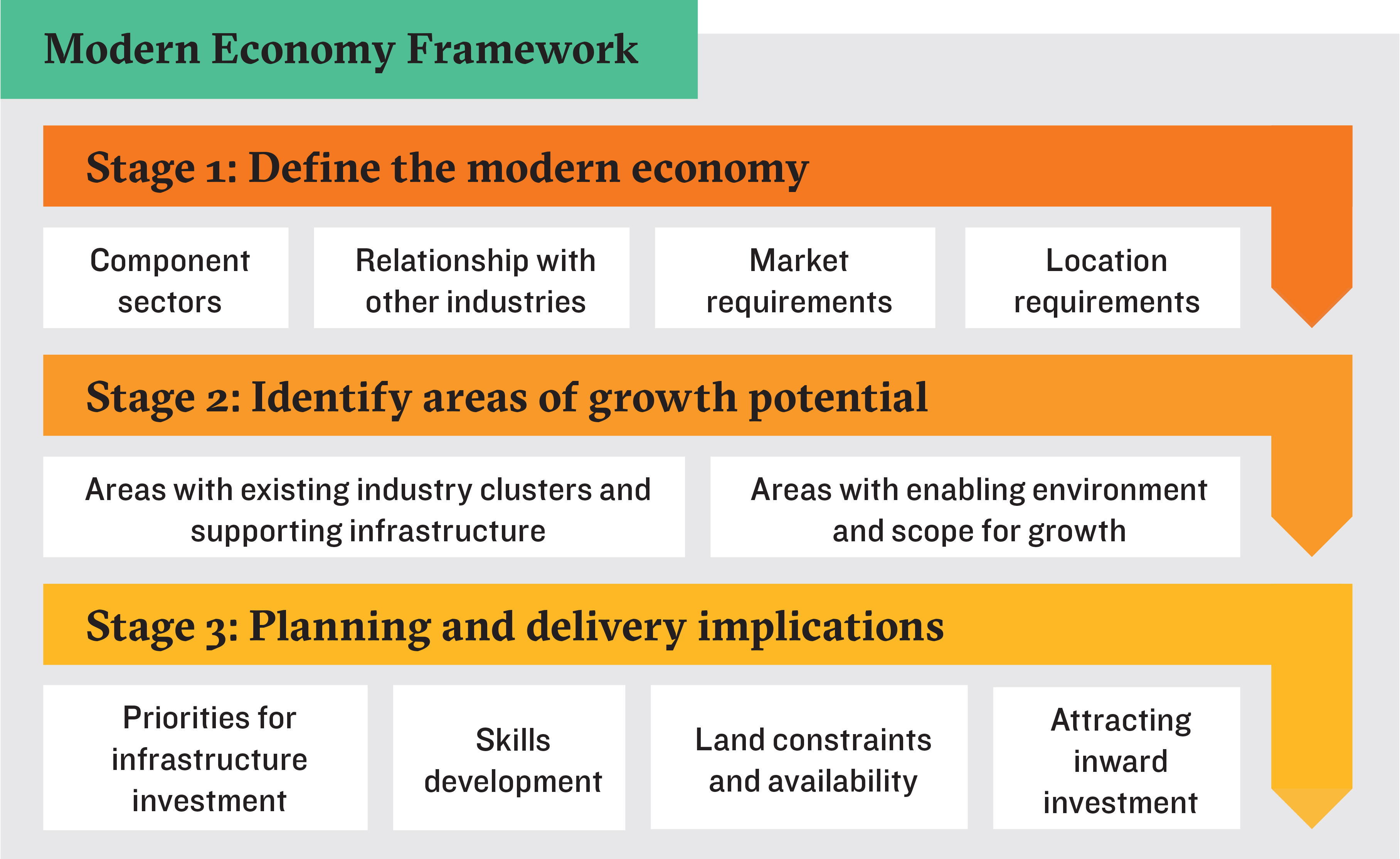
Source: Planning for a Modern Economy, Lichfields.
Ensuring New Towns are more than the sum of their parts
The most effective New Towns are those conceived as expansions of existing economic systems. As the Centre for Cities blog previously mentioned states, the Taskforce’s chosen locations are ‘in the right places, for the right reasons’, generally adjacent to or within commuting distance of major cities.
This allows New Towns to strengthen agglomeration effects – one of the most powerful drivers of productivity – by enabling:
-
larger integrated labour markets;
-
better matching between skills and jobs;
-
economies of scale in public and private services and facilities; and
-
greater potential for innovation and knowledge spillovers.
Economic governance
The role of existing and new Combined Authorities and Metro Mayors, and other strategic-level authorities and groups of authorities aligned with the production of Strategic Development Strategies, will be critical in shaping and sustaining the economic success of New Towns. These bodies are well-positioned to align New Town development with wider regional economic strategies, infrastructure investment, and skills provision.
Effective governance will require long-term co-ordination between development corporations, local authorities and strategic authorities to ensure that New Towns are not delivered in isolation, but as fully integrated components of functioning city-region economies.
Conclusions
The next generation of New Towns will succeed only if they are conceived, designed, and delivered as economic interventions, not simply as large housing developments. Housing delivery is important, but it is not the (only) end goal. An important purpose of New Towns should be to create successful, productive places that reinforce wider regional and national economies.
The New Towns Taskforce made clear that New Towns are at their most effective when they help expand labour markets, relieve constraints in high‑growth areas, support agglomeration, and provide new platforms for business creation and innovation. The Government’s consultation on the seven shortlisted locations marks a critical next step in translating the New Towns vision into reality. However, it is clear that this initial group will not be the end of the story, with further locations and proposals expected to emerge.
What matters now is not just where these New Towns are built and how many homes they deliver, but how they will contribute to local, regional and national economies. Each must be grounded in a clear and realistic understanding of its role within regional and national markets – whether that is supporting high-value innovation clusters, enabling logistics and distribution growth, or expanding labour markets around the UK’s most productive cities.
If these principles are applied consistently, the New Towns programme has the potential to do far more than address housing need – it can help reshape the geography of economic growth across England.
Footnotes