The current fundamental crisis in London’s supply of new homes is widely recognised but its historical resonance is still striking. The drop off in planning and delivery (clearly signposted in the London Plan Review)
[1] is now forecast to be the lowest since 1944 (See Figure 1).
Figure 1: Housing Delivery in London 1937 - 2027
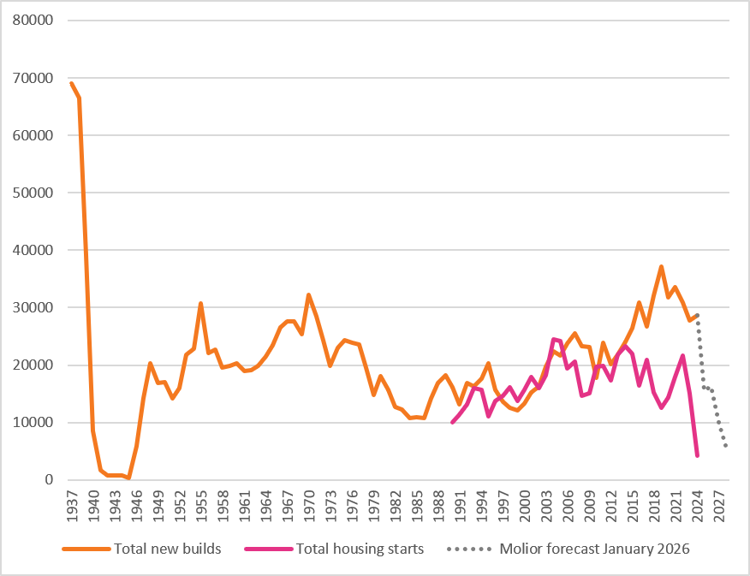 Source: GLA data, Centre for Cities and MHCLG published Table 123/217 and Molior January 2026 report.
The causes of near zero housing delivery were different 80+ years ago (not least the role of the Luftwaffe),
[2] but London at that point faced a housing crisis – including overcrowding and squalid slums - at least as serious as that faced in 2026. Then, as now, the response was a new plan for London: The Greater London Plan produced by Sir Patrick Abercrombie. It set an agenda that we are living with today.
With the draft of the next London Plan (the sixth iteration of its modern incarnation) expected to be published for consultation in July,
[3] more signals are emerging on what it will include to address the challenges of 2026, by way of proposals to meet the new local housing need of c.84,000 homes a year.
[4]
Deputy Mayor Jules Pipe used a series of recent speaking events to trail some of its key policy measures.
[5] He largely confirmed what he said in 2025, that a plan to meet the Standard Method target in London is an
“intellectual exercise” without a change to the funding approach to infrastructure and affordable housing, given the structural shift in development viability.
[6] Although the plan would
“absolutely not increase the overall burden of planning policy requirements on development” it would set
“high standards” and would also seek higher densities on Green Belt release (at five to six storeys) and around rail stations, something that will surely pose viability and design difficulties on some sites.
[7]
The
“intellectual exercise” positioning – that the London Plan will show how housing targets can be met within London’s boundaries, but only in theory
[8] – sets a challenge for the Government, not least given its proposed tests of soundness for Spatial Development Strategies (SDS) in the draft NPPF, scheduled (prior to recent national political ructions) for publication this summer.
[9]
It also marks a vivid contrast with the policy approach adopted back in 1944.
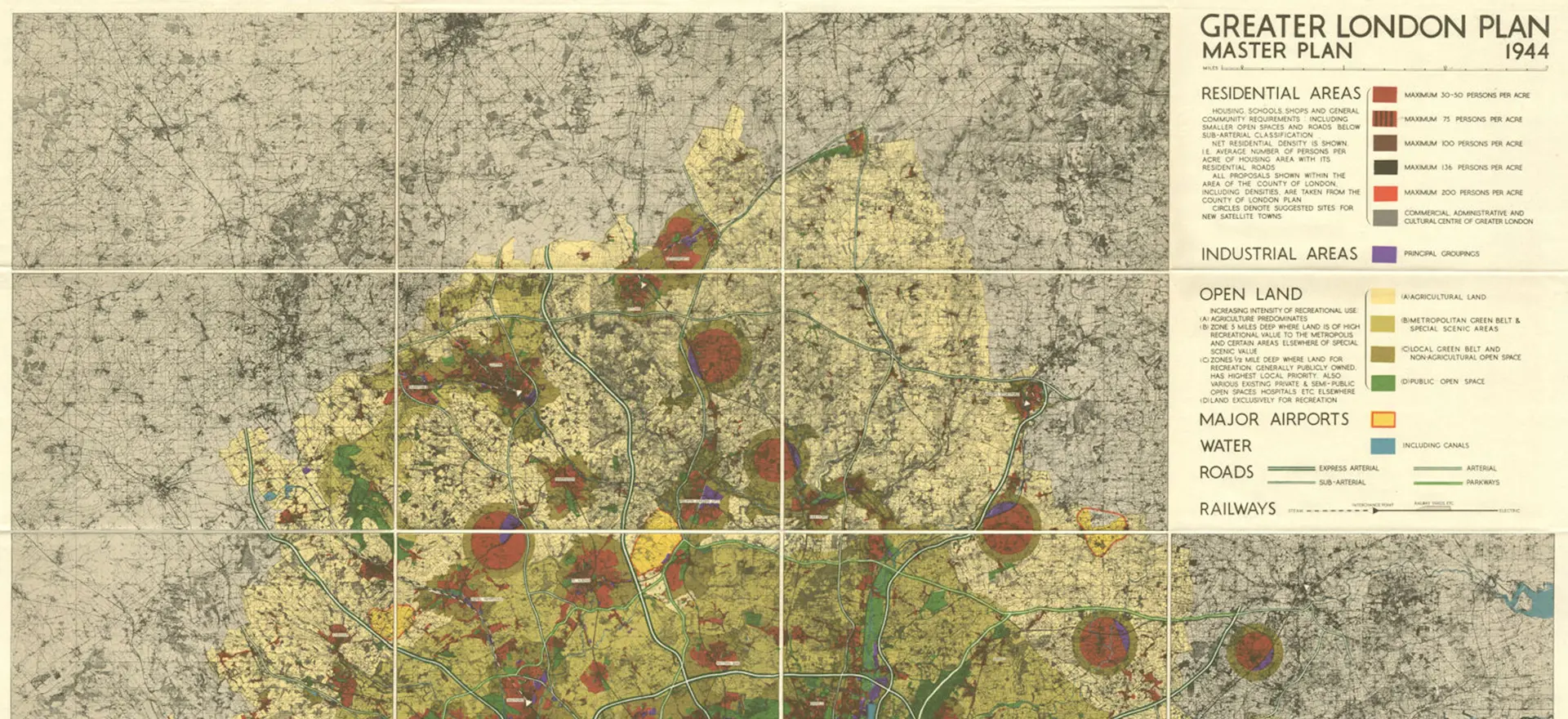
Abercrombie’s Greater London Plan
Abercrombie’s Greater London Plan had as its object
“to provide the foundations for Greater London upon which homes, work and fresh food can be supplied not only quickly but permanently in full measure.”[10]
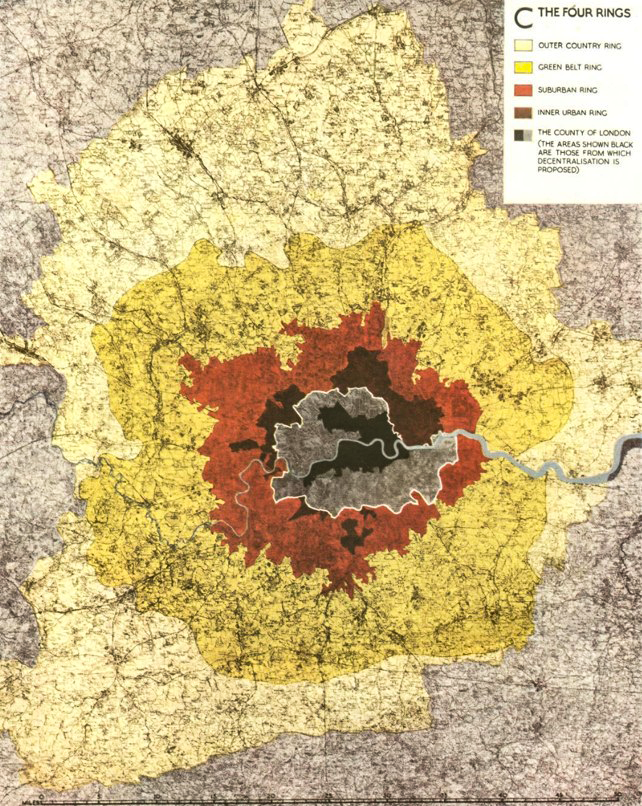
He delivered a bold and pioneering piece of strategic planning that defined London for its post-war growth and set development patterns and constraints that remain. His answer combined two core policy instruments, (in)famous in today’s world: the protection of a Green Belt and the creation of New Towns beyond London,
[11] linked through a broader vision of decentralisation and growth corridors, set within four rings (see Figure 2). An eagle-eyed observer will note that the Green Belt now is far wider than originally conceived by Abercrombie.
[12]Figure 2: The Greater London Plan’s Four Rings
Source: Greater London Plan 1944
In due course, the opportunity half of the Abercombie concept – New Towns – fell away,
[13] but the constraining other half – Green Belt – remained.
The Compact City and Opportunity Areas
The adopted Spatial Development Strategy for London – the London Plan - was published in 2004, with an express ‘compact city’ model.
[14]
But this concept for London was not new, carrying forward several planning principles that had been introduced by the post-1986 settlement following abolition of the Greater London Council and which saw formation of LPAC.
[15] In its 1988 Strategic Planning Advice for London (which informed RPG3)
[16], LPAC said it:
“supports the regional objectives of containing development within London and regenerating the older parts of Inner and East London. It accepts that both are a prerequisite to ensure that new development does not conflict with the ... aim to conserve the countryside. [...] Development within London avoids the need to develop greenfield sites outside London and that over-provision for development in ROSE could be wasteful and unnecessary. [...] Housing development must not be at the expense of the Metropolitan Green Belt, Metropolitan Open Land, or other urban open spaces; and housing demand alone should not be sufficient justification in itself for the release of Green Belt or Metropolitan Open Land."[17]
So, the current strategy has now run for around four decades, and Figure 1 shows it has not delivered the scale of housing delivery that the Capital now needs. It is based on intensifying the urban area, building at higher densities, initially in Docklands under the LDDC and then in designated Opportunity Areas (Figure 3).
Figure 3: London’s Opportunity Areas
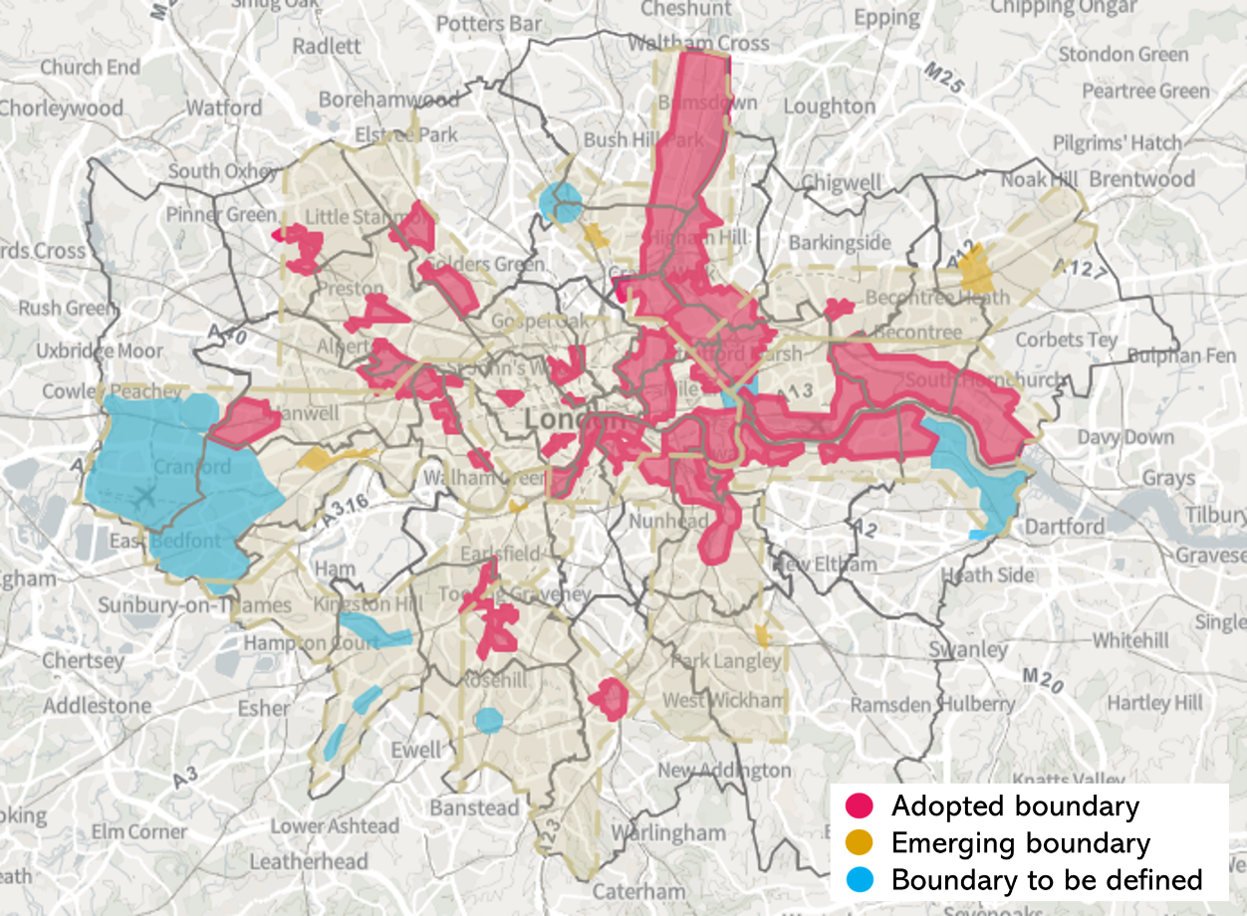 Source: GLA Opportunities Areas Map
These zones have been central to successive London Plans, where they were introduced to
“intensify and accommodate substantial growth, especially in economic activity.”[18] In the 2021 London Plan, 275,000 of the 523,000 homes planned for 2019 to 2029 were in these areas. Some of the most recognisable feats of housing delivery in London stem from this Opportunity Area thinking; Nine Elms, Greenwich Peninsula, King’s Cross and Olympic Park are examples of what coordinated land assembly/ownership and robust delivery mechanisms can achieve.
However, each of the 48 Opportunity Areas have developed – or remained undeveloped – at differing paces. In preparing for the next London Plan, the GLA categorised its Opportunity Areas.
[19] and with our interpretation of each, we have identified the remaining housing capacity. Out of the total capacity of c.246,000 homes, our analysis suggests around two thirds (c.169,000) are delayed in their progress, stalled through infrastructure blockers, or perennially nascent (See our interactive graphic as Figure 4 for the categorisation of each - click on each category to identify the relevant capacity and OAs).
Figure 4: Opportunity Area Categorisation
Source: GLA / Lichfields analysis
Why do Opportunity Areas fail?
By their nature, Opportunity Areas face many challenges, often in combination, which are causing them to stall, broadly across three key themes: a) infrastructure; b) frameworks and coordination; and c) deliverability (See our interactive chart as Figure 5 - click the icons for more information).
Figure 5: Opportunity Areas: Why they fail
Source: GLA / Lichfields analysis
Of these, the most significant barrier is dependence on major infrastructure. In 16 of the 48 areas, housing capacity is tied to transport schemes that remain unfunded, delayed or politically uncertain. New Southgate exemplifies this issue, where its reliance on Crossrail 2 has held back any real growth and it is expected that this will lead to the area’s de-designation.
Alongside these ‘big ticket’ infrastructure dependencies, lack of local connectivity has also been a barrier. Even where strategic transport exists, many opportunity areas (around 20 out of 48) are weakened by physical severance, poor pedestrian access and lacking effective cycle links – all of which rely on sufficient development viability to secure investment.
In essence, the more deliverable Opportunity Areas have been secured – often with concerted investment efforts.
[20] This leaves the more challenging locations representing a substantial proportion of remaining capacity: areas that are already underway but progressing more slowly (c.84,000 homes) or classified as ‘ready to grow’ but with major barriers unresolved (a further c.52,000 homes). A further c.77,000 homes are not out of the starting blocks or look set to be dropped.
Without moves towards more targeted investment, infrastructure delivery and stronger coordination, this potential remains under-realised.
The new London Plan: what’s next?
The draft NPPF set an expectation that Spatial Development Strategies look ahead a minimum of 20 years.
[21] Assuming the Mayor follows this stipulation (which surely makes more sense for a strategic plan than the ten year targets that are automatically set up to fail)
[22], then the London Plan needs a positive vision for securing up to 1.69 million homes. Draft NPPF policy PM14 says that for an SDS to be
“sound” it should be, inter alia,
“effective” where
“there is a reasonable prospect that local plans will be capable of identifying site allocations to implement its spatial strategy.” For Local Plans to be sound, Draft Policy PM15 requires them to be
“realistic” where
“there is a reasonable prospect that its site allocations are capable of being deliverable at the time envisioned.”[23]
An analysis of potential sources of supply points to the major challenge involved in this endeavour (See our interactive chart for Figure 6 - hover over each component for the rationale analysis).
Figure 6: Sources of Supply for 1.69m homes
Source: GLA / Lichfields analysis
Even with optimistic assumptions about addressing the current viability challenge; small site capacity (including an uplift based on rolling out the Croydon experiment);
[24] strengthened pro-development policies including
grey belt and
development around ‘well connected’ railway stations; and the residual capacity of all extant opportunity areas and large brownfield sites, there remains a substantial housing gap (perhaps as much as 875k homes) over the next two decades.
The social and economic implications of this gap are stark. London Boroughs are facing unprecedented costs – estimated at £5.5m a day – in providing temporary accommodation for homeless households.
[25] The
lack of secure housing clearly undermines prospects for young people.
The Deputy Mayor’s remarks suggest a SDS for meeting need that is more an
“intellectual exercise” than one it considers likely or realistic. This seems intended to set the Mayor of London up for some interesting discussions with HM Treasury and asking likely Prime Minister Burnham (the
"King of the North") for more transport investment in a Capital he has not always talked about positively.
[26]
If London is to genuinely meet the challenges with a realistic long-term strategy – one with an Abercrombie-esque scale of ambition and boldness – on top of the benefits arising from a more rules-based system and encouraging development of smaller sites, it seems likely to require at least four strategic moves:
-
First, unlocking the existing pipeline. The most immediate gains are likely to come from those homes already in the pipeline in existing Opportunity Area designations and other large sites. Yet, this requires investment and proactivity that the GLA already understands: viability gaps, infrastructure timing, land assembly and delivery coordination to name a few. A credible strategy starts with these identified zones shifting existing capacity into on-the-ground delivery. Easier said than done.
-
Second, within the GLA boundary and taking account of the 20-year horizon for SDS,
creating the next generation of Opportunity Areas, without necessarily any expectation that much is delivered in the short term. A mix of bold ambition but also realism to focus on creating the right conditions early, including delivery structures, the framework for land assembly and infrastructure planning. The tests of soundness for SDS recognise this.
[27]
-
Third, the
Green Belt needs to be loosened strategically, as the Mayor has signalled he will do.
[28] However, the challenge here relates to the Mayor’s expected demand for high densities which pose challenges for viability, the demand for family homes, and the design and landscape considerations often applicable on such sites.
[29] Further, because the SDS cannot allocate Green Belt sites itself, it relies on Local Plans that will not be adopted for some years and this puts their delivery trajectory into the second or third phases of any strategy.
All of the above is needed, but even with an optimistic outlook, this might realistically get London to a position where it is achieving development of around 40-50,000 homes a year. This takes one to the inescapable conclusion that a fourth strategic move is needed, and it is as old as the hills:
-
Looking beyond the boundary. This was a foundation of Abercrombie’s strategy. It was part of the 1967 Strategic Plan for the South East.
[30] Both recognised that London’s problems cannot be solved within London alone. The current London Plan recognises it even if not responding directly: Policy SD2 is designed to frame engagement with the wider South East for future reviews of the Plan and Policy SD3 focuses on potential growth locations outside London.
[31] The Inspectors examining the last London Plan said:
“If London cannot accommodate all of its development needs, the most significant strategic issue facing the wider South East for the coming decades will be how and where to accommodate that growth outside London in a way that will contribute towards achieving sustainable development. Many representors, with a wide variety of interests, have argued that this could and should be achieved. However, it is clear from past experience and evidence about increasing development pressures that areas in the wider South East outside London already face, that there are no easy solutions or clearly identified potential growth locations.”[32]All of this was based on an assumption – with evidence - that London would not meet its needs within its boundary, and that there was a requirement to work with the wider South East, even if it was acknowledged at the time that there were no clear mechanisms (or appetite) to do so. A similar argument existed in 1944, in 1967 and it exists now.
The draft NPPF would require the next London Plan to be positive in seeking to meet needs, but also be appropriate and effective. If it becomes apparent that needs cannot be met, the Mayor will need to show that
“stringent efforts have been taken to meet those needs through cooperation with other strategic planning authorities”. Footnote 20 expressly references the Mayor of London as being subject to this test.
The new London Plan seems likely to adopt a different, entirely inward-facing approach to meeting its needs, just at the moment when – over the M25 - the
new architecture for strategic planning is emerging, blinking into the light. There is also a more overt central Government intervention by way of New Towns (albeit not on the scale of post-war programme).
[33] Arguably, there is more of a platform – or at least a smaller, more manageable number of interlocutors – for the Mayor to engage on strategic matters than has been the case since 2010.
Conclusions
London was famously described by William Cobbett as the ‘Great Wen’ – a monstrous entity that drains the life, wealth and population from the rest of Britain. And yet the Capital undisputedly faces an acute housing crisis; authoritative studies on Britain’s poor economic productivity show that addressing the lack of homes – in and around London - is part of any policy to help support an improvement in economic growth, as part of - not instead of - an approach that addresses regional inequality.
[34]
The Mayor's prospective London Plan – in advancing an ‘intellectual exercise’ capacity-based approach to meet need (at least on paper) within its boundaries that expressly relies on high densities and an ask for public money to address a broken funding model – seems set for a collision course with either HM Treasury or the new NPPF tests of soundness for SDS. Perhaps both.
One must assess a plan based on what it says and the evidence on which it is based – and nobody outside the GLA has seen that yet – but realistically the supply it might unlock is unlikely to exceed 40,000 – 50,000 homes per annum. It is difficult to conceive that any Inspectors examining the Plan will do anything other than conclude – as they did in 2019 and in 2014
[35] – that London on its own will fail to meet its objectively assessed housing need and that it is necessary – as was the case (albeit in different circumstances) in 1944 and 1967 – to look beyond into the wider South East for solutions. Those solutions must work in parallel with whatever is a realistic outcome from the vision put forward by the Mayor.
Footnotes
[2] Including the site of Lichfields’ London office which was nearly completely destroyed as shown here.
[3] As reported here (£).
[4] Based on the Standard Method for Local Housing Need
[5] This included the Landmark Chambers London Planning Conference – at which one of the authors of this blog also presented some of the analysis that forms the basis of this blog.
[6] Remarks made to the London Assembly planning and regeneration committee in June 2025, as reported here
[7] Media write-ups of the event include in Planning and OnLondon
[8] Akin to basing a housing target on the largely abstract estimates of urban capacity that were generated by the studies of the late 1990s prepared under the guidance of Tapping the Potential (see here) (see this blog on PPG3 for the history lesson)
[9] Housing Secretary Steve Reed indicated publication “very very shortly” in his remarks to UKREiiF in May 2026 – reported here – but this obviously pre-dates the small matter of a change in Prime Minister, a possible change to Secretary of State, and the Cabinet Secretary’s missive to Departments not to announce any major new policy until a new Prime Minister is in place (£).
[10] Greater London Plan, 1944 Preamble
[11] Green Belt was progressively designated by local authorities. Following the New Towns Act 1946, between 1946 and 1970, 22 New Towns were designated, many of which delivered upwards of 25,000 homes each.
[12] Abercrombie’s Green Belt finished before towns like Guildford, Royal Tunbridge Wells, Chelmsford and St Albans; all of which are now surrounded in whole or in part by the Metropolitan Green Belt.
[13] The New Towns programme ended in the late 1970s, although developments in designated New Towns continued.
[14] This 2017 piece by Duncan Bowie reviews the genesis of the ‘compact city’ approach advocated by Lord Rogers as adviser to Mayor of London Ken Livingstone and expressly sought to meet London’s housing needs within its boundary. It finds that the concept increased social polarisation and displaced lower income households.
[15] LPAC was the Joint Planning Committee for Greater London. The Local Government Act 1985 required the London Boroughs to establish the committee; it provided advice to the Secretary of State who was responsible for preparing Regional Planning Guidance (RPG3) An account of the story of LPAC – prepared by Richard Derecki - can be found here
[16] The 1989 iteration of RPG3
[17] Paras 2.5 and 3.12 Strategic Planning Advice for London: Policies for the 1990s October 1988
[18] London Plan 2004 §2.3
[19] The GLA’s evaluation of London’s Opportunity Areas through Pen Portraits:
[20] Not least, the works for the 2012 Olympics, the Channel Tunnel Rail Link, or the TIF model for Northern Line extension.
[21] Draft Policy PM1 of the December 2025 Consultation Draft NPPF
[22] Relying on implementation by Local Plans that are often not adopted until mid-end of the ten year period and which the NPPF requires to look ahead a minimum of 15-years from adoption, perversely providing more of a strategic outlook than the strategic plan that sits above them.
[23] Draft Policy PM15 of the draft NPPF
[24] The Croydon Suburban Design Guide (SDG) was introduced in 2019 through to 2022. See for example this Centre for Cities analysis
[25] As referenced in this London Councils analysis
[27] Policy PM14 states: “Where spatial strategies anticipate a change in market conditions which the strategy itself is intended to foster, a proportionate approach should be taken in assessing assumptions in the longer term given the uncertainty which is likely to surround them.” On reliance on future infrastructure, it says: “there may be limited certainty about the delivery of infrastructure towards the end of the plan period. Where this is the case, it will be sufficient to assess whether reasonable assumptions have been made based on a adequate engagement with the relevant infrastructure providers.”
[28] The mayor signalled his change in policy in a 2025 speech. Even in 2019 the Inspectors examining the current London Plan said “the inescapable conclusion is that if London’s development needs are to be met in future then a review of the Green Belt should be undertaken to at least establish any potential for sustainable development.”
[29] Developments on Green Belt land are typically a max of three storeys to minimise landscape impacts, respond to the typical character and setting, address local objections, and provide family housing which is often the market demand in these locations. Mid-rise height introduces viability challenges – potentially requiring more stringent fire safety requirements, but without the critical mass of a high-rise building, and involving provision of more apartments when the prevailing demand might be for two or three storey houses.
[30] The 1967 Plan proposed growth centres, following a testing of two alternative options: the corridor strategy of the South East Economic Planning Council based on the ‘countermagnet’ strategy of the 1964 South East Study; 2) more emphasis on population and employment growth close to London, aligned to ideas from the Standing Conference on London and South East Regional Planning. A summary is in this article from 1971 by D. E. Keeble of University of Cambridge in Vol 3. No. 2 of Area – the Journal of the Royal Geographical Society.
[31] See the London Plan 2019 Examination Report Para 108
[32] Ibid para 111
[33] See New Towns Draft Programme 23rd March 2026. The New Towns Taskforce report expressly addressed the role of new settlements within and outside London as a means for addressing the housing crisis in London – note Lichfields assisted the Taskforce with its strategic case.
[34] For example, Stansbury, Turner & Balls, Tackling the UK’s regional economic inequality: Binding constraints and avenues for policy intervention, 2023. It states: “Investing in housing in London and the South East would contribute to easing regional divides by easing the barriers to labour mobility. Interregional mobility in the UK goes in the wrong direction: people on net move away from high-productivity London to other regions, as high housing costs in London, and to a lesser extent the South East, erode the London wage premium for most of the income distribution, making the net return to migration to London small or negative (and therefore limiting the opportunity to benefit from London’s productivity to either the highly educated, or to those who happened to own property there already). This suggests a clear role for policy in alleviating London’s housing crisis.”
[35] Mr Thicket’s 2014 report on the Further Alterations to the London Plan concluded that: “The evidence before me strongly suggests that the existing London Plan strategy will not deliver sufficient homes to meet objectively assessed need. [...] The Mayor has committed to a review of the London Plan in 2016 but I do not consider that London can afford to wait until then and recommend that a review commences as soon as the FALP is adopted in 2015. In my view, the Mayor needs to explore options beyond the existing philosophy of the London Plan. That may, in the absence of a wider regional strategy to assess the options for growth and to plan and co-ordinate that growth, include engaging local planning authorities beyond the GLA’s boundaries in discussions regarding the evolution of our capital city.”