On 15 April 2026 the Government published its much-awaited response
[1] to consultation
on Biodiversity Net Gain (BNG) for Nationally Significant Infrastructure Projects (NSIPs), alongside confirmation that the requirement will apply to applications made in England on or after
2 November 2026. This joins the announcement of upcoming changes to make the existing BNG system simpler, more flexible and more proportionate as described in
Nuala Wheatley’s blog.
The consultation generated 260 cross-sector responses plus 10,143 email responses from a Royal Society for the Protection of Birds (RSPB) campaign. A delay of six months is perhaps understandable when considering the challenges in adapting the BNG system to take advantage of the strategic scale of NSIPs. The requirement represents a huge opportunity for landscape-scale interventions, funnelling significant private capital investment into the unit market and aligning with public support for nature recovery.
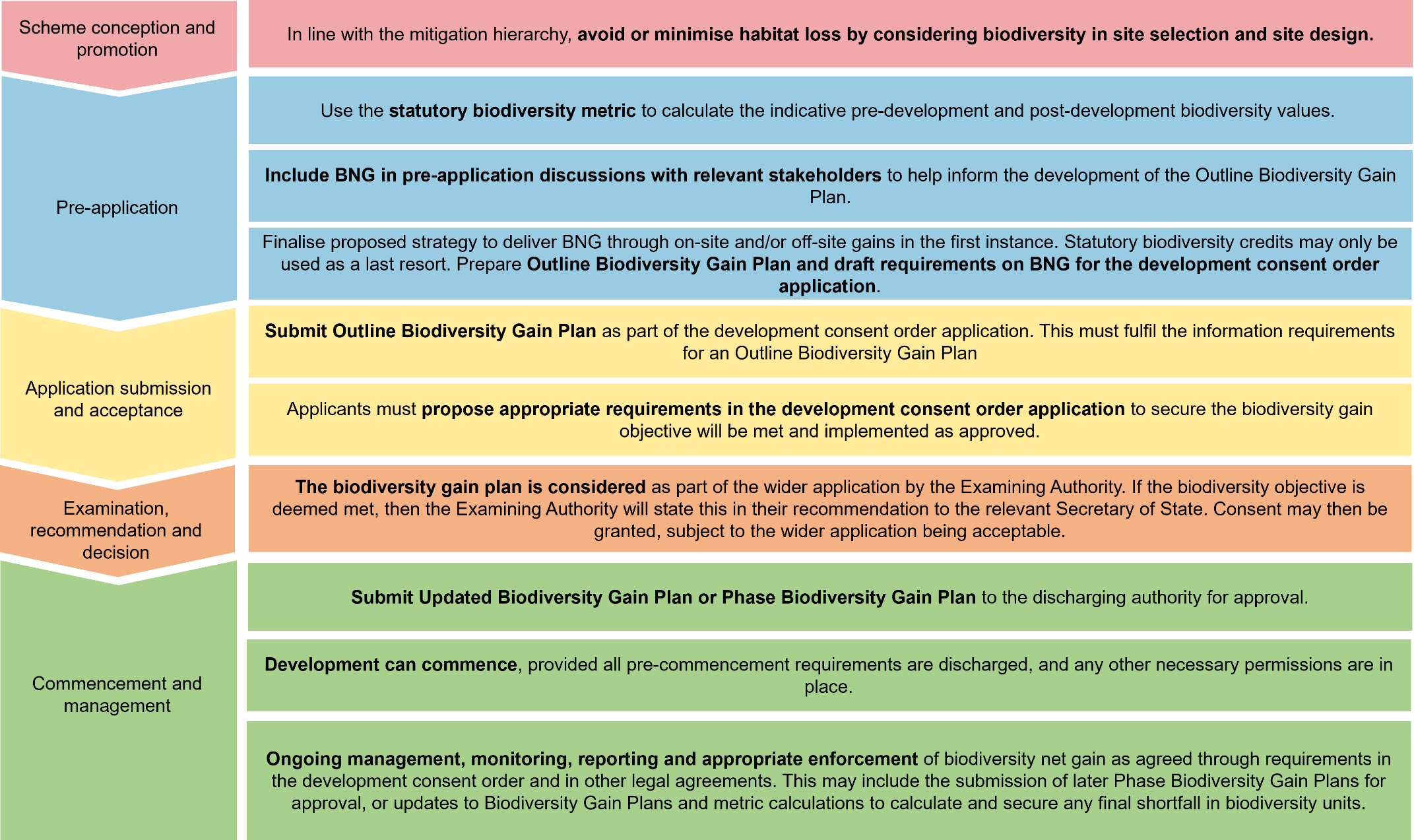
Despite the diversity of NSIPs, BNG will apply consistently across all project types, except for those in the marine environment beyond the intertidal zone and changes to DCOs that were not subject to mandatory BNG at the time of application. A timeline has also been published identifying how BNG will integrate into the NSIP process.
 [3]
[3]
The response document has confirmed that NSIPs will need to use the statutory biodiversity metric; it will be interesting to see how this works for large-scale projects where redesign and iteration is both essential and encouraged. However, it is encouraging to note the submission of an outline biodiversity gain plan for acceptance followed by an updated version post-consent as a positive way to balance upfront and strategic considerations of BNG against the need to preserve flexibility.
Further guidance will be published in due course on the criteria for an Inspector to confirm that biodiversity objectives can be met. Whether one or several updated BGPs and metrics might be required during the Examination isn’t yet clear, and likely to be decided on a case-by-case basis.
The response document also addresses the following:
-
The ability to use a ‘BNG boundary’ instead of the Order Limits for the BNG baseline which establishes proportionality and helps to preserve the utility of the Rochdale Envelope;
-
Temporary impacts do not need to be legally secured for the 30-year period, preserving temporary acquisition as a practical tool for developers and landowners;
-
The essential backstop of compulsory acquisition for BNG purposes is retained, reducing the potential for applicants needing high-distinctiveness habitats landing in a ‘ransom position’ in the unit market; and
-
On and off-site gains will be treated as equal, aligning with updates applying to minor developments (see Nuala’s
recent blog). We can expect significant private capital investment to the nascent unit market to support its ongoing use alongside this. Combined with the confirmed ability to site non-watercourse gains anywhere within the Order Limits, even transboundary projects could deliver landscape-level ‘deep and green’ intervention where it is most needed.
The delay of BNG roll-out for NSIPs to 2 November 2026 will allow careful consideration of the pending further guidance which will hopefully reduce risks to infrastructure providers. We hope that the guidance provides further clarity and gives applicants confidence on the following two issues:-
-
The Examining Authority’s approach to considering how an application has demonstrated early in the project that it has secured as many units “
as can reasonably be secured”
, while maintaining recognition that this will vary project to project; and
-
Where a BNG boundary is a more suitable approach for specific projects rather than the entire Order Limits - though the latter may
"demonstrate a more ambitious approach”, so that baseline standards for the BNG assessment are clear and achievable.
The consultation response demonstrates Defra’s commitment that mandatory BNG should work with the NSIP process to maximise its considerable potential for restoring habitats across the country. Being the largest projects undertaken in England, there is considerable opportunity for landscape-scale benefits from the new mandatory requirement. We welcome the emerging approach, which has responded to the sector’s needs for flexibility and iteration. However, it is clear that implementing it in practice will require early consideration, with consultation and input from ecologists, contractors, stakeholders and policy experts to achieve the best outcomes.
We look forward to more details in forthcoming separate guidance for applicants and decision-makers
to add to the existing National Policy Statements, to give some more clarity within the complex NSIP process. As these details emerge, Lichfields’ DCO experts and in-house BNG Team can help navigate the changes.
Footnotes