Manchester City Centre generated more than £1 billion in consumer spend and attracted over 40 million visits in 2025.
[1] A notable achievement, this milestone shows how regional city centres can continue to thrive and succeed by proactively rethinking town centres rather than waiting for a return of pre-pandemic or pre-digital activity.
Through previous Insights, Lichfields has explored how town and city centres are responding to change through diversification, reuse, repurposing and the introduction of a broader mix on the high street
[2]. Manchester is one of the clearest examples of that shift in practice. Rather than treating change as a temporary disruption, the city centre has increasingly promoted dynamic change as a model to drive interest and maintain activity.
Adapting from retail dominance
For many centres, the decline of traditional ‘bricks and mortar’ retail is still framed as a problem to be solved. In Manchester, however, it is increasingly clear that the city has already adapted to this shift by using diversification as an effective model across the city centre.
Traditional retail however still remains an important part of Manchester’s offer, with high profile openings such as Arc’teryx, Alo, and Represent, alongside the expansion of JD Sports unit in the Arndale Centre showing that there is still demand for well positioned physical retail. However, retail is no longer the sole organising principle of the city centre. Instead, Manchester now functions as a genuinely mixed use environment in which leisure, food and drink, culture, employment and residential uses all contribute to footfall, spend and vitality.
This shift is not accidental. It reflects a broader trend that we have tracked through our work at Lichfields, particularly in our
Out with the old, in with the new Insight.[3] The contraction in traditional retail demand appears structural rather than cyclical with online shopping, changing consumer expectations and new patterns of living and working redefining what town and city centres are for.
Manchester’s strength, therefore, lies not simply in outperforming the market, but in recognising how the market has changed and responding to that change more effectively than many other places.
Repurposing: from fallback to first choice
One of the most significant aspects of Manchester’s recent evolution is the extent to which repurposing is commonplace.
Former department stores and large retail units are no longer simply left vacant in the hope that demand will return. Instead, they are being rethought, subdivided and repositioned to attract new uses. Mixed-use redevelopment, change of use and reconfiguration have become active strategies rather than a last resort. Where major retail anchors such as Debenhams have fallen away, new combinations of office space, leisure and active ground-floor uses are beginning to redefine what prime city centre space can support.
On a smaller scale, our blogs on high street rental auctions have illustrated that individual units can attract the same flexibility, in principle whether for meanwhile uses or otherwise to keep units occupied and the high streets dynamic rather than vacant. Whilst not a feature in Manchester, the principle applies whereby the question is not how to recreate the past, but how to unlock a more viable future for underused space.
The growth of the experience economy is the clearest expression of the changing environment. Manchester City Centre no longer serves only the traditional shopping trips but functions as a destination for local, regional and increasingly wider visitor markets. Large former retail units have been repurposed for leisure and entertainment uses, including cinemas, bowling and other evening economy attractions, broadening the city centre’s appeal beyond conventional retail hours. Combined with the city’s wider strengths in sport, music and culture, this has helped to create a more diverse visitor economy that supports activity throughout the day and into the evening.
No Quarter
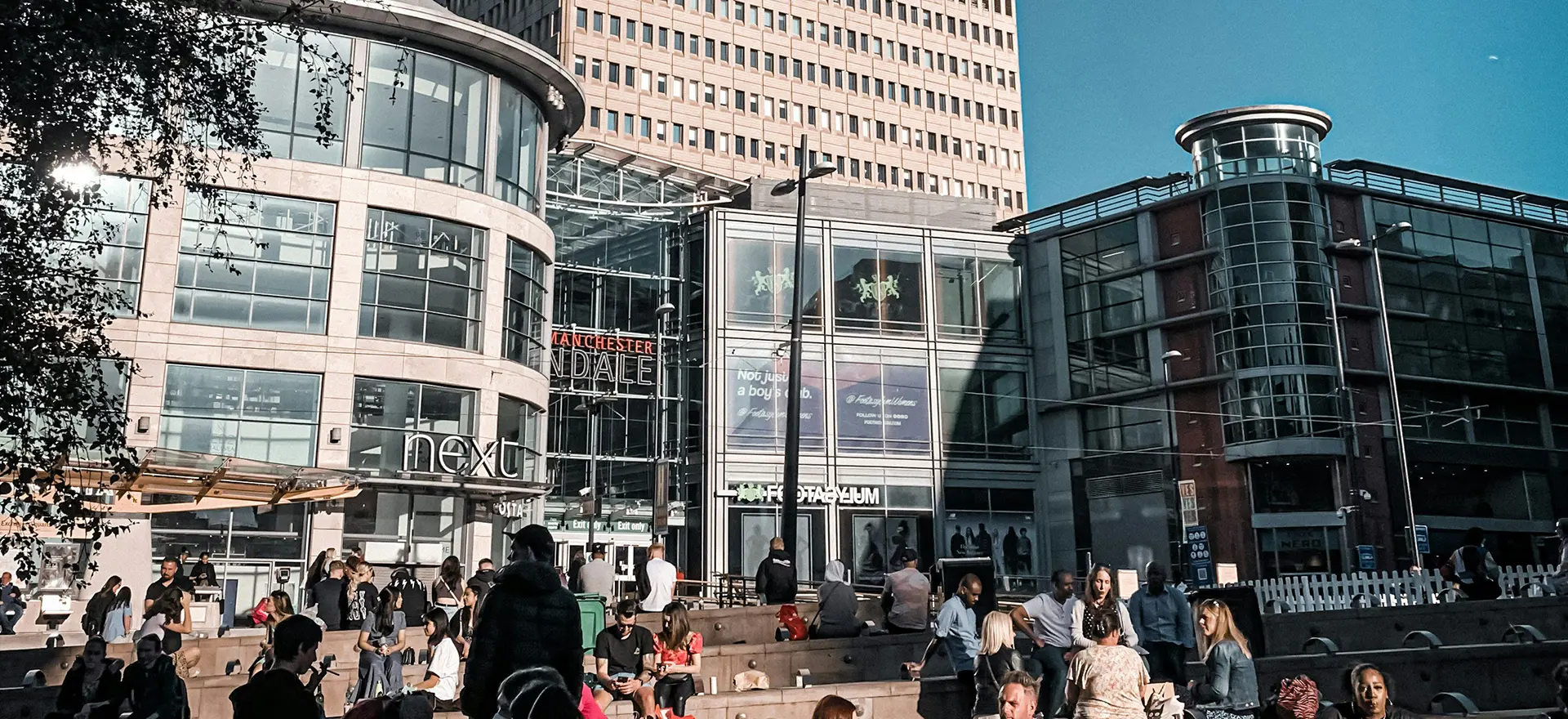
Manchester also benefits from having a series of recognisable and distinct city-centre districts, each with its own role and audience. The Arndale Centre and main shopping streets serve high street retail along with the growing leisure-led market. Areas such as Northern Quarter attract second-hand shops, record stores, cafes and bars, whilst Deansgate remains the epicentre of the city’s evening economy as well as an office hotspot attracting daytime footfall. Together, they create a centre with multiple identities rather than a homogeneous offer, fostering spatial diversification but also an agility to respond to trends and the preferences of varying consumers.
Variety and distinct quarters help to attract different visitor groups, supports more experimental forms of retail and leisure and contribute to the greater dynamism that sets Manchester apart from many competing centres. Manchester’s Core Strategy 2012 to 2027 (Policy CC1) has specifically sought to encourage and support defined areas of the City Centre and its fringes through planning policy.
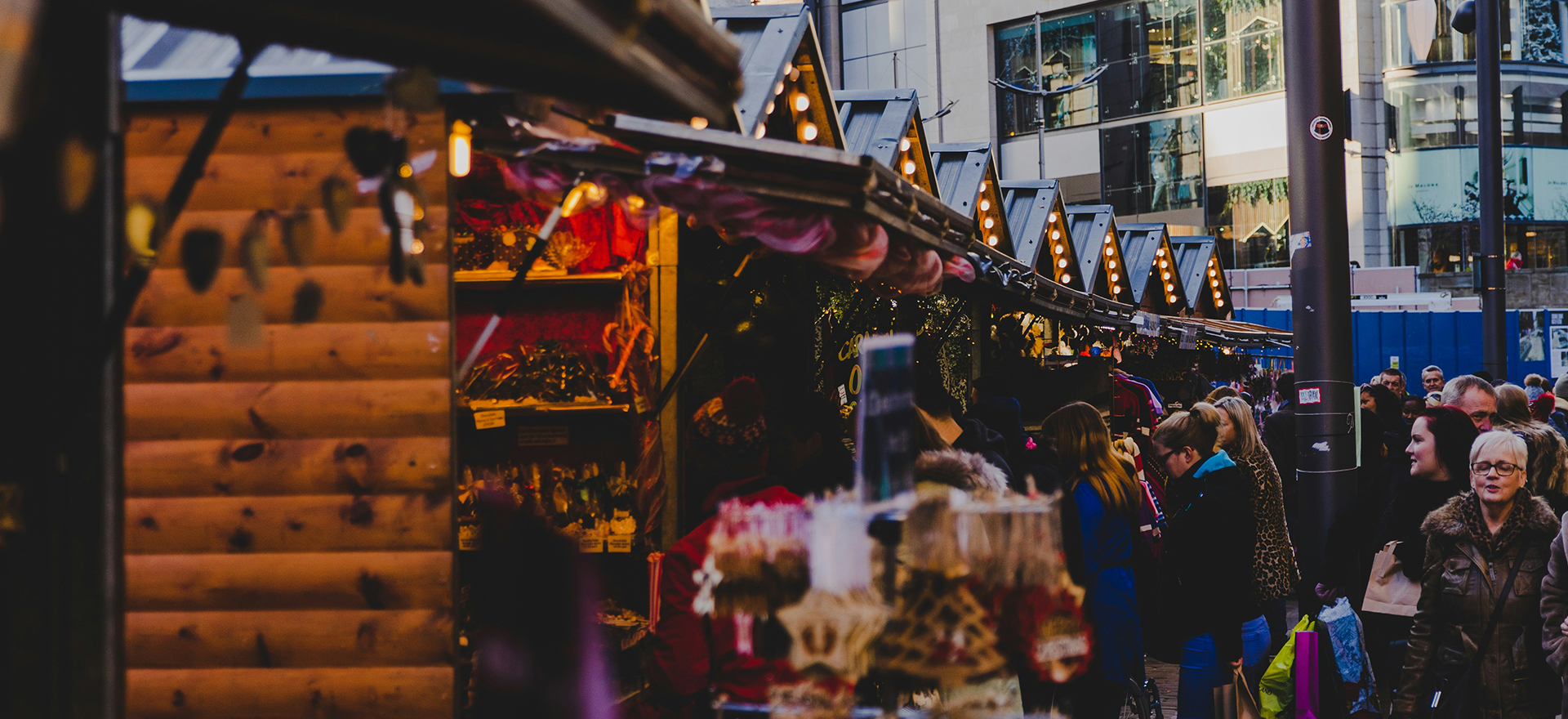
Whilst many of these areas have evolved organically over time, effective and active town centre management is also key to growth. Manchester City Centre Business Improvement District, led by CityCo and Manchester City Council, provides a practical example of town centre management in action with businesses collectively investing in additional services and initiatives focused on attracting and welcoming visitors, as well as improving the street environment. A regular programme of curated events throughout the year, including major seasonal and family-focused attractions such as Halloween in the City, the Manchester Christmas Parade and the Christmas Markets, all of which help generate repeat visits and sustain city centre footfall beyond routine shopping trips.
The creation of a dynamic centre with strong identities to attract a range of consumers throughout the year is essential but when realised through effective private and public investment.
Housing and employment are reinforcing city centre vitality
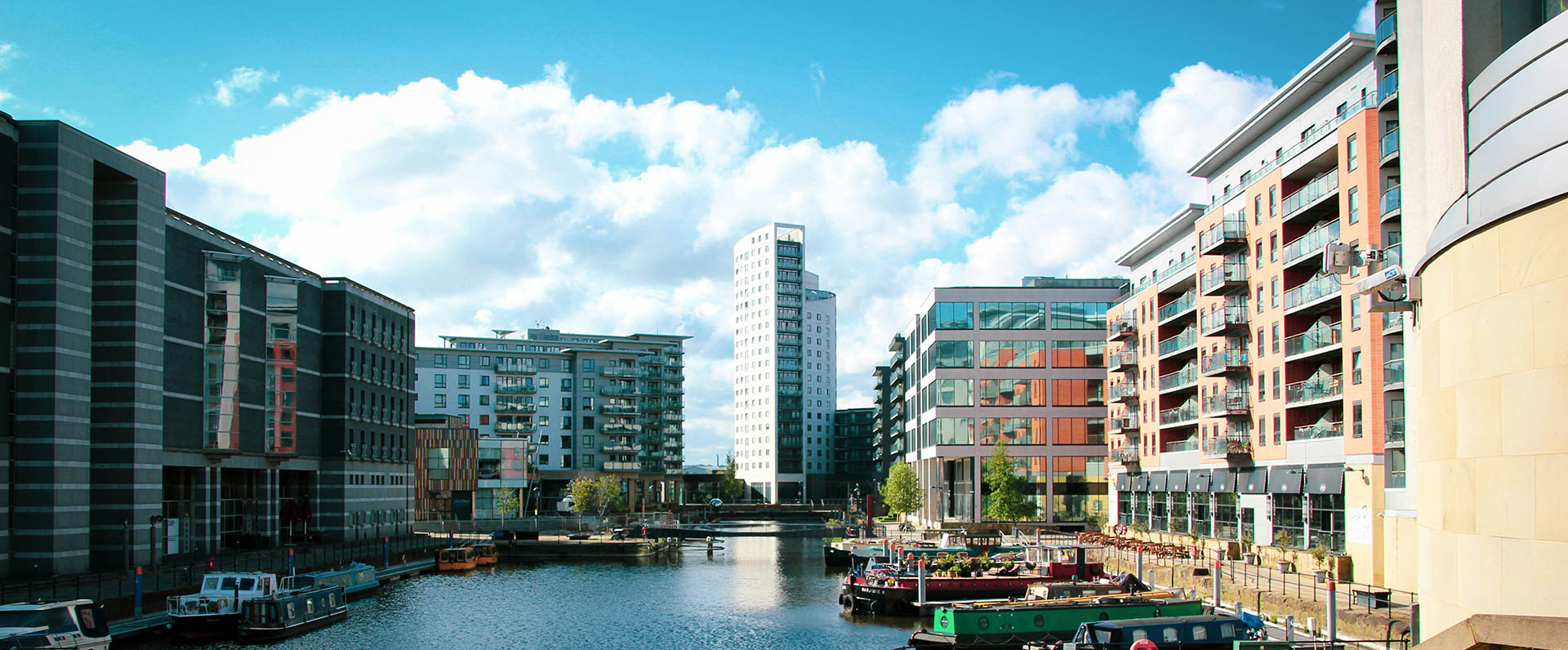
The city centre’s performance is also reinforced by sustained demand for both housing and office space. The everchanging Manchester’s skyline speaks for itself but its gains are felt at street level. By directing significant and strategic growth into the city centre, the city supports a larger resident and worker population whose presence underpins everyday spending, footfall and demand for services.
Manchester City Council’s State of the City Report establishes that the city centre population was now approaching 100,000 in 2023,
[4] reinforcing Lichfields’ emphasis on the marked rise of city-centre living has risen markedly over the past decade across England’s larger urban centres.
[5]Supported through its Core Strategy to deliver a minimum of 16,500 new units in the City Centre by 2027, Manchester City Council was an early mover in embracing large-scale city centre residential development and is now seeing the benefits of that model in supporting both retail and entertainment throughout the week.
The city also benefits from one of Europe’s largest student populations, fuelling further demand for housing, food and drink, leisure and helping to ultimately animate the centre through the day and evening.
In that sense, Manchester is not simply delivering homes and is building the critical mass of a population that many successful centres now depend upon. Resilient centres are not sustained by visitors alone but are strengthened by people who live and work there.
But how can the wider region respond?
Manchester should not be treated as an isolated success story. It is better understood as a case study in how regional city centres can respond to structural change. Therefore, the question is not whether other places can or should replicate Manchester but which of its underlying principles can be adapted to different local contexts.
Not all centres will be able to attract the same scale of investment, density or leisure offer or serve the same role as Manchester, but that does not dismiss the relevance of its trends. The key lesson is to apply the same broad principles of adaptation, diversification and proactive intervention, as reflected in our
Revitalise toolkit:
-
Support the traditional retail market where there is still demand but do so in a way that responds to local need, changing consumer behaviour and the wider role of the centre.
- Encourage the introduction of new high street uses, including food halls, leisure, health and other service-based activities that broaden the function of the centre.
- Embrace the repurposing of redundant retail space, including department stores and shopping centres, for housing, hotels, student accommodation, workspace or other viable long term uses and boost footfall.
- Use planning policy and public intervention proactively to shape regeneration and investment, whether through strategic frameworks, targeted town centre strategies or top down tools such as High Street Rental Auctions.
- Support growth through local identity and distinctiveness to diversify the offering of centres.
- Fostering a town and city centre population to support regular spending, footfall and demand for services.
Manchester’s billion pound year is not an outlier, but a clear demonstration of successful adaptation. Successful centres rarely evolve by accident and should be underpinned by planning policy that enables housing, offices, leisure, public realm and infrastructure improvements to come forward together, rather than as a purely retail destination. While few centres will match its scale, the real lesson lies in its approach in a willingness to diversify, repurpose and proactively redefine the role of the city centre for a changing future.