The Scottish election is now days away, and, as we set out in our
recent insight focus,
the (current) Scottish Government have declared a “Housing Emergency Action Plan” to address the challenge of dwindling housebuilding.
As we have grown used to, every political party's manifesto recognises as a political priority, that additional housing is urgently required, but each party offers different commitments and policy proposals to address the issue. These manifesto statements clearly serve as summaries of broader policy objectives, with more detailed information forthcoming from the successful party. However, they offer a valuable outline of each party’s main priorities and overall direction.
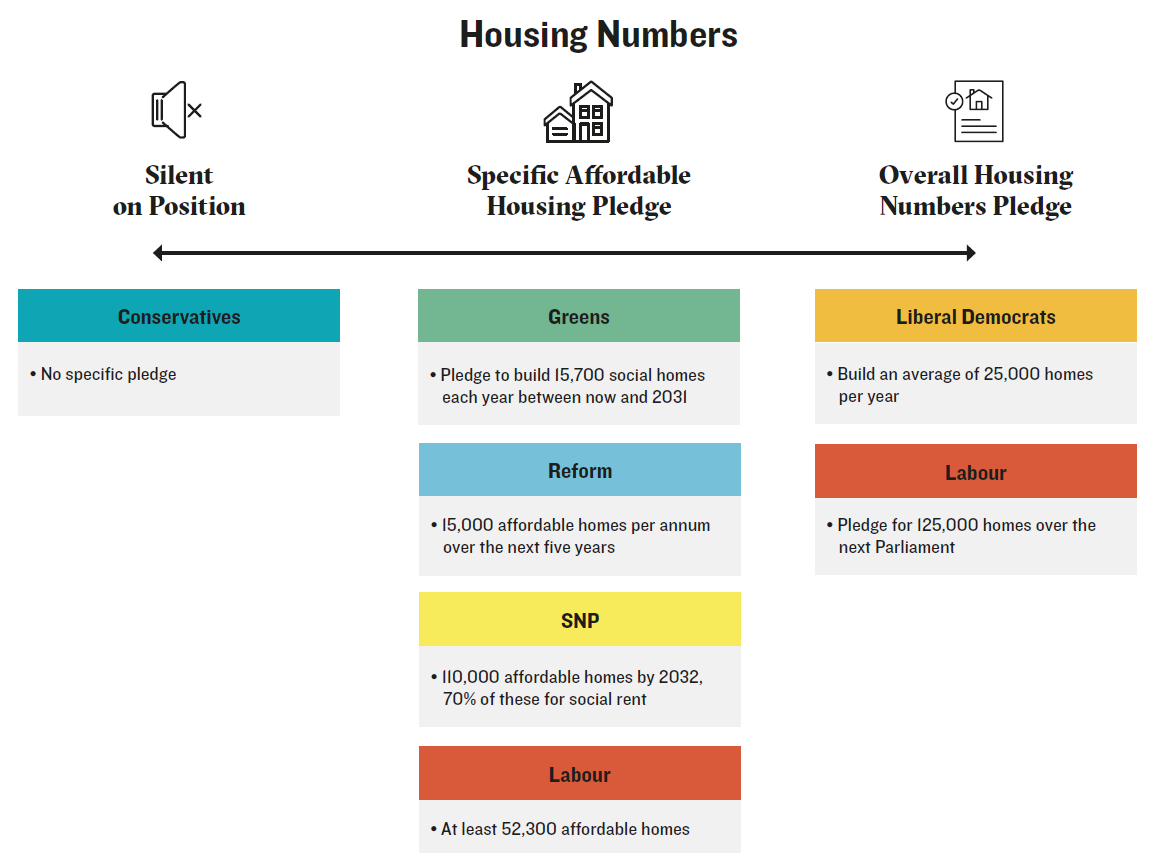
Only the Liberal Democrats and Labour have committed to an overall housing target, both pledging to build 125,000 homes over the next five years (requiring on average 25,000 per year, an increase of 60% from recent housing stats).
Four parties – including Labour – propose an affordable housing target, of which the SNP’s is the most ambitious, followed by Reform and the Green Party, which have set remarkably similar targets for parties whose other policies on housing diverge significantly. Labour’s pledge would assign just over 40 percent of their target as affordable housing.
Only the Conservatives have chosen not to set any form of housing target, banking on deregulation of national planning policy to deliver an increase in housing.
Recent announcements of the housing Emergency Action Plan and the (election pending) forthcoming new agency More Homes Scotland have been set out by the current government to meet these challenges. To achieve the manifesto pledges, Holyrood decision makers will also be looking to planning reform to do much of the heavy lifting.
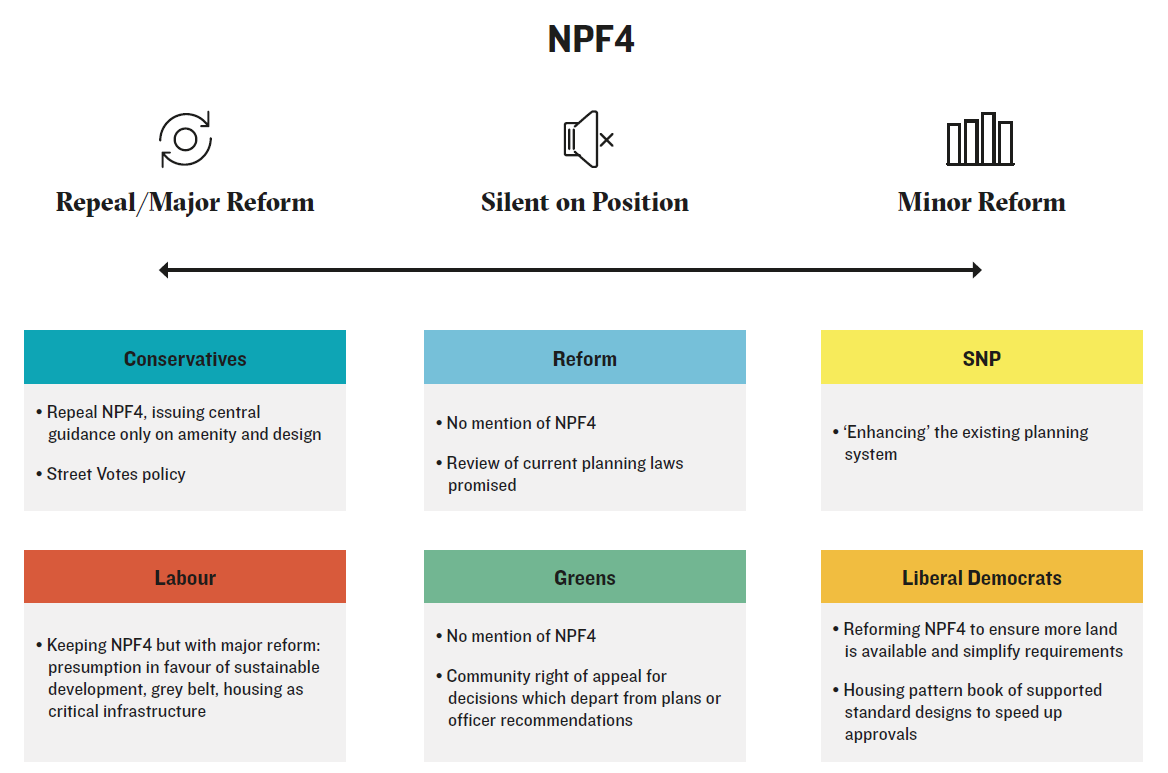
The Conservatives pledge to repeal the National Planning Framework 4 (NPF4, in force since February 2023), which is the most significant change to planning policy of all the parties’ manifestos. Central guidance would be issued only on amenities and design, leaving the remainder of planning policy to councils agreed through Street Votes modelled on those introduced (but not implemented) in the Levelling-up and Regeneration Act in England.
The Liberal Democrats share a focus on design, aiming to introduce a pattern book of pre-agreed standard housing designs which they hope would speed up approvals. They would keep the NPF4, however, pledging reforms to ensure ‘sufficient’ land is available to developers and reduce the level of pre-approval reports, particularly for SME builders.
Labour are promising further substantial reforms to NPF4, designed to make it a more positive, rules-based framework for development. Similar to Labour’s planning reforms in England after 2024, the presumption in favour of sustainable development would be reintroduced, and a ‘grey belt’ designation would be created, to allow development on sites which do not strongly serve green belt purposes.
Unsurprisingly, the SNP have vowed to enhance the existing planning system, which will need to address the current undersupply in affordable housing to meet the targets set out.
Reform and the Greens are silent on NPF4 and have chosen to focus on other planning matters, particularly the standards for new homes.
Reform and the Conservatives both argue that existing regulations, such as the New Build Heat Standard, which effectively bans oil and gas boilers in new-build homes and buildings, and upcoming net-zero targets for new housing, modelled on the Passivhaus standard and due to be implemented in 2028, form a major additional cost on housebuilding. They have therefore pledged to repeal these – Reform’s position as part of a wider position to repeal all net-zero related targets – and not to introduce any new building regulations in the next parliament. Labour has taken a more cautious position, promising a review of regulations that add costs to housing developments while also considering standardised building requirements.
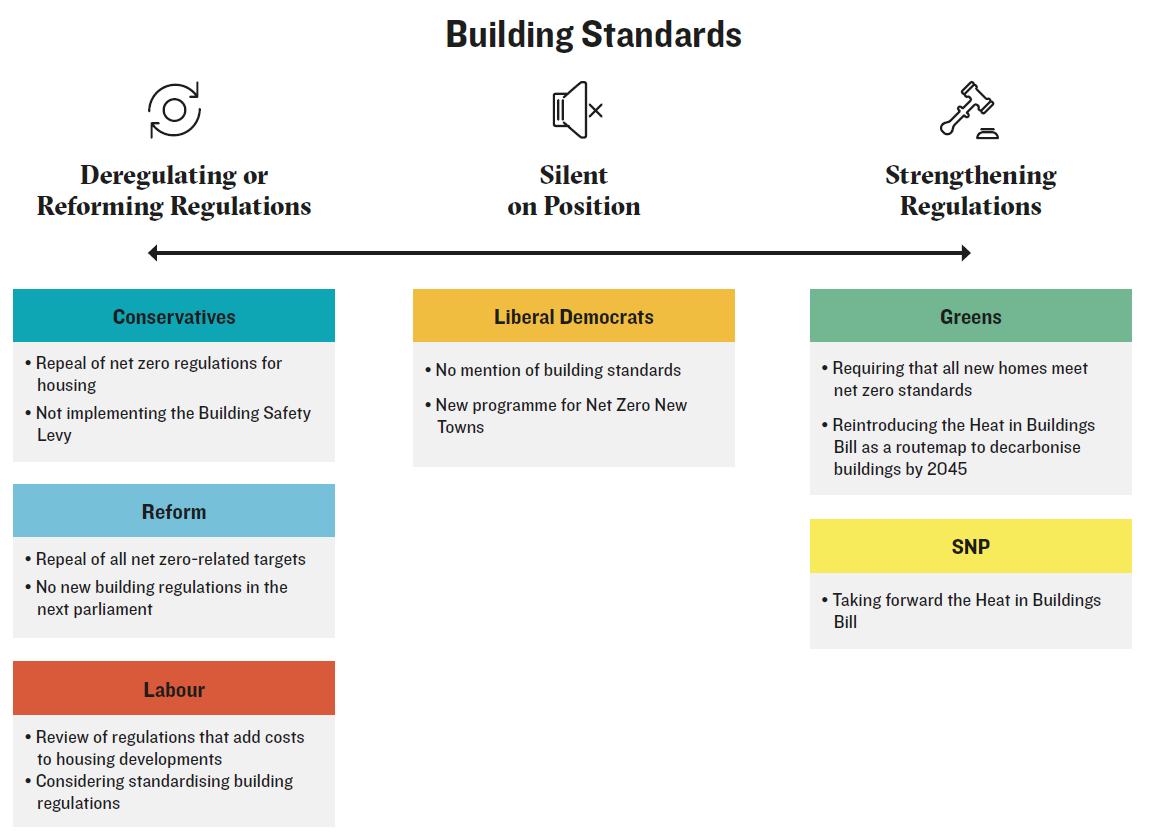
By contrast, the Greens and SNP have pledged to strengthen building regulations. The SNP will take forward the Heat in Buildings Bill, which was originally proposed in the previous parliament before being put on hold in response to consultation feedback. The bill will have a less ambitious scope than its original form, but will still set a target for decarbonising heating systems by 2045 and give ministers powers to set minimum energy efficiency standards for certain building types
[1]. The Greens have also pledged to take forward this bill, with an intention to decarbonise buildings by 2045.
A further issue in this election cycle has been approaches to rent control. The SNP introduced emergency rent caps in 2022 in response to the cost of living crisis, before making provision for permanent rent controls in the Housing (Scotland) Act 2025. Under this act, ministers have the power to designate rent control areas, in which rent increases for applicable properties will be capped
[2]. Under a future SNP government, the first rent control areas would likely be introduced, while the Greens have pledged to take rent controls further, scrapping the exemption made in April 2026 for build to rent and mid-market rent properties and restoring the emergency rent controls which expired in 2025.
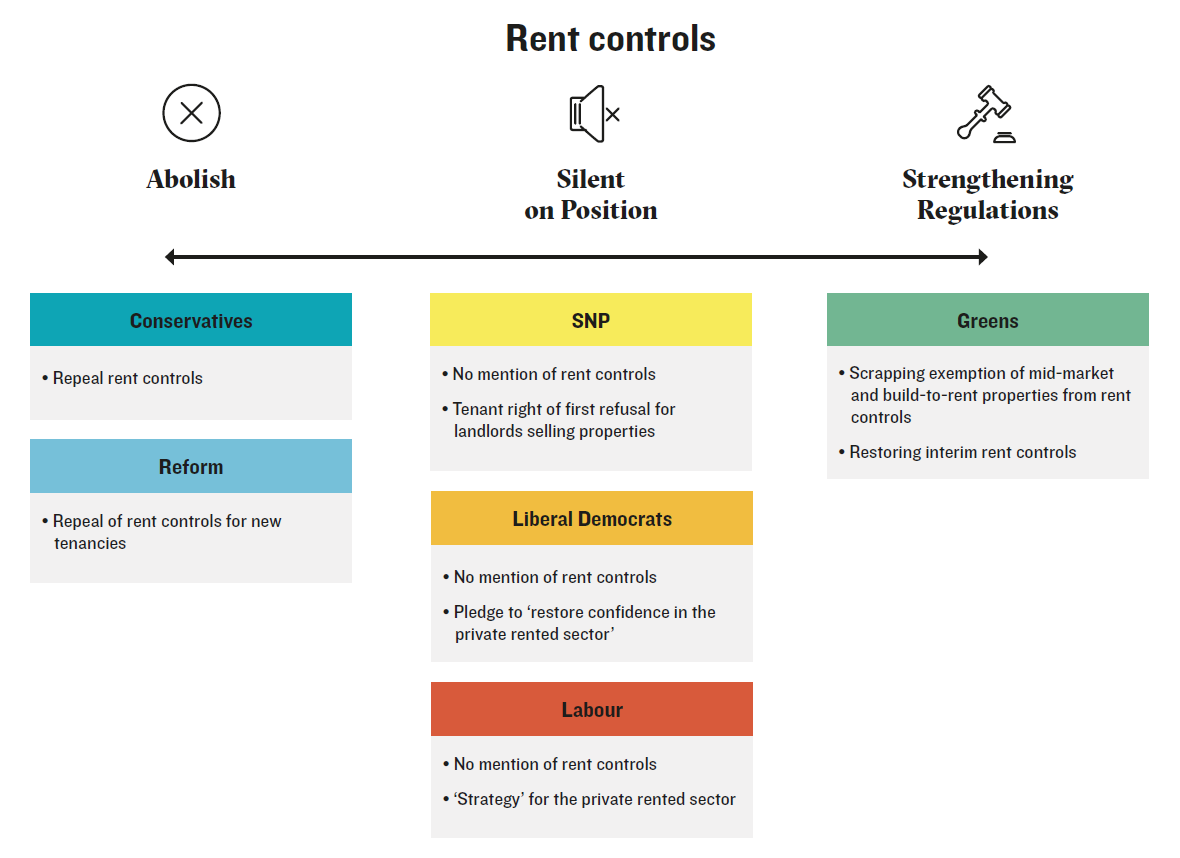
In contrast, the Conservatives have made the strongest opposition to rent controls, arguing that they have reduced housebuilding and promising to repeal them. Reform have also pledged to remove rent controls, but only for new tenancies, which would lead to a more gradual phase-out. Labour and the Liberal Democrats have not declared a position on this issue but have promised respectively a ‘strategy’ for and to ‘restore confidence’ to the private rented sector, which could suggest weakened or removed rent controls.
All parties have set out a suite of policy choices and targets within their manifestos to meet the significant housing and planning challenges facing Scotland. On taking office, whoever the ruling party is will face the same conditions whereby housebuilding of all types is (in the light of policy 16) falling drastically short of what is required and the dwindling number of homes granted planning permissions pointing to delivery worsening at least in the short term.
If the parties hope to meet their varying housing targets, and with it provide the homes and affordable homes required, a rapid and significant uptick in the number of homes being granted permission will be required. Changes will be necessary to encourage more allocations – or to allow development on non-allocated land – given the dwindling stock of allocations, as covered in Lichfields’ report
Misallocating growth?.Scotland’s rate of house building can ill afford business as usual, it is therefore encouraging that across the parties, housing and planning again seems to be high on the agenda.
Footnotes
[1] https://www.gov.scot/publications/heat-in-buildings-plans/
[2] To the Consumer Price Index (CPI) plus 1 percent, up to a maximum 6 percent.