The electricity grid is at the centre of the national economic debate. At the Labour Party Conference on 29 September, Andy Burnham identified high energy costs and grid connection delays as barriers to growth. He announced Great British Grid, a publicly owned body within Great British Energy, intended to invest alongside the private sector, increase competition and accelerate delivery.
Less than three weeks earlier, the National Audit Office (NAO) had published Upgrading the electricity transmission network, examining whether the network can expand quickly enough to support Clean Power 2030, rising demand and economic growth.
[2]Together, they describe the same national challenge. Britain has made remarkable progress in renewable generation. The next phase requires networks, connections, storage and wider infrastructure to be delivered at a comparable pace as part of a coordinated infrastructure programme.
From diagnosis to delivery
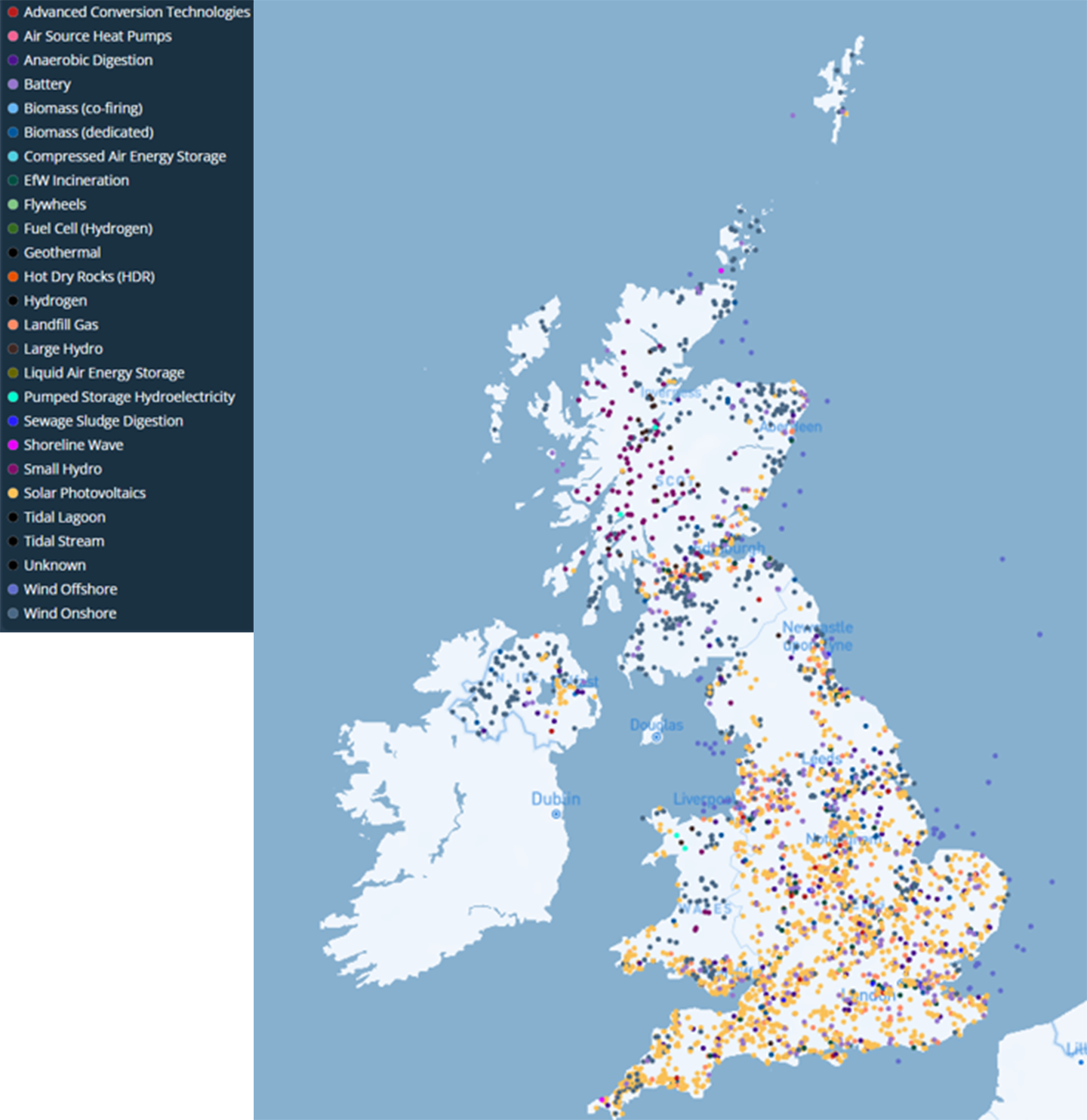
Britain’s electricity geography has been redrawn. In 2000, generation was concentrated around a relatively small number of large power stations. In 2026, offshore wind, solar and other sources are distributed much more widely across the country (Figure 1). At the same time, electrification is expected to increase demand from homes, transport and industry.
Built largely between the 1950s and 1970s for a more centralised system, the transmission network must now carry growing volumes over longer distances and in different directions. Ofgem estimates that up to £70 billion may be required to upgrade and maintain the network by March 2031.
Figure 1: Renewable energy projects in the UK - operational or under construction
Source: DESNZ Renewable Energy Planning Database
NESO identified 80 transmission projects as necessary for Clean Power 2030. By March 2026, 12 had been completed and 12 had been absorbed into newer projects, leaving 56 ongoing. Only 17 of those were in construction; the remaining 39 were still at earlier stages of development, planning and consenting. NESO also identified eight additional projects whose acceleration could further reduce constraint costs.
[2]The NAO found that most projects were forecast to complete later than the date NESO originally considered optimal, with four expected after 2030. It concluded that delivering the required programme by 2030 will be very challenging.
Why pace matters
When the network cannot transport electricity from where it is generated to where it is needed, NESO must intervene to keep the system secure. This can mean paying generators in constrained areas to reduce output and asking other generators closer to demand to increase theirs. This clearly is a highly inefficient way of managing our energy network and certainty not a sustainable long term solution.
Thermal constraint costs rose from £0.6 billion in 2018/19 to £1.9 billion in 2025/26. The NAO reports that they could reach up to £7.8 billion in 2030 if network upgrades do not keep pace with new generation. NESO’s estimate for 2030 rises to as much as £12.7 billion in a scenario without any further network upgrades.
[3]The issue is not that Britain has developed too much low carbon generation. Far from it. It is that network capacity has not expanded at the same pace. Closing that gap would enable more clean electricity to reach consumers and reduce the cost of managing congestion.
What Great British Grid could change
Great British Grid is intended to add public capital and delivery capacity. Network operators retain their roles, Ofgem remains the regulator and NESO the system operator and planner. The new body will be able to co-invest and compete for transmission projects as competitive tendering expands.
[4]The government also intends to widen self-build connections, allowing developers and businesses to construct their own where appropriate. If designed well, this could help projects constrained by connection lead times. At Lichfields, we see a number of our energy developer clients considering options that incorporate self-build primary substations into their generation schemes.
For planning, a new delivery body does not remove the need for land, consents or environmental assessment. Self-build infrastructure may still require permission, land rights and environmental evidence. Clear strategic direction will be essential if competition is to accelerate projects rather than fragment them.
The announcement is therefore best understood as an additional delivery mechanism. Its impact will depend on its remit, funding, access to skills and the quality of coordination with the organisations already responsible for the system.
Planning remains a critical dependency
The NAO gave its most serious red risk rating to planning and consenting and to connections reform. It noted that nationally significant infrastructure projects (NSIP) can take more than four years to gain consent, with similar timescales in Scotland. Compulsory land rights can add between 18 months and three years.
[2]New overhead lines, substations and associated works can have landscape, ecological and community effects. Speed cannot mean treating those impacts as incidental. Nor does a prolonged and unpredictable process necessarily produce better outcomes.
The Planning and Infrastructure Act 2025 has removed the statutory pre-application consultation duties for NSIPs, although applicants must still have regard to government guidance, and proportionate engagement will remain important to effective project development. The government has also confirmed its intention to increase the distance threshold at which qualifying overhead lines enter the development consent order regime and route more projects through the Electricity Act process, although implementing legislation is still required. These changes may reduce process time, but legislation alone will not deliver the programme.
Projects need a clear strategic case, mature routeing, a credible land strategy and coordinated environmental evidence. Decision makers need the people and expertise to assess them. Communities need a clear account of why infrastructure is required, the alternatives and how local impacts will be reduced.
Andy Burnham’s proposed stronger role for mayors and local leaders could connect national energy planning with place-based priorities. The test will be whether it produces earlier alignment on routes, investment and community benefit, rather than another decision-making layer.
Networks are not the only answer
Transmission reinforcement is indispensable, but the most efficient system will use several tools. Suitably located storage systems can absorb electricity and discharge it later, provide rapid flexibility and stability services, and help make better use of existing network capacity. Longer duration storage, interconnection, demand response and smarter operation also have important roles.
These technologies are complements, not substitutes. Planning and connections policy should enable each to contribute where it offers greatest system value.
This is also where decentralisation matters. A future system will combine large scale generation and transmission with more locally distributed generation, storage and flexible demand. The government’s Local Power Plan, which supports local and community energy projects, reflects that direction.
[5] Good spatial planning will need to consider how national and local infrastructure interact.
A strategic plan and a national effort
The NAO identifies the absence of an agreed spatial plan as a weakness in earlier investment decisions. The Strategic Spatial Energy Plan, expected in 2027, is intended to set out the broad location and timing of generation, storage and demand. A Centralised Strategic Network Plan will then identify the transmission investment required to support it.
These should explain what is needed, where and how projects fit together - improving investment decisions and allowing project-level consenting to focus on routeing, design, alternatives, cumulative effects and mitigation.
Skills were the most frequently reported significant project risk in the NAO’s sample, followed by supply chain constraints, planning and access to the live system. Britain is competing internationally for engineers, planners, equipment and construction capacity.
The energy transition was always going to require something close to a wartime mobilisation of capital, skills, planning and industrial capacity. The welcome change is that grid delivery is now being treated as a mainstream economic priority.
The prize remains substantial: greater energy security, reduced exposure to volatile international gas prices, lower system costs, skilled jobs and investment across the country, and the infrastructure needed to meet the UK’s climate commitments. Britain has abundant renewable resources and an established energy sector. Great British Grid, connections reform and strategic energy planning offer the ingredients of a stronger delivery model.
The next task is to make those parts work together - and to sustain the effort well beyond a single political announcement and a single Parliament.
Footnotes
[1] The Labour Party Andy Burnham’s speech to Labour Party Conference 2026, 29 September 2026
[2] National Audit Office Upgrading the electricity transmission network, 11 September 2026
[3] National Energy System Operator 2025 Annual Balancing Costs Report
[4] Department for Energy Security and Net Zero and Great British Energy Great British Grid to speed up connections and cut bills, 29 September 2026
[5] Department for Energy Security and Net Zero and Great British Energy Local Power Plan, Updated 18 February 2026
[6] HM Government Clean Power 2030 Action Plan