England is facing a catch-22 within education planning: pupil numbers are falling sharply across the country, yet new places funded by housing development increase at pace.
This blog explores why this contradiction is emerging, what it means for the school network, and how planning can help respond.
Why pupil numbers are falling
Total fertility rates have been on a downward trajectory for several decades, reaching record lows in recent years. These trends have a direct impact on school rolls. We saw how the temporary rise in births in the mid-2000s and early 2010s (coined the ‘mini baby boom’) created a short-lived ‘bulge’ in primary-age pupils. However, with the number of births falling since 2013, that bulge has now passed through the system and, with no equivalent cohort replacing it, the population attending primary school peaked in 2019, secondary school populations peaked in 2024/25, and recent projections suggest that the number of children in special educational needs (SEN) schools will peak in 2027/28.
Colleagues set out the early signals of this shift in London in their
blog in late 2024 and, consistent with London often acting as a bellwether for wider demographic change, similar patterns are now emerging nationwide.
What the national pipeline shows
National pupil projections published last month confirm that pupil numbers are continuing to fall, with an estimated drop of 473,000 nursery and primary pupils and 249,000 secondary pupils by 2030. This aligns with recently published regional forecasts
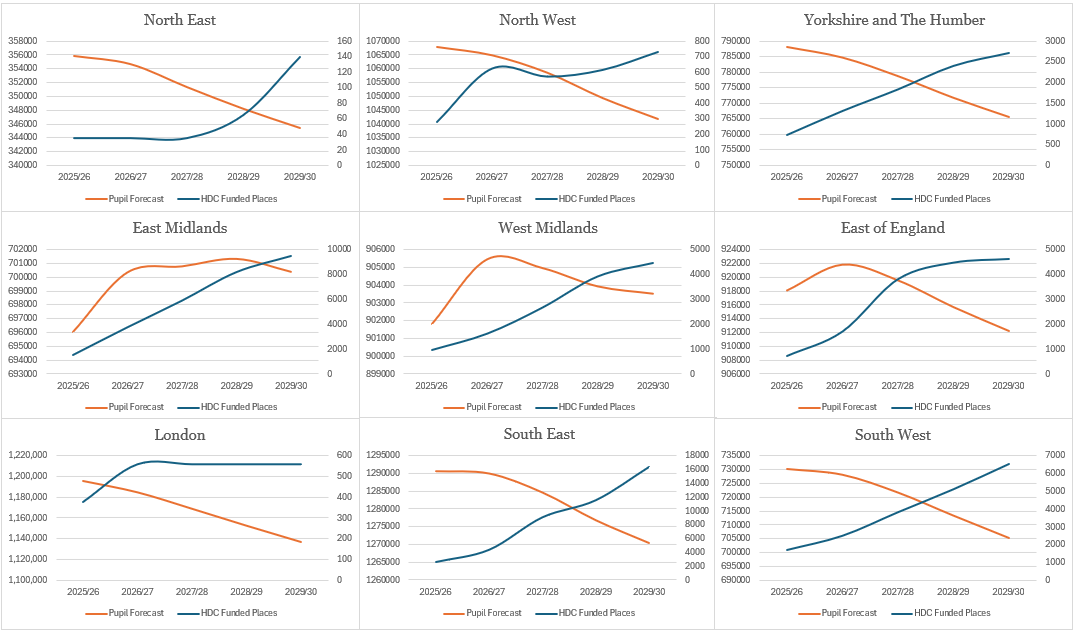
, which show that seven out of nine regions are expected to see a reduction in total pupil numbers over the same period. At the same time, the number of new school places funded through the Housing Developer Contributions (HDC) mechanism rises.
Projections of Pupils and HDC Funded Places across all nine regions between 2025-2030
Source: DFE, Lichfields Analysis
Across the regions, London experiences the most pronounced pupil decline, with the North East, North West, Yorkshire and The Humber, South East and South West also seeing steady downward trends.
It is notable that, in last year’s projections, the East of England, East Midlands and West Midlands were expected to experience sustained growth in pupil numbers, a trend that appeared to reflect a combination of London out-migration and international net migration
. However, the latest projections suggest this uplift is beginning to weaken, with pupil numbers in the West Midlands and East of England expected to peak in 2026/27 before declining, while growth in the East Midlands is starting to level off. This is particularly significant given that the latest national projections identify the recent 50% fall in long-term net migration as a key factor behind lower pupil forecasts
, suggesting that migration-driven growth may prove more temporary than previously anticipated.
Taken together, the data shows a clear disconnect between demographic projections and planned education provision. Pupil numbers are declining across most of England, yet investment in new school places through Housing Developer Contributions (HDC) continues to grow. But if this isn’t driven by demographic need, what is it driven by?
The influence of housing delivery
Across England, local authorities are bringing forward significant numbers of large, strategic housing allocations to respond to the UK government’s target to tackle the housing crisis through the delivery of 1.5m homes by 2029. While the location of these sites varies, a prominent number comprise edge of settlement locations (often referred to as ‘urban extensions’), where land availability makes large-scale delivery easier.
At these strategic sites, local authorities generate a pupil yield based on the size of homes provided. A proportion of these children will be of primary school age, and local policy generally requires that primary-aged pupils can access a school within a walkable distance. In many cases, the nearest existing schools (even where they have spare capacity) are either too far away or not safely accessible on foot. As a result, developers are required to help fund new provision through the Housing Developer Contributions (HDC) mechanism.
The effect of this is visible everywhere in the national dataset. Despite pupil numbers falling in every region, HDC-funded places are set to increase steadily in all nine English regions, including the ones with the steepest demographic decline (for example, the North East is seeing pupil numbers fall by 2.9% while HDC funded places grow 300%).
How might this impact the school network?
Creating new school places in anticipation of emerging communities is not always an issue. For example, the government’s proposed ‘New Towns’, projected to deliver a minimum of 10,000 homes each
, will undoubtedly need to deliver new schools to accommodate such a vast pupil yield. There are also strong opportunities here to plan well in advance to ensure that schools remain centrally located and easily accessible for residents from the outset. The challenge lies in how new provision interacts with the existing school network.
One such challenge relates to the long-term sustainability of new schools that are heavily reliant on the pupil yield generated by a single development or growth area. While the risk might not be present early on as rolls are filled by pent-up demand and the first phases of occupation, there is risk further into the future once those pupils have moved through the system. At that point, the school’s reliance on a relatively localised catchment makes it more vulnerable to ageing population and the wider housing lifecycle, and with limited pupils in surrounding areas to draw from, they can potentially become under-occupied over the longer term.
Conversely, as a large proportion of new family housing is now delivered on edge of settlement sites, the new schools in these locations can capture a large proportion of the settlement’s incoming pupils. This creates the risk that existing schools (which typically serve established villages and neighbourhoods with fewer young families and limited housing turnover) no longer receive the intake that has historically sustained their rolls. This reduction in demand can make them increasingly vulnerable to reduced admissions which lead to reduced funding and, in turn, potential closure. We are already seeing early signs of this emerging across authorities in the North East, and colleagues will be able to report similar pressures elsewhere in the country.
Rethinking how we plan school places
Newly appointed Prime Minister Andy Burnham has called for a "complete rethink" of how young people are supported through the education system. While the detail of any reforms remain to be seen, the challenges outlined in this blog suggest that school place planning may be one area in need of such a rethink. We have identified the following key opportunities:
-
Recognise that housing growth can be used to support existing schools: Housing growth should be viewed as part of the solution to falling school rolls. Supporting new family housing in settlements with underutilised school capacity, including many villages and smaller towns, can help sustain pupil numbers and support local facilities.
-
Make better use of existing school capacity: Councils should explore how the capacity of existing schools can be used before considering new provision. For instance, some mainstream schools have successfully introduced Special Educational Needs and Disabilities (SEND) units to respond to rising demand while reducing the need for separate new‑build facilities. This is a more sustainable solution to building new SEND schools when considering that SEN pupil forecasts are also set to drop later this decade. Equally, the Department for Education’s School Rebuilding Programme already delivers new and replacement schools, usually on a like-for-like basis in terms of pupil roll, and could be applied more flexibly.
-
Improve access to existing schools: Leverage S106/HDC funding for walking/cycling routes, crossings and improved bus routes to unlock existing capacity for those in edge of centre locations. This would complement wider sustainable travel objectives.
-
Assess net pupil demand at a system level, not site level: Replace site-based pupil yield formulas and focus on assessing net additional demand across the network. This should consider existing school capacity, active travel opportunities and longer-term demographic trends, while recognising that not every child living in a new development generates demand for an additional school place, particularly where households are relocating within the same local area and children continue to attend their existing schools.
-
Ensure new schools are justified by demonstrable need: New schools should be provided where assessments show that existing capacity and accessibility improvements cannot accommodate projected demand.
Closing thoughts
The current trajectory is concerning, and we need to seriously consider whether the school network we’re planning now will still make sense over the long term.
Housebuilding will play a vital role in boosting pupil yield, but we need to ensure that growth is supported in the right locations so it supports existing capacity and only delivers new schools where they’re genuinely needed.
Footnotes
ONS (2026)