The Government has made clear its ambition to deliver 1.5 million homes over the course of this Parliament. This commitment sits at the heart of its wider planning reform programme which includes revisions to the NPPF, housing targets, and accelerated decision-making processes.
Latest statistics published by MHCLG indicate that housing delivery has fallen some distance from this required trajectory. Housing supply in England amounted to 208,600 net additional dwellings in 2024/25, down 6% on 2023/24 delivery. Provisional estimates published alongside those figures indicate that 275,600 net additional homes were delivered between the start of Parliament in July 2024 and 9 November 2025, implying that delivery to date is running well behind the level needed and highlighting that it would need to rise very considerably above recent output if this target is to be achieved.
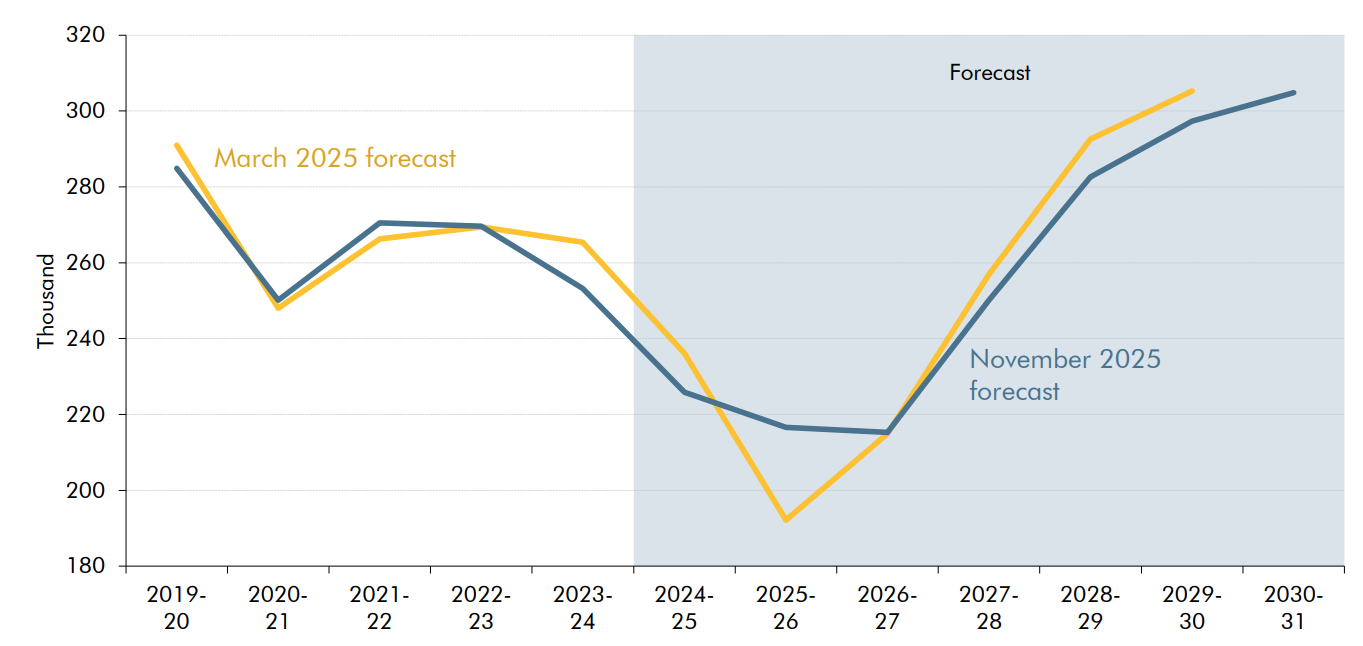
This weaker delivery is reinforced by Office for Budget Responsibility’s (OBR) November
2025 Economic and Fiscal Outlook, which revised down its housing forecast. Whilst the OBR projects housing delivery to rebound after a period of decline, the revised forecasting implies that that housing delivery will only exceed 300,000 dwellings in one year (2030/31). Indeed, the OBR forecasts imply the Government will deliver c.1.2 million homes over the Parliamentary term – a significant shortfall.
Figure 1: OBR Housing Market
Source: OBR Economic and Fiscal Outlook – November 2025 (2025)
The Viability Squeeze
The OBR point to shortages of viable sites in parts of the country as a constraint on supply. This view has been supported by 2025
research undertaken by the House Building Federation (HBF) which found that almost two-thirds (64%) of respondents identified viability pressures as a major barrier to housing delivery. The report also suggested that these pressures are no longer confined to particular regions, but are now being felt more widely across England, increasing the risk of development dampening in all parts of the country due to viability constraints.
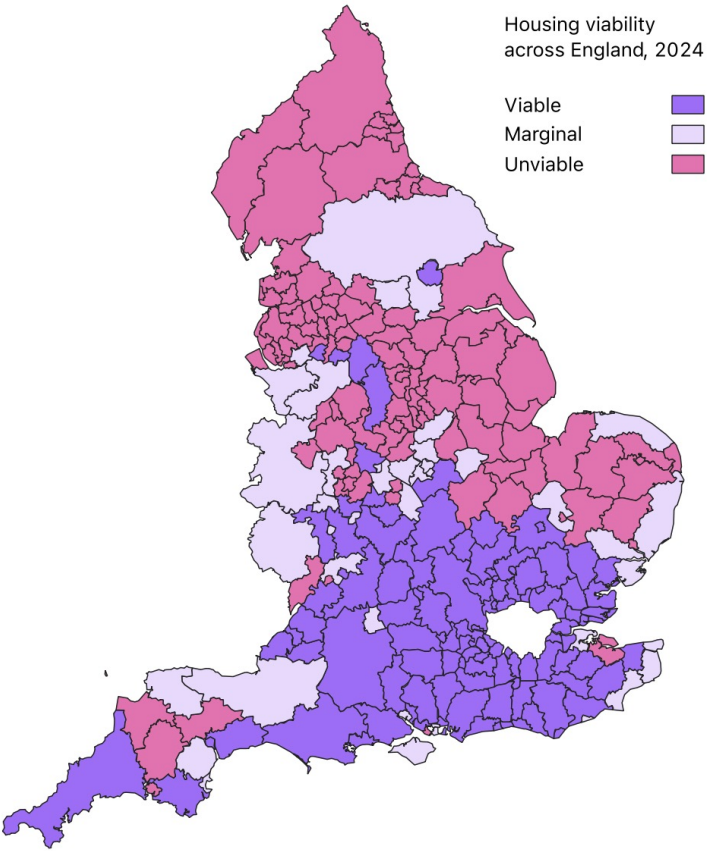
A similar position was identified
by Zoopla, which found in September 2025 that viability challenges affect almost two-thirds of local authority areas (64%) in England.
Figure 2 Housing Viability across England
Source: Zoopla Research – new homes viability model (2025)
These increasing viability pressures have stemmed from a number of factors, most notably including:
- Rising construction costs: An analysis of Building Cost Information Service (BCIS) build cost data and ONS sales price data highlights that build cost increases have outpaced sales values. Over the period Q3 2021 and Q3 2025 build costs increased by 21.8% whilst sales values grew by just 13.1% over the same period.
- Regulatory costs: recent changes have included more stringent building regulations, the introduction of Biodiversity Net Gain requirements in 2024 and ongoing nutrient neutrality requirements. going forward, additional policy and regulatory requirements, including the Future Homes Standard and Building Safety Levy will further increase the costs associated with the delivery of new housing.
- Tax increases: rises to national insurance contributions, corporation tax and landfill tax have all had an impact for housebuilders and add to the cost burden which impacts on the viability of development.
Analysis presented within the recently published HBF Viability Crunch report found that the construction of a hypothetical 90sqm low-rise dwelling now costs £76,000 more than in 2020. This is significantly above house price inflation over the same period.
Table 1: Additional costs for each new home
| |
Additional Costs (2025 compared to 2020)
|
|
Material and labour
|
£37,000
|
|
Future Homes Standards
|
£10,200
|
|
Building Regulations
|
£7,770
|
|
Nutrient neutrality
|
£7,000
|
|
Biodiversity Net Gain
|
£5,700
|
|
Landfill Tax
|
£2,000
|
|
Taxes
|
£2,055
|
|
S106 Inflation
|
£985
|
|
Building Safety Levy
|
£2,320
|
|
Total
|
£76,000
|
Source: HBF Viability Crunch (2026)
NPPF Consultation 2025: Viability Updates
Policy DM5 of the draft NPPF, which was published in December 2025, relates to development viability and builds on Paragraph 59 of the current NPPF. The accompanying consultation document sets out that the revisions seek to reduce cases of unnecessary site-specific viability assessment. Revisions to the wording appear somewhat at odds with growing issues of viability nationally as highlighted within this blog. Policy DM5 (2) speculates that:
“There may be limited circumstances in which it is not possible for development to proceed on a policy-compliant basis.” (Lichfields emphasis).
Policy DM5 provides some examples of the circumstances in which viability assessments may be justified to inform decision-making. These include:
- The development is significantly different from any typology assumed in the development plan viability assessment;
- Site characteristics differ substantially from the assumptions used to assess viability when the relevant development plan policies were prepared;
- The development is demonstrably burdened by costs which were unforeseen when the development plan was prepared; and/or
- Site or economic circumstances have changed significantly since the development plan was prepared.
It is noted, however, that this list of circumstances echoes that already set out in the Planning Practice Guidance at Reference ID10-008-20190509.
The new plan-making system underpinned by legislation in the Town and Country Planning (Local Planning) (England) Regulations 2026 sets out a requirement for the preparation of new Local Plans to be developed five-years after the previous plan is adopted.
The NPPF establishes at paragraph 59:
“Where development proposals accord with relevant up-to-date plan policies, they should be assumed to be viable.”
However, almost two-thirds (65%) of the Local Plan and CIL Viability studies assessed as part of Lichfields’ Fine Margins 2 study were more than five-years old (with a median age of 5.83 years). Whilst Local Plan viability assessments provide a helpful framework for understanding broad viability, they provide a point in time view and may therefore fail to reflect current economic and market conditions; they do not consider the costs associated with policy obligations emerging post-implementation.
As presented in the previous sections of this blog, housebuilding is an inherently fluid and dynamic industry which is sensitive to economic and policy changes. The economic, regulatory and tax landscape can change substantially in reasonably short timescales and affect development viability. Policy DM5, it seems, affords some flexibility to reflect this. Whilst the NPPF reiterates that the role for viability assessment remains primarily concerned at the plan-making stage, viability can and should be re-visited in instances where economic circumstances have shifted. It is expected that viability will continue to be subject to review at planning application stage and will inform discussions about potential deviation from policy requirements where viability constraints necessitate this.
Lichfields’ Fine Margins
The current and draft NPPF (and the PPG) solidify the need for accountability, consistency and transparency in viability assessments, stating that practitioners should clearly and reasonably justify their inputs and assumptions and make all information sources explicit within viability assessment.
As part of this, Annex B of the draft NPPF reaffirms that standardised inputs to viability assessments should be used to provide a consistent framework for evaluating development proposals and ensuring both authorities and developers have greater certainty in the viability assessment process.
Lichfields’ Fine Margins: Second Edition research draws on an analysis of 144 Local Plan and CIL Viability Studies to present and ascertain a sensible range of input assumptions across key metrics adopted within viability assessments. The study provides a comprehensive overview of the input values that can be utilised in development viability assessments.
The publication of the Fine Margins: Second Edition study provides a timely update in response to the proposed changes to viability as set out within the NPPF and considering the critical challenges of viability in housebuilding. To discuss how Lichfields can support with regard to development viability matters, please get in contact with Simon Coop (Senior Director) or myself.
Footnotes