London’s visitor and business economy relies on having the right hotel accommodation in the right places. National and strategic policy broadly supports hotel growth, but the position at borough level across London is more nuanced: our review found that 24 of the 34 London planning authorities assessed (71%) have a bespoke hotel or visitor accommodation policy.
We reveal growing policy support for hotel developments in the CAZ under the emerging draft London Plan, and at the local level, a varied policy landscape in which location, competing land uses and the quality of the proposed scheme can determine whether a planning application for a hotel is likely to succeed.
National and regional context
National policy supports hotel development as an important part of the visitor economy and a driver of economic growth. The Government’s ambition to attract 50 million international visitors a year by 2030 underlines the need for sufficient infrastructure and accommodation capacity. This direction is reflected in the National Planning Policy Framework (NPPF), which recognises tourism’s contribution to economic growth and encourages planning authorities to support sustainable visitor accommodation in appropriate locations. The NPPF classifies hotels and other visitor accommodation as main town-centre uses and promotes a town-centre-first approach, directing development towards town-centre and edge-of-centre locations where possible.
At a strategic level in the capital, the emerging London Plan places greater emphasis on supporting the capital’s visitor economy by providing additional hotel accommodation in well-connected, sustainable locations. The draft policy approach recognises tourism as a major contributor to London’s economy and seeks to secure sufficient hotel capacity while balancing impacts on housing delivery and local communities. It gives particular support to locations within the CAZ, town centres, high streets and locations with good public transport links (see box below); reflecting the wider objective of accommodating economic growth in a sustainable manner.
| |
The next London Plan – Draft Policy GLE6 Visitor infrastructure
… “Development of serviced visitor accommodation should be supported in the CAZ, town centres and high streets. Elsewhere in London, serviced visitor accommodation development should only be supported in locations that are well-connected by public transport and in line with the national sequential test for town centre uses”…
|
|
Central London - growing support for larger hotels within all areas of the CAZ
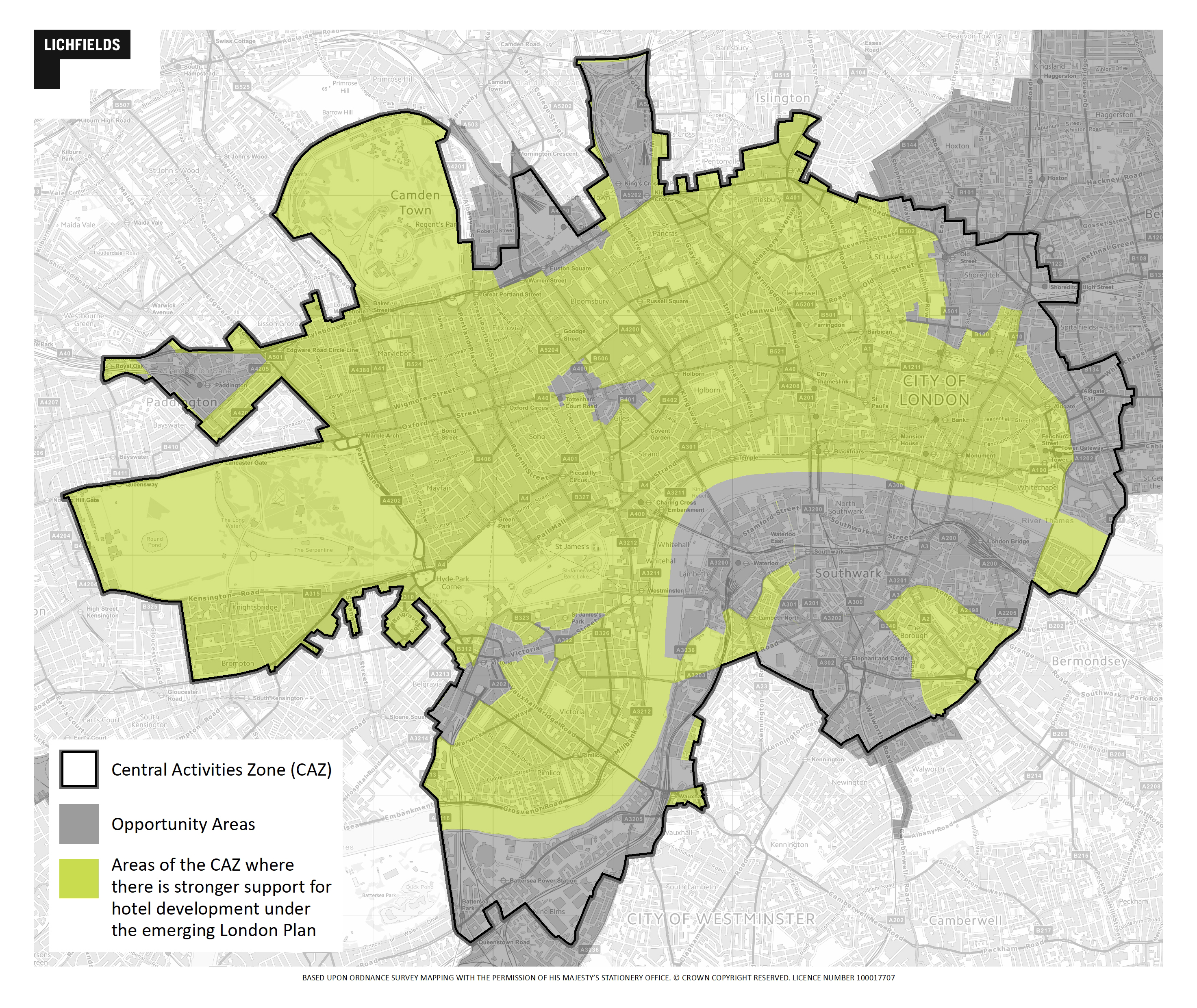
Under adopted London Plan policy, ‘strategically significant’ hotels over 20,000sqm in the CAZ (Central Activity Zone) are directed to Opportunity Areas, with the intensification of hotels of all sizes resisted where it would harm amenity or upset land-use balance. In comparison the draft London Plan moves away from this tightly controlled CAZ and size-based approach, supporting the development of serviced visitor accommodation (of all sizes) across all areas of the CAZ.
Figure 1 illustrates the Opportunity Areas within the CAZ where current London Plan policy directs significant hotel development (grey) and the expanded wider areas of the CAZ where the principle of hotel development is afforded greater support under the draft London Plan (green).
Figure 1: Central Activities Zone (CAZ)
London boroughs and the local policy picture
The demand for, and delivery of, new hotels in London is not just limited to Central London and the CAZ. Outside of the CAZ we are seeing increased interest in the delivery of new hotels across Inner and Outer London boroughs. It is important to understand how Local Plans seek to control proposals for new hotels and the specific policy nuances that apply in each borough. As such, we have undertaken a detailed review of each borough’s local policy regarding hotels and visitor accommodation.
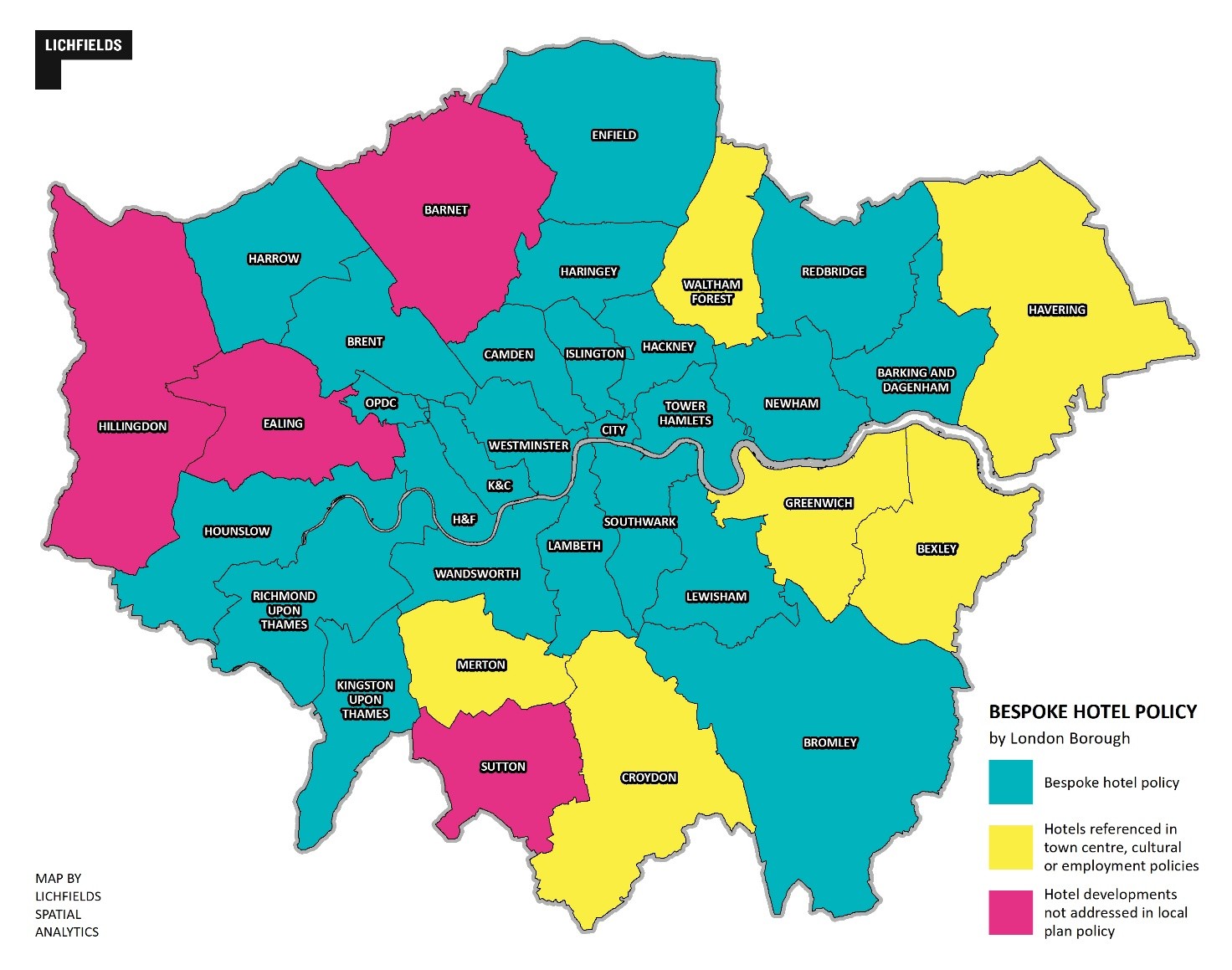
Of the 34 London planning authorities reviewed (32 London boroughs, the City of London and the OPDC), 24 (71%) have a bespoke hotel or visitor accommodation policy. A further six (18%) address hotels through overarching town-centre, tourism or employment policies. Bespoke policy coverage is therefore established and widespread: hotels are rarely treated simply as an ordinary commercial use.
Figure 2: Local Plan approaches to hotel policy
As is illustrated by figure 2, the boroughs without a separate hotel policy (or where hotel development is addressed through wider town-centre, employment or cultural policies) are all located in outer London (Barnet, Ealing, Hillingdon, Merton, Sutton, Croydon, Greenwich, Bexley, Havering and Waltham Forest). All inner London boroughs and the remaining outer London boroughs have bespoke hotel policies. This includes areas containing major visitor attractions or significant transport hubs, which may generate particular development pressures requiring a dedicated policy response.
Principle of hotel development and locational requirements
Our research found that, at the borough level, hotel development is generally supported in Local Plans where it is appropriately located. Policies frequently direct hotel development towards:
-
Town centres
-
Areas with high PTAL or strong public transport accessibility
-
Opportunity Areas
-
In some cases, the Central Activities Zone (CAZ) or locations close to specific visitor attractions or transport hubs
Hover over the authority name in the map below for additional locational criteria.
Figure 3: Local Plan variations in locational criteria for hotel development
As can be seen from Figure 3, locational requirements vary significantly between boroughs. Some Local Plans identify specific growth areas, attractions or venues where hotel development will be supported. Other boroughs direct hotels towards town centres but still allow proposals in specified (or, in some cases, more general) locations outside of town centres where defined criteria are met.
We anticipate that the wider locational support for hotel development suggested by the draft London Plan will begin to be applied to individual boroughs with greater standardisation of policy by borough as local plans conform with the London Plan. In the meantime, the picture remains mixed and Local Plan specific.
Additional policy tests
Although Local Plan policies generally support hotel uses, a significant number of boroughs apply one or more additional tests that hotel developments must satisfy. These tests are intended to ensure that proposals are fully justified, do not displace priority land uses (most commonly C3 housing) and they do not contribute to an overconcentration of hotels:
-
41% prioritise and protect other uses, such as housing or office space before hotel uses are accepted;
-
15% require applicants to demonstrate evidenced need for hotel development;
-
12% seek to limit an overconcentration of hotels; and
-
62% detail specific additional design considerations for hotel developments, including accessibility requirements, amenity standards, servicing strategies and/or active frontages.
The distribution of these considerations across different boroughs is illustrated in the plans below.
The protection of housing and other uses is a common issue in local hotel policy. Many boroughs require applicants either to demonstrate that there will be no net loss of homes or to show that hotel development will not compromise land needed for new housing, including on allocated sites and sites with residential planning permission. Given the GLA’s and boroughs’ focus on housing delivery, this can be a significant barrier where a site is also suitable for residential use, particularly when that potential is identified in the Local Plan.
Employment uses receive less explicit protection in bespoke hotel policies, but they are often protected through other employment Local Plan policies covering employment land. Where a proposal would convert an office or other commercial site to a hotel, a key hurdle can be demonstrating that there is insufficient demand for the existing office use (typically through marketing evidence) and clearly explaining the hotel’s local employment benefits.
Presenting clear evidence of the need for hotel accommodation is cited in local plan policy by a number of authorities, including the inner London Boroughs of Hackney, Tower Hamlets and Lewisham, which are often attractive locations for operators. In such locations, Lichfields' newly launched ‘Accommodate’ toolkit can be used to help demonstrate the need and demand for new hotels, support investment in existing assets, or assess the loss of existing stock.
Design & operational considerations
Finally, our analysis identified several recurring design themes within hotel policies. As identified above, 62% of boroughs expect hotel schemes to address one or more of these matters, identifying them as the key design considerations for hotel development:
- Access and servicing – provide safe, convenient access for guests, staff, deliveries and servicing, with clear arrangements for vehicles (sometimes coaches), taxis, cycles, waste collection and loading that minimise impacts on surrounding streets and neighbouring uses.
- Amenity standards – protect the living conditions of neighbouring occupiers and provide a good environment for guests by managing noise, privacy, overlooking, lighting, hours of operation and the effects of plant and equipment.
- Accessibility – embed inclusive design throughout the building and its approaches, including step-free access, accessible shared facilities and the often-stated requirement for 10% wheelchair-adaptable accommodation.
- Active frontage – create an attractive and welcoming street presence through well-designed entrances, transparent and animated ground-floor uses, and layouts that contribute to natural surveillance and the vitality of the surrounding area.
Five boroughs (15%) also require ancillary amenities and facilities within hotel developments to be available for wider public use. In Southwark, for example, 10% of a hotel development’s floorspace must provide ancillary facilities for public use and employment. Lambeth and Newham similarly expect leisure facilities to be accessible to non-hotel visitors. These requirements can introduce additional operational and management considerations for hotel schemes.
What does this mean for your hotel development?
For developers, the key message is that London remains supportive of hotel growth, but the prospect of a successful planning outcome is heavily dependent on identifying the right site and understanding and addressing borough-specific policy requirements from the outset. Proposals are most likely to succeed in town centres, the CAZ, Opportunity Areas and other locations with strong public transport accessibility.
Our key takeaway messages are:
- Test the location early: confirm whether the borough directs hotels to particular local centres, growth areas or transport-accessible locations, and establish whether a sequential assessment is needed and, if so, whether that assessment will present compelling evidence.
- Address competing land uses: demonstrate that the scheme will not displace existing or planned housing, undermine employment land or conflict with other protected uses. A period of marketing evidence or an assessment of local demand may be required where an existing commercial use would be lost.
- Build the evidence base: where relevant, provide a robust assessment of hotel need, ensure the hotel scheme is differentiated from other existing/emerging hotels, and explain why the proposal would not result in overconcentration of visitor accommodation.
- Design for operation as well as appearance: resolve access, servicing, deliveries, waste, noise, lighting, inclusive access and active frontage requirements at an early stage. Public access to ancillary facilities may also be expected in some boroughs.
Conclusion
London’s policy framework is positive about the development of new hotels and visitor accommodation, but support is neither uniform nor unconditional. The strongest prospects are in accessible, well-connected locations where a proposal complements and strengthens town-centre activity or a recognised growth area. Applicants must show that schemes will not undermine housing or employment priorities, and they will not contribute to an overconcentration of hotels or fall short on design and operational matters.
Early policy analysis is essential. Understanding the borough-specific position, and responding clearly to its location, land-use and design requirements, can help identify risks, shape a stronger proposal and build a more persuasive planning case for development.
Please do get in touch if you would like to discuss your hotel and visitor accommodation projects in London with our team.