The GLA has published a new London View Management Framework (LVMF) which is out for consultation until 4 December 2026. It provides guidance on managing change within London’s strategic views.
Presented in a more accessible A3 format, the draft LVMF represents an evolution of the 2012 guidance rather than a wholesale change. The overall approach to protecting London’s strategic views remains familiar but includes much needed updated photography, introduces images with clear identification of Grade I and II* heritage assets and clear explanation of the components. The view numbering remains the same but with revised view types comprising Panoramas, Static and Kinetic views replacing the current Linear Views, Townscape Views, River Prospects and London Panoramas.
The focus remains the protection of London’s Strategically Important Landmarks (St Paul’s Cathedral and the Palace of Westminster, Tower of London and Maritime Greenwich World Heritage Sites) as well as views along and across the River. There is strengthened protection through increased use of Protected Silhouettes and the introduction of kinetic views and a number of changes to assessment points and paths at some Viewing Locations. Updated visual management guidance is provided for each view, including additional specific guidance on kinetic views, as well as some overarching advice on each view type.
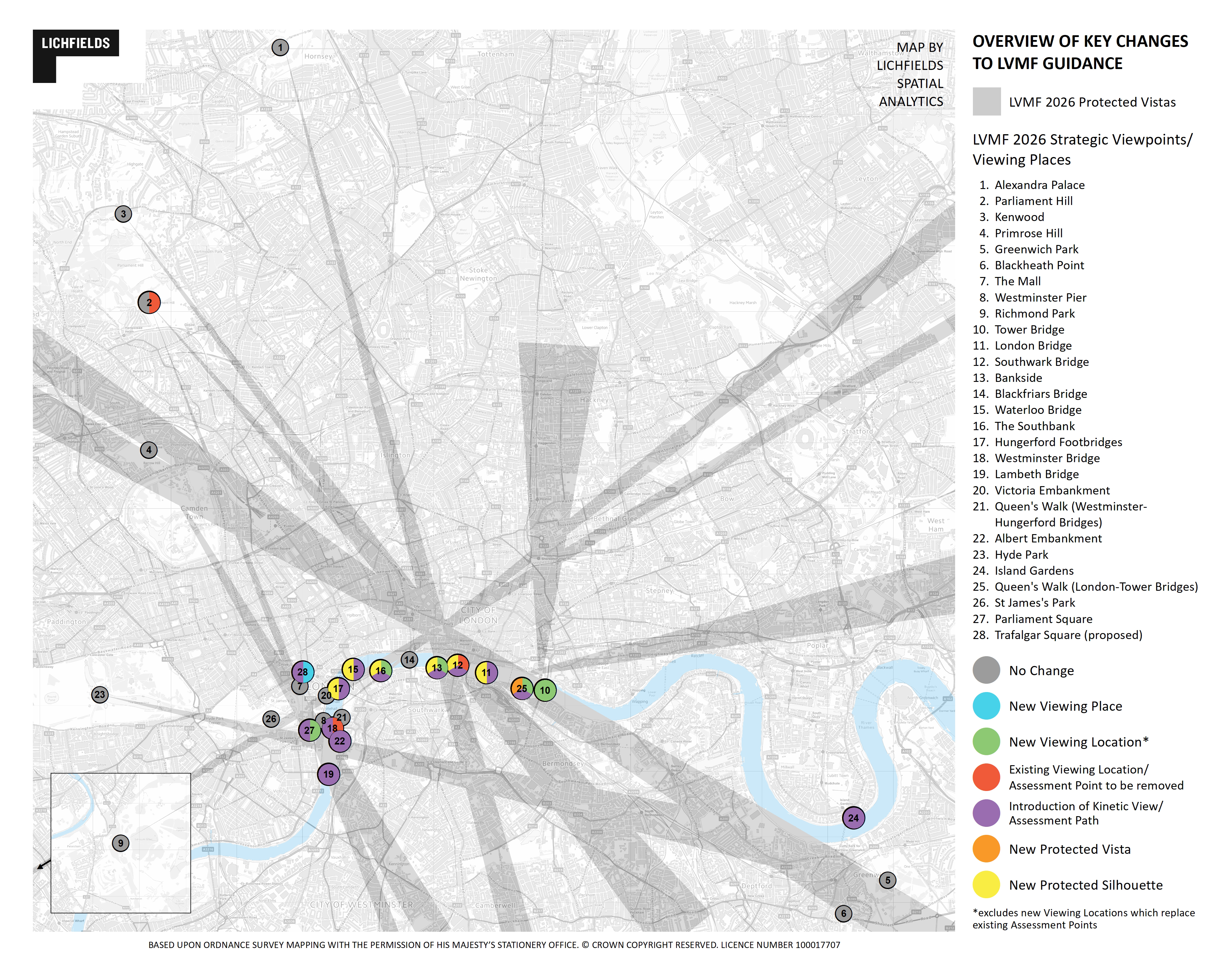
The main headline points that we think are worth being aware of are summarised below and shown on the attached map:
Changes to Protected Vistas
The location of the Protected Vistas and their Viewing Corridors remains largely the same, save for the proposed removal of view 2B.1 from Parliament Hill (towards the Palace of Westminster), although consultation on sites within the background consultation area will be continue to be required until adoption of the emerging draft London Plan.
An additional Assessment Point with a Protected Vista (25B) has been included at View 25 (renamed The Queens Walk between London and Tower Bridges), from further upstream, around the site of Old London Bridge looking towards the Tower of London. Proposals for developments that exceed the threshold heights in this new Protected Vista will also need to be assessed, if visible, once it comes into effect.
The updated LVMF formalises the extension to the background consultation areas of the Protected Vistas. This will require tall buildings that exceed the threshold in these zones, including parts of outer London to be tested/ assessed. Consultation on developments falling within these extended background areas has been informally requested by the GLA as long ago as 2017, when the Manhattan Loft scheme appeared in the view of St Paul’s Cathedral from Richmond Park, and this update should help to provide greater certainty and clarity on when assessment is needed.
The Wider Setting Consultation Area has been split into Lateral Assessment Areas (either side of the Protected Vista) and the Background Consultation Area (the area beyond the landmark). These have been altered to respond to the effects of differing topography in some views of St Pauls and the Tower of London with a stepped plane being introduced in places. Detailed technical guidance is provided to enable a calculation of whether sites breach the threshold heights as per the current version, although further 3D imagery to show how these work would be helpful.
New Strategic View from Trafalgar Square
A new strategic view is proposed from Trafalgar Square (View 28A) to protect the view of the three towers of the Palace of Westminster. As the draft guidance covers both adopted and emerging versions of the London Plan, this additional strategic view will only come into force when the draft London Plan is adopted.
Expanded use of Protected Silhouettes
More Protected Silhouettes are proposed to apply to Assessment Points and Paths where Strategically Important Landmarks are seen against the sky to maintain their distinctive skyline profile. This now includes 8 views towards St Paul’s Cathedral from the River Thames in addition to the Tower of London, Palace of Westminster and Maritime Greenwich. Protected Silhouettes have been added to several existing Viewing Locations. This, combined with the alterations to the Assessment Points and Paths, will increase the extent to which careful scoping of visual assessments for developments within London will be required.
Where development is seen but would be appropriately separated from the Protected Silhouette, guidance is provided on the clustering of tall buildings and gradation in height that will be expected. This is clear and helpful guidance, but will require an understanding of the effects on LVMF views at an early stage before height and massing are ‘fixed’.
Introduction of Kinetic views
Linked to the Protected Silhouettes, the updated LVMF proposes a total of 19 Kinetic Viewing Locations spanning 13 Viewing Places, the majority located along the River Thames. The introduction of the kinetic view type i.e. those views that are seen sequentially along a path/ route will require rigorous early testing of proposals to identify the most relevant view location for a given project.
This will identify whether a development would be seen above or touching a Strategically Important Landmark from any of the positions along the path where there is a Protected Silhouette. Specific analysis of the effects on kinetic viewing places will be needed for each project together with agreement with the Council and other relevant consultees of the most appropriate view location(s) to be assessed for that project.
Initial analysis of this type has been made easier by 3d city modelling such as VuCity programmes and can be supplemented by AVRs to refine the assessment. In our experience analysis of this type is sometimes needed from some of the existing LVMF Viewing Locations and Assessment Points but the amended draft will require this to a far greater extent.
Alterations to Viewing Locations
There are various alterations to the viewing locations including several new Assessment Point and Paths which will need to be taken into consideration in scoping townscape and visual assessments:
-
Additional View 10B - on the south bastion of Tower Bridge looking upstream (to maintain mid rise scale/ visibility of landmarks including St Pauls, The Monument and Custom House
-
Additional View 11C – London Bridge, looking downstream (east) from the centre of the bridge across the Pool of London towards Tower Bridge and the Tower of London (to enable appreciation of the importance of the River and the open view between the towers of Tower Bridge)
-
Additional View 13C and amendments to 13B– referred to in the draft guidance as ‘Bankside’ where kinetic views are proposed either side of the Millenium Bridge, both with a Protected Silhouette of St Paul’s Cathedral.
-
Extension of the Viewing Location for 15B from Waterloo Bridge, further to the south, looking downstream. This includes a Protected Silhouette of St Paul’s Cathedral and requirement for kinetic analysis
-
Additional kinetic View 16C from ‘Southbank’ which is included to protect the silhouette of St Paul’s Cathedral on the skyline
-
Changes to the views from Westminster Bridge including removal of 18A.3
-
Additional View 25B, which includes a Protected Vista and an extension to View 25A, which starts closer to Tower Bridge
-
Additional views from around Parliament Square: a kinetic view (27C) along the south pavement looking towards Elizabeth Tower which includes a protected silhouette, View 27D from the junction of Whitehall and Bridge Street, View 27E from Parliament Square Gardens
Use of Zone of Theoretical Visibility mapping
The draft LVMF introduces guidance on the selection of views and the use of Zone of Theoretical Visibility (ZTV) mapping. This can help to initially identify where further visual testing is required, although its extent will need to be proportionate. As its use reflects standard practice for preparing Townscape and Visual Assessments it should not be unduly onerous.
Conclusion
The proposed update to London’s view management guidance is clearer about what will and will not be acceptable within/ adjacent to the Protected Silhouettes. However, greater upfront analysis will be needed to properly define the scope of townscape and visual assessment affecting strategic views and Protected Silhouettes. More comprehensive and tailored analysis of the viewing experience will also be needed to identify the most relevant locations along the kinetic Assessment Paths, although this is now made easier by a range of tools including GIS, ZTV mapping and 3D digital city analysis tools such as VuCity.
Overall, the net additional assessment points and need to consider kinetic assessment paths will extend the areas to which the guidance in the LVMF will apply compared to the existing situation. Although the background consultation areas have been extended relative to those shown in the 2012 LVMF, this is formalising the existing informal position and for some views will reduce the areas currently under consideration informally.
Ultimately, the LVMF will provide supplementary guidance on application of draft Policy PV8 Strategic and Local Views of the new London Plan once that is adopted, but the intention is for the final version to apply to policies HC3 and HC4 of the 2021 London Plan, in the interim.
The updated
London View Management Framework (LVMF) is out for consultation until 4 December, please do get in touch if you’d like to discuss.
Footnotes
11A London Bridge | upstream; 12A Southwark Bridge | upstream – from Southwark; 13B Bankside | at Tate Modern; 13C Bankside | east of Blackfriars Bridge; 15B Waterloo Bridge | downstream; 16B The Southbank | The Observation Point; 16C The Southbank | west of Blackfriars Bridge; 17B Golden Jubilee/Hungerford footbridges | downstream