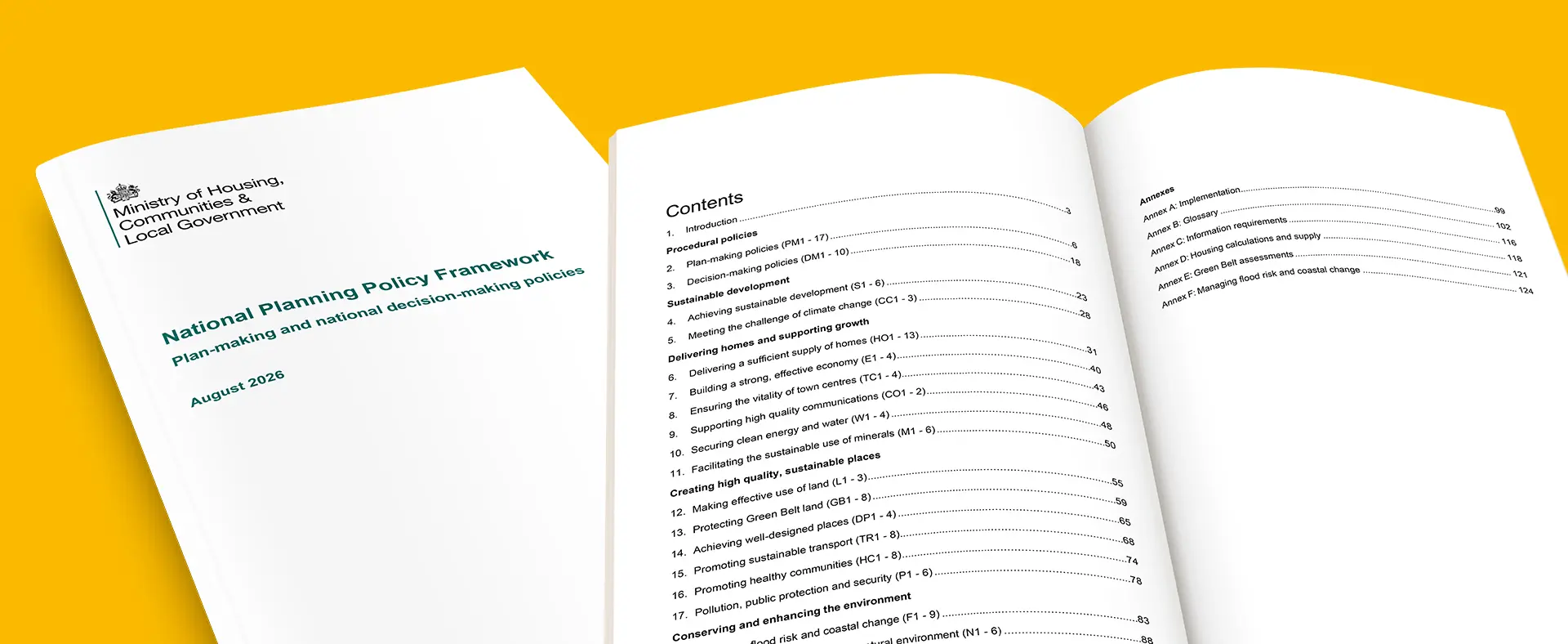
The December 2025 draft did not start here. Draft Policy PM2 proposed retaining the 15-year horizon. It was the accompanying consultation that asked whether this should instead be ten years.
[3]The Government response records 1,074 responses to Question 10a. 69% disagreed with reducing the period to ten years. The response summarised the main concerns: that a shorter horizon would undermine long-term planning and create difficulty for larger strategic sites. The Government nevertheless proceeded, citing the new 30-month timetable, the expectation that plans are commenced no later than five years after adoption, and the role of Spatial Development Strategies (SDSs) in setting a longer strategic framework.
[4]Of course, it is for Government’s to decide: a consultation is not a referendum. But it does mean the shift should be seen for what it is: a deliberate choice rather than a product of consensus.
As ever, there is a historical benchmark.
PPG12 (1999) advised that the duration of local plans should normally extend for ten years from forecast adoption date.
Back then - as now intended with SDSs - a local plan did not carry the strategic burden. In two-tier areas, the Structure Plan provided a county-wide framework. The local plan translated that into detailed allocations and policies. Above it was Regional Planning Guidance (RPG).
The 2004 reforms replaced RPG and Structure Plans with statutory Regional Spatial Strategies (RSSs). The 2004 update of PPS12 maintained the ten-year horizon, but with the aim to look ahead for the longer-term, set by RSS.
So, is the case for moving back to ten years properly explained simply with reference to reintroduction of a strategic planning tier? Only up to a point.
The move to minimum 15-year period from adoption period for local plans actually came in the 2008 version of PPS12, when the then-Government’s vision for strategic planning was at its zenith.
This was then carried through into the localism era; to the 2012 NPPF where a 15-year horizon was a ‘preference’.
Later NPPF editions converted this into a firmer ‘minimum’,
with a vision for longer periods (of up to 30 years) expected where plans included larger-scale development.
The new shift to ten years is therefore a genuine reversal in approach, even if it revives a duration from a previous planning generation.
Why the effective plan period will be much shorter than ten years
Even if the nominal period for the plan is ten years from adoption, the period for which its new proposals can influence housing delivery is shorter, perhaps just half its period. This comes down to lead-in times and the inescapable facts of a trajectory.
Under Policy HO3, plans need to demonstrate a five year land supply of “specific deliverable sites” at adoption and developable sites for years six to ten.
Most of the supply treated as deliverable in years 1–5 will come from the inherited planning and development pipeline.
A plan’s new proposals focus more on shaping supply in years 6–10 and beyond, as developable sites and broad locations come forward following applications prepared in the first phase. The window in which new allocations can move through consent and into delivery has been heavily concentrated from years six onwards.
A shorter plan period, might not matter if development was getting faster. The evidence points the other way.
Lichfields research -
How long is a piece of string? - found that the average time taken to determine a major outline residential application had risen from eight months in 2014 to two years in 2024.
Strategic sites: less reward for the same difficulty
The analysis in
Start to Finish shows that for large strategic sites of 1,500 homes or more - the threshold the NPPF itself now uses to define one
[13] - the planning and pre-commencement periods can run well beyond five years before a single home completes.
[14] All things being equal, the strategic sites the NPPF now encourages (via Policy HO4) will contribute relatively little or nothing within the ten-year period against which the plan is tested.
Strategic sites require the most difficult choices about the distribution of growth, settlement form, infrastructure funding, transport, landscape, Green Belt, education, health, utilities, viability and community impact. They are also most politically visible. The costs, controversy and technical work are front-loaded. A shorter plan period does not make any of these issues any easier.
It simply reduces the proportion of the site’s eventual output that helps the plan meet its requirement. This changes the calculus for difficult choices and trade-offs – see Table 1.
It is ironic that the NPPF’s positive framework for strategic sites is accompanied by a measure that makes local planning authorities (LPAs) less incentivised to allocate them.
Table 1 Fifteen year and ten-year plan horizons: different incentives
|
Issue
|
15-year plan horizon
|
10-year plan horizon
|
| New strategic allocations |
More later-year delivery can count toward the plan period. |
Earlier years dominate the development trajectory. |
| Infrastructure planning |
More scope to plan for strategic infrastructure and phased delivery. |
Greater temptation to rely on infrastructure already in the pipeline or capable of near-term delivery. |
| Political incentives |
Difficult choices are harder to defer because more need must be planned for. |
More difficult or strategic choices can be pushed into the next local plan. |
| Housing supply resilience |
More capacity to create a rolling pipeline beyond existing permissions and hedge against uncertainties associated with supply. |
Greater dependence on existing commitments, windfalls and residual allocations. |
SDSs are the counterargument - but not a complete answer
The Government’s consultation response points to the fact that local plans site alongside SDSs which will set a positive vision for growth at a sub-regional scale. The December 2025 draft suggested they plan for at least 20 years; the 2026 NPPF increased it to 25.
Policy PM2(1)(a)(iii) requires local plans to reflect longer-term expectations extending beyond the plan period where appropriate, including for large-scale development proposals.
That provides a hook for local plans to engage with large-scale development that will not make its full contribution within the 10-year local plan period. It gives examining Inspectors and strategic plan-makers the basis to ask whether a local plan is genuinely aligned with the longer-term picture rather than simply meeting the housing needs of the first decade (See NPPF Policy PM2(1)(a)(iii) and PM2(1)(b). But that leaves three practical challenges:
-
Dependency on the SDS doing the hard yards of identifying broad locations for growth, rather than just distributing housing targets. The history of some RSSs shows such plans can also be vulnerable to political deferral. Will all Mayors and combined authorities be up to the challenge of setting broad locations rather than delegating the difficult choices to LPAs, who can then use a shorter plan period to duck them?
-
Secondly, timing matters. Many SDSs will need to be prepared through new as yet untested governance arrangements. That creates uncertainty over sequencing; if the new plan making system is as effective as promised, many new-style local plans are likely to be well down the track before the SDS has laced its boots.
-
Thirdly,
SDSs do not allocate specific sites or scrutinise deliverability in the way local plans do. Experience suggests that LPAs ambivalent about growth can be adept at deferring the difficult question (for, example, an SDS broad location where the local evidence suggests barriers to implementation) to the next local plan cycle. They may have in mind a hope for a change in political weather that will see the SDS revoked or changed in the meantime.
Strategic planning is essential, but it is not magic; nor is its effectiveness automatic. It will need governance, evidence, discipline, scrutiny and diligent examining inspectors.
Ultimately, there is little evidence that 15-year local plans were an obstacle to strategic planning. Indeed, the 2008 PPS12 shift to 15-year plans suggests they are (were) an enabler of its effectiveness.
What problem is the ten-year plan designed to solve?
There is a legitimate concern that local plans have been too complex, take too long to prepare, and often failed to stay up to date. But it does not follow that a 15-year horizon was the cause. The evidence points to a broader set of problems: policy churn, resourcing constraints, statutory consultee delay and political risk.
That being the case, the solutions are to simplify process, reduce duplication, improve evidence proportionality, align infrastructure bodies, maintain clear national policy and properly resource plan-making. That is what the LURA and new NPPF reforms have been about.
Does a shorter period, thus with less housing to provide for, mean the local plan strategy easier to prepare? Counterintuitively, the answer is no; it may even make it more difficult. A study of most housing supply trajectories explains why. They typically show a total supply broadly equal to the plan’s total housing requirement (its target) with the delivery of pipeline supply in years 1-5, a bulge of developable sites for years 6-10 before it falls away in years 11-15. Real world delivery is then spread out, some sites proceeding as planned, others taking longer. Reduce the plan horizon to ten years and you concentrate the risk associated with delivery in years 6-10 onto a smaller pool of sites. This demands better evidence on deliverability or to allocate more land than the total housing requirement to act as a buffer.
The shorter horizon thus sits a little awkwardly with the Minister of State’s recent letter on pragmatism in local plan examinations. The letter urges inspectors to assess allocations over the plan period as a whole and to distinguish fundamental barriers from matters that “could reasonably be expected to evolve over time as market conditions change”. Its central proposition depends on there being sufficient time for circumstances to evolve; ten years gives less of it.
The change to ten year plans does not itself simplify; it just reduces how much future growth the plan must address. If a barrier to plan making was that they involve difficult choices over planning for growth, it is an curious response for a growth-orientated government to say the answer lies in asking them to do less.
More little plans?
Most of the policies in the new Framework seem likely to support the achievement of the Government’s ambitions for housing growth, but the shift to ten-year local plans is a material wrinkle.
The change was not asked for and the case for it is not proven. There are arguments to support how it might work that are coherent in theory. But only if every plan maker behaves how the Government wants them to.
But history tells us not all participants in plan making do what Government expects, and minimum requirements shape behaviour. And any political instability at local, mayoral and national levels will make it more likely plan making is gamed or decisions are ducked, with growth falling between the cracks. The case for sticking to 15 years was (and is) unassailable.
Daniel Burnham’s maxim was not arguing for big plans at any cost. It was an argument for plans with enough ambition and permanence to shape the future. More frequent plans may be welcome, but if each local plan is encouraged to look only just far enough ahead to avoid the toughest choices, the system may produce more plans while doing less effective planning.
[1] Those interested in diving down rabbit holes can trace the etymology of that particular quotation here. The full quote, which came as the peroration of a longer speech, was: “Make no little plans; they have no magic to stir mens’ blood and probably themselves will not be realized. Make big plans; aim high in hope and work, remembering that a noble, logical diagram once recorded will never die, but long after we are gone will be a living thing, asserting itself with ever-growing insistency. Remember that our sons and grandsons are going to do things that would stagger us. Let your watchword be order and your beacon beauty.”