


Our award winning blog gives a fresh perspective on the latest trends in planning and development.
|
London Borough of Bromley[10]:
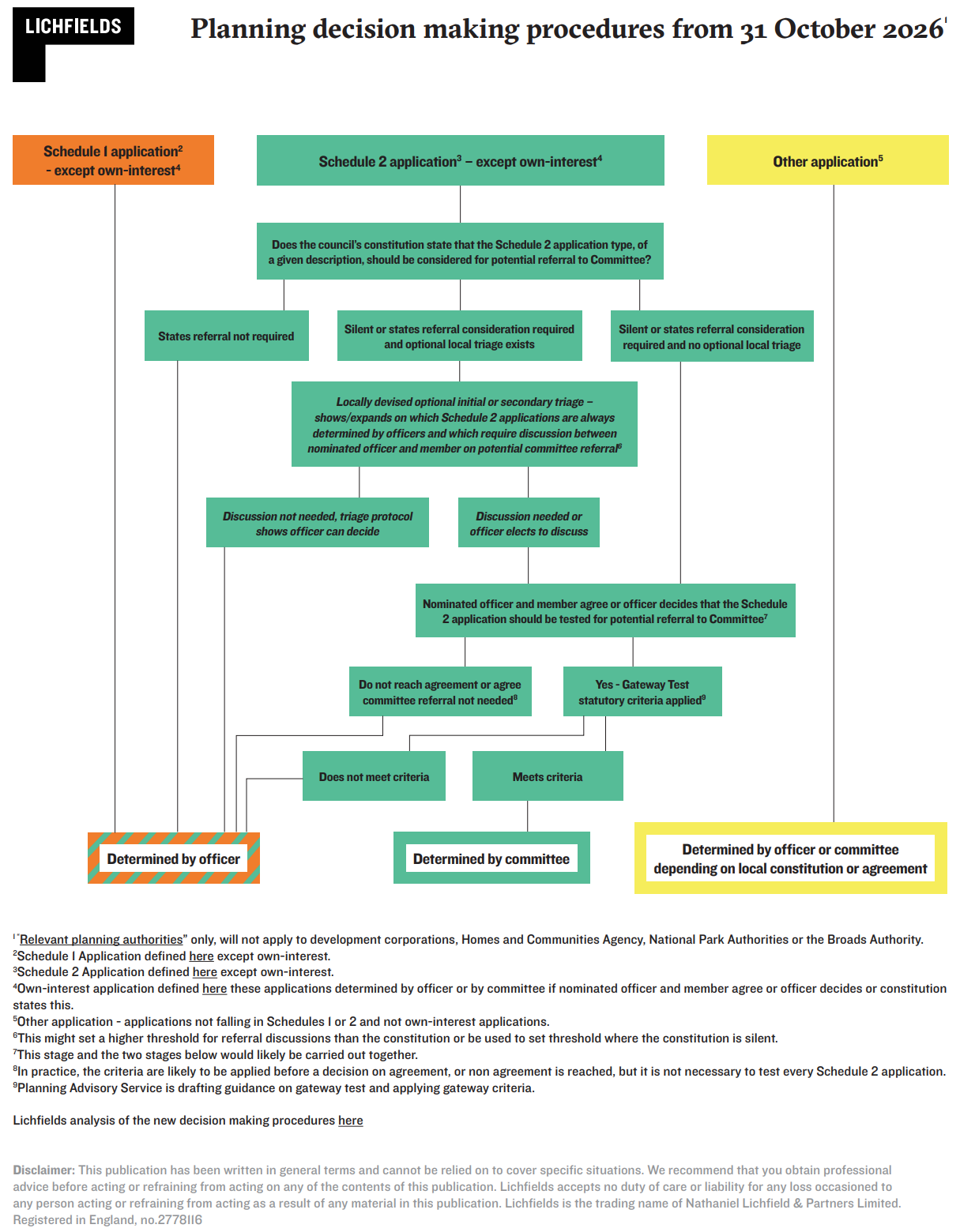
A weekly list will identify whether applications are Schedule 1 or Schedule 2. A Councillor (not just the relevant Ward Member or Planning Committee Member) has three weeks to ‘call-in’.
The nominated officer and member will decide which of these goes to committee by applying the gateway test.
Informal guidance to be issued to all members to help with understanding the new restrictions and processes
|
||
|
London Borough of Merton[11]:
Schedule 2 application should be determined by officers, unless the Nominated Member and Nominated Officer or their authorised substitute agree to refer it to committee under the gateway test within 28 days of the date of the valid registration of the application.
The Gateway Test must be applied to a ‘Residual Schedule 2 Application’[12], to decide whether it needs to be reported to Planning Committee in a list of 15 circumstances including “Where conflict arises between the officer's recommendation and the advice issued by Historic England, the Environment Agency or other body with similar statutory status”
|
||
|
East Suffolk Council[13]:
Two routes for Schedule 2 to be determined by committee – Referral Panel and Call-in
The Referral Panel is comprised of the Chair and Vice-Chair of the relevant Planning Committee as well as two nominated Planning Committee members. Operates where officer recommendation is contrary to material planning consideration comments received from a Town or Parish Council, Ward Member or a statutory consultee. The Planning Referral Panel may conclude that a ‘Relevant Schedule 2 application’[14] should be referred to the Planning Committee, but the final decision on the determination route will be made by the Nominated Officer.
Call-in process is triggered if within the 21-day consultation period Town/Parish Council and Ward Member(s) position is contrary to the officer recommendation – or Ward Member requests committee determination. Notification is sent to Planning Committee – a member must respond within 5 days saying it should be considered by the Committee and setting out how they consider it meets the gateway test. A call-in request bypasses the Referral Panel.
|
||
|
Wakefield Council[15]
The nominated officer is not authorised to determine a Schedule 2 application where the nominated officer and nominated member agree that the application passes the Gateway Test
|
||
|
North Somerset Council[16]
The nominated persons will consider whether an application should be referred to the Planning and Regulatory Committee by applying the Gateway Test when either nominated person considers it necessary or a Ward Councillor, in accordance with the Code of Practice, submits a formal written request using the prescribed form.
|
||
|
Stockton-on-Tees Borough Council[17]:
A Schedule 2 application will receive a referral assessment where one or more of six circumstances applies, including more than 10 qualifying individual letters or emails express a view contrary to the case officer’s proposed recommendation (except tree applications). And/or the nominated officer considers that the application may pass the Gateway Test.
|
||
|
Sunderland City Council[18]:
The gateway test will always be considered in relation to a list of six applications types, provided they fall within Schedule 2 of the Regulations, including where accompanied by an Environmental Statement and where there is an objection from a Statutory Consultee and the Local Planning Authority are minded to approve the application. In addition, all other Schedule 2 applications (with the exception of own interest applications) will be subject to a triage process to assess whether, based on the identified impacts, there is a requirement to proceed to the gateway test.
|
||
|
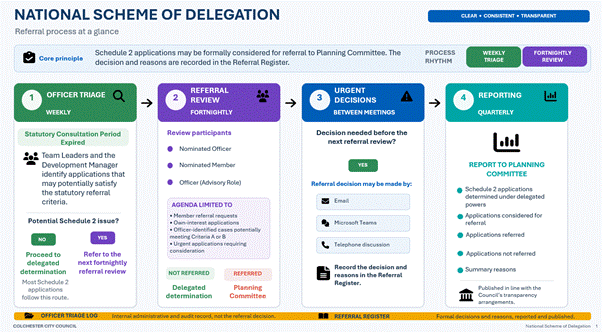
Colchester City Council[19]
Colchester City Council has produced a ‘referral process at a glance’, which includes scope for member referral requests to be considered:
 |
||
|
|
||
|
Paragraphs 23 and 24 of the statutory guidance provide examples of what ‘significant’ or ‘significant planning matter’ are in the gateway test. Some Councils are providing their own examples, including Colchester City Council:
“Examples may include:
Matters are less likely to constitute significant planning matters where:
Milton Keynes City Council is to require[20] that all Schedule 2 applications that pass the gateway test are not determined by officers. But the example of what might pass appears to raise the bar higher than in the guidance and requires Member action:
“Ward Councillors, Town/Parish Councils and members of the public, when submitting consultation responses, should highlight the following factors for those applications they consider should be referred to Planning Committee:
That the application raises significant planning matters, for example there is a material conflict with the Council's approved planning policies”.
Both the Colchester and Milton Keynes examples leave scope for flexibility in application.
|
||
Categories