Changing Context
Lichfields’
blog series has charted the rise of co-living in London over the last half-decade, to its current status as an established form of housing against the backdrop of an otherwise challenging residential market. Several years in, policy has now largely caught up with these applications, with recognition in most London boroughs’ local plans, positive adopted and emerging London Plan policy and established standards set out in London Plan Guidance.
Beyond the capital, the same pattern is beginning to appear, though it is still early days. Operational co-living schemes and applications have begun to spring up in cities across the country, including Manchester, Leeds, Brighton, Bristol and Birmingham, but at present, policy recognition is sparse. As a result, applications can face extensive negotiation to establish the land use principle and basic elements of co-living form, such as room sizes and amenity provision, all of which, in London, are grounded in policy.
This is set to change, however. The transition to a new plan-making system has brought about a flurry of plan-making, with approximately 90 local planning authorities (LPAs) either set to submit a plan this year under the previous system or ordered to commence plan-making this year under the new system, according to Lichfields’ estimates. With some of these LPAs responding to their first co-living applications, co-living policy is beginning to populate these emerging local plans for the first time nationwide.
The recently published NPPF (August 2026) adds to this policy momentum. For the first time adopted national policy recognises co-living as a specialist form of accommodation, and sets out a specific definition and provides a positive national platform for co-living.
In which areas is co-living policy appearing?
Lichfields has studied the trend of co-living policy outside of London. We have looked at the state of policy coverage in adopted plans, emerging plans, and supplementary planning documents (SPDs) in the 84 LPAs most likely to see co-living activity. This comprises the 35 most populous urban areas outside of London, university towns, and commuter towns around London.
Of these 84 authorities, only Salford and Watford refer to co-living in their adopted local plans. Four more authorities provide co-living guidance in SPDs (Birmingham, Leeds, Brighton and Hove, Chelmsford). In combination, this policy and guidance equates to just 7 percent of the LPAs reviewed leading this new policy frontier. This is less than 2% of all LPAs in England.
When emerging plans and draft SPDs are taken into account, however, the proportion of LPAs which discuss co-living in policy and guidance grows to more than 25 percent of these reviewed authorities (6% across all LPAs in England). This trend is concentrated in the largest cities: of the ten largest cities outside London, seven include co-living in their emerging local plans or guidance, up from just two (Salford and Watford) at present. These cities are: Birmingham, Leeds, Liverpool, Sheffield, Bristol, Coventry and Nottingham.
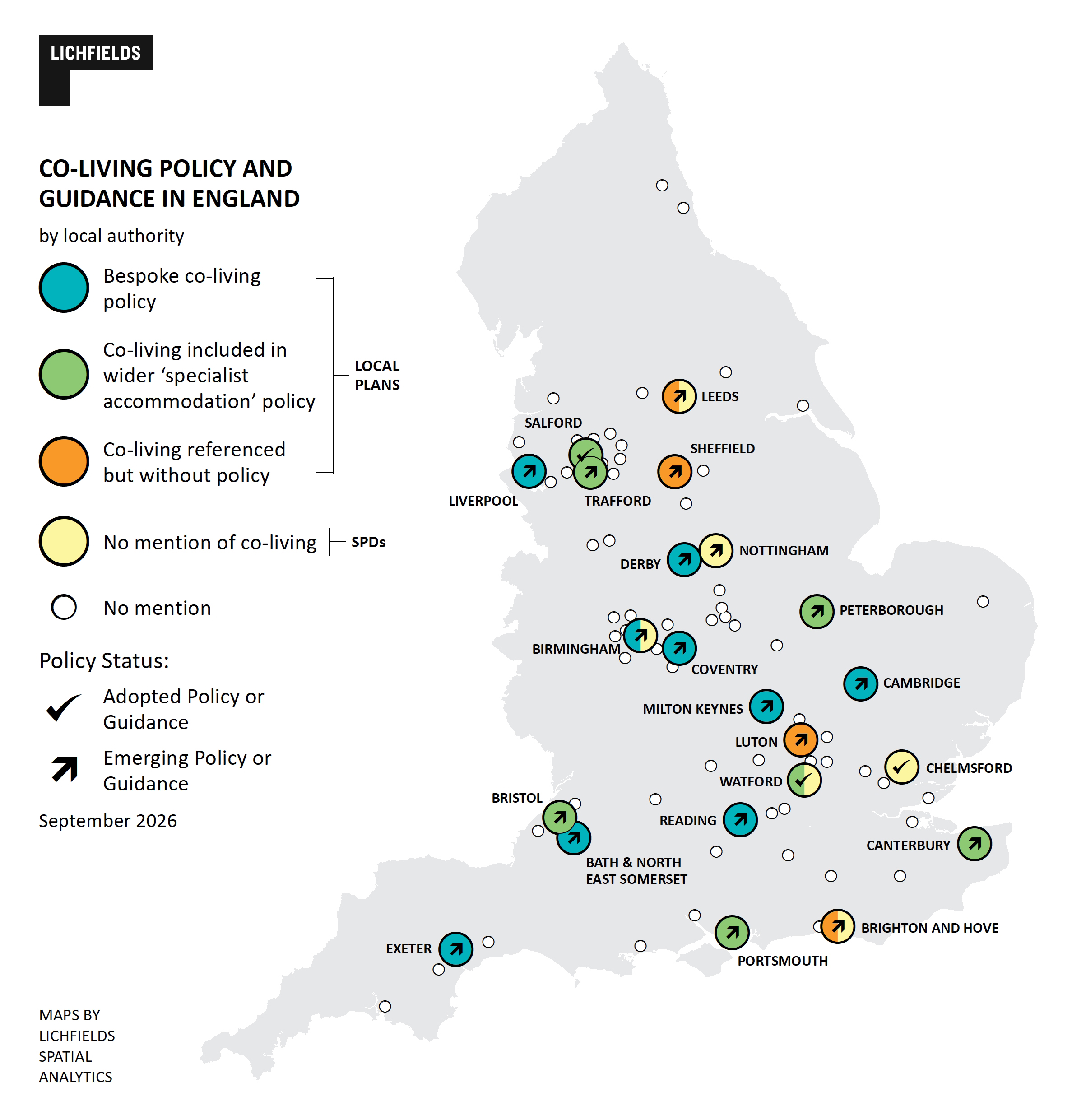
Co-living policy recognition is therefore becoming more common, although it is still focused in a relatively small number of areas in the context of such a significant opportunity. The language of emerging plans does indicate the momentum of this trend however: some emerging plans borrow or take as a starting point policies adopted elsewhere, aiding policy formulation and lending a common pattern to co-living policies emerging across the country. The rest of this blog covers these patterns in more detail.
How do emerging plans approach co-living?
In general, emerging plans take a positive approach to co-living. As opposed to London, where some authorities have sought to introduce policies intended to restrict co-living, the tone is supportive in almost all emerging plans elsewhere.
Plans tend to take a strict approach to locational requirements, targeting co-living in accessible locations and established centres. But, provided these locational considerations are met, authorities are encouraging of co-living schemes. In particular, many plans consider co-living to be a more affordable alternative to renting conventional C3 housing and welcome the use accordingly.
Beyond this generally receptive baseline, plans differ greatly in the level of detail they provide for co-living policy. Some plans stop there, with three plans referencing co-living but not providing any policy details, while other plans cover co-living either alongside other forms of specialist accommodation (typically build-to-rent and student accommodation) or in a bespoke policy. Though these policies all cover similar themes – location, affordable housing, space and amenity standards, and management policies – the level of detail provides more variability than the policy approach itself, as set out below.
Location and need requirements
In the 84 authorities reviewed, location typically emerged as the biggest concern for co-living. Nearly 80 percent of authorities with policy or guidance provided explicit location requirements, all of these directing co-living towards well-connected areas, town centres, or both. This makes sense: co-living is typically large scale, high-density development most appropriate in areas well-served by public transport, and Lichfields’ research into London schemes has found that most of these are found in highly accessible locations. Policies typically encourage cycle parking provision, with a minority of plans specifying or encouraging that co-living provide only accessible parking spaces, making accessible locations yet more important.
Nearly a quarter of plans further specify that co-living should not jeopardise the delivery of conventional housing. These policies typically state that applications on land currently used or allocated for C3 housing will not be approved, which, when coupled with town centre requirements, shrinks the pool of available land for co-living quite substantially. Lichfields’ view is that this approach is not necessarily appropriate in all instances. Whilst there is clearly a pressing need for C3 homes, this is also true off all forms of residential accommodation, including co-living, which has an important role to play in meeting local housing needs. A ‘C3 first’ approach runs the risk of preventing sites which could be better suited for co-living accommodation, or a mixture of both C3 and co-living, from coming forward.
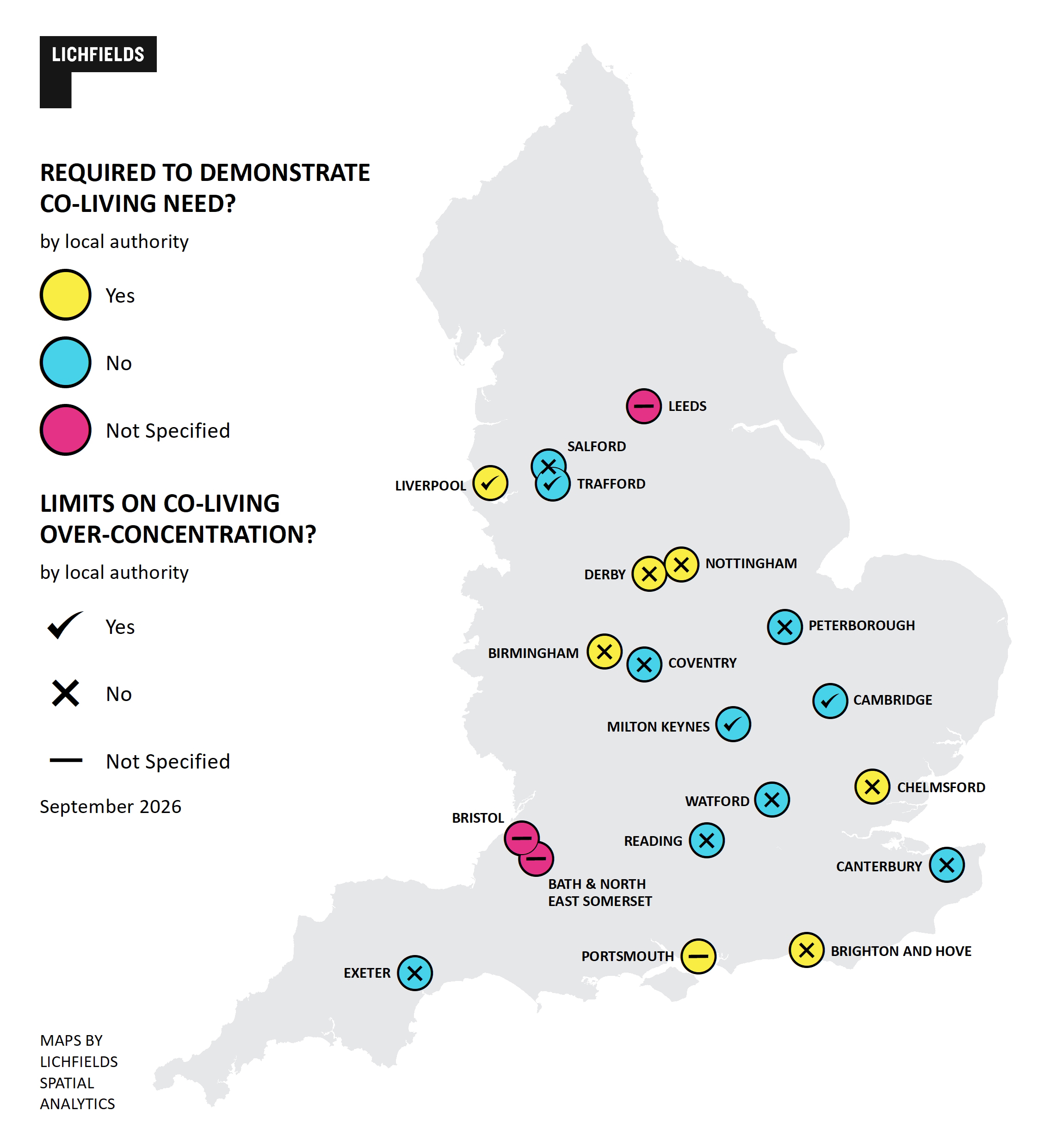
Six authorities – half of which also fall into the previous group adopting a ‘C3 first’ approach – require co-living applications to demonstrate need, while four set limits on co-living concentration. These limits are typically based on planning judgements, such as in Milton Keynes’ emerging plan, which states that co-living proposals will be supported where they “create or maintain a mixed and balanced community within the wider neighbourhood and do not result in an over-concentration of that type of home in that location”, in addition to being in highly accessible locations within settlement boundaries.
Affordable housing
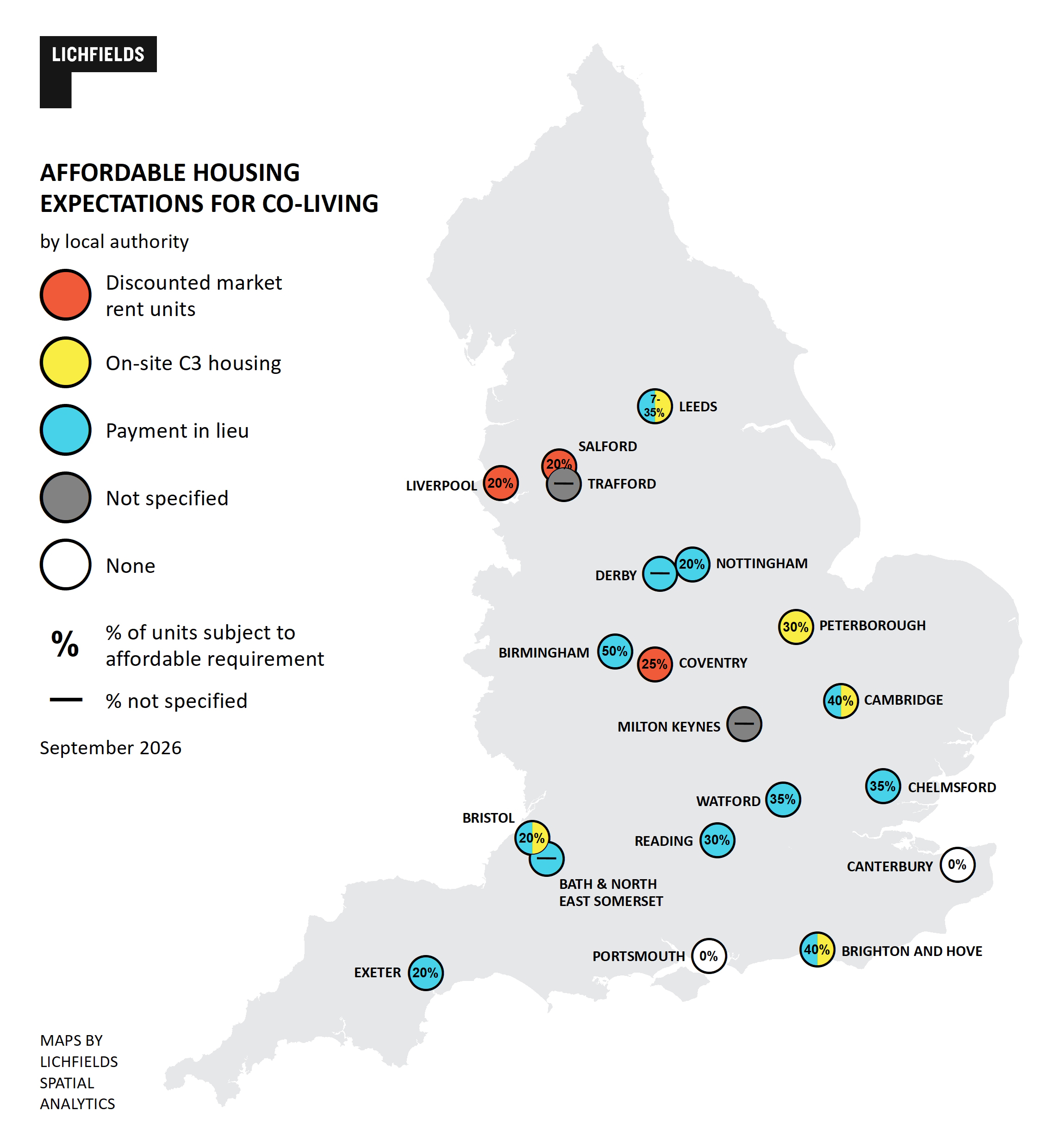
Authorities differ quite significantly in their approach to affordable housing for co-living schemes, both in type and quantity. This is to be expected given that affordable housing policies respond to specific local need and housing markets. Affordable housing policies typically ask for a payment in lieu, but this is not always the case and a sizable minority of plans actively support on-site affordable housing. Whilst London boroughs typically specify that on site affordable housing alongside co-living should be separate, self-contained C3 housing, many policies outside London merely defer to their generic affordable housing policy in the context of co-living without considering the implications of this.
The level of affordable housing promoted by policy typically ranges between 20 and 35 percent, though there are exceptions to this. Birmingham’s emerging plan, for example, calls for a payment in lieu equivalent to 50 percent affordable housing (by unit), a sizeable increase from its existing SPG, which seeks 35 percent. Brighton and Cambridge set the level at 40 percent, either to be delivered on-site or through a payment in lieu, while Trafford has a sliding scale between 25 and 45 percent depending on the location. At the other end of the spectrum, Canterbury and Portsmouth do not ask for any affordable housing, considering co-living to be an affordable product in and of itself.
Space and amenity
The variation in policy detail is perhaps most evident in space and amenity policies, which is again to be expected. The London Plan Guidance (LPG) sets specific standards for floorspace and amenity expectations – a minimum room size of 18 sqm and recommended amenity space of 4 sqm per resident for the first 100 residents, tapering down to 2 sqm per resident past 400 residents. However, less than half of LPA policies outside London provide similar quantitative standards.
Of these, just three follow the LPG’s room minimum of 18 sqm, with other plans ranging from 25 to 37 sqm, in line with the nationally described space standard for a one bedroom (i.e. C3; non-co-living) flat. The LPG sets a maximum room size of 27 sqm, to avoid blurring the line with self-contained C3 flats. It is unclear whether authorities setting these large standards have fully considered the implications of conflating the floorspace expectations of co-living and C3 flats.
The more common approach, however, in just over half of policies, is to not set room standards at all, instead calling for “adequate” or “well-designed” living space. While a qualitative approach can provide welcome flexibility, in Lichfields’ experience this can cause issues at the decision-making stage, as officers and committee members may not be familiar with room standards in co-living or have access to comparable schemes. In our view, it is preferable for policy to set realistic floorspace standards for co-living units which provide some flexibility and are differentiated from the national standards for C3 flats. The approach in the LPG is appropriate.
Quantitative standards for amenity space are fewer and further between, found in only a third of authorities’ policies. Where such policy standards do exist they tend to be more in line with LPG levels, promoting either 4.5 sqm per resident or 4 sqm tapering to 2 sqm with over 400 residents, as in the LPG.
Other policy issues
Plans are more consistent when it comes to building management, with most specifying that a management plan is needed and often setting minimum tenancy lengths to provide security of tenure and to avoid co-living homes from being used as hotel accommodation. Some policies also dictate that the design of co-living schemes should provide inbuilt adaptability, to allow for alternative uses with minimal conversion should a change of use be needed in the future. This issue is now being raised frequently on Lichfields co-living projects and typically requires submission of a design study to evidence a scheme’s inbuilt future proofing and adaptability should need and the market pressures change.
Conclusion
The present state of co-living across the country is in many ways reminiscent of the position in the capital five years ago. Applications for co-living have begun to come forward in increasing numbers, but a policy lag means that local plan policies are rare and many applicants are faced with a policy vacuum. The current state of policy in London is therefore perhaps a sign of what is to come, with policy coverage the norm in the capital and convergence between plans to allow for standardised approaches. This is likely to increase following the recent publication of the new NPPF.
Certainly, the evidence suggests this is the direction of travel. Outside of London, co-living is virtually non-existent in adopted plans, but emerging plans – especially in large cities, the majority of which have drafted co-living policies – are covering co-living in increasing number.
While many of these early policies are light on detail, the tone of these emerging plans is also encouraging. In almost all plans, LPAs are recognising the value of co-living as a more affordable alternative with some distinct advantages, in sociability and flexibility, to conventional housing.
As the policy map continues to be populated, the greater certainty provided by co-living policy in urban authorities across the UK should encourage yet more applications to come forward. This virtuous cycle of co-living policy coverage and delivery, though still in very early stage across most of the country, looks set to accelerate.
Footnotes