The Mayor has now published his draft of the next London Plan. Some will contend that it feels like Groundhog Day and others will debate whether it is a plan of realism or defeatism. What should be recognised is that drafting a London Plan in the current economic and regulatory context is an immense challenge and is one that the GLA has sought to grapple with directly.
In this blog, we deliver our initial verdict on what the draft London Plan means for housing in London and some of the key housing-related policies to look out for.
The requirements of an SDS
The government is embarking on a policy approach to roll out Spatial Development Strategies (SDSs) across England. In its draft NPPF (December 2025), the government defined a set of requirements (PM1) and a series of tests of soundness (PM14) that SDSs should meet. The London Plan is likely to be the first SDS to be tested against these policies – and, as we consider below, this is likely to present another set of challenging decisions for its future Inspectors.
The draft NPPF (Policy PM1) requires that an SDS should, amongst other things:
-
set a positive vision for future growth and change
-
be genuinely strategic in nature and allow for more detailed issues to be considered and addressed through other parts of the development plan
-
set a strategy for a sustainable pattern of growth covering a period of at least 20 years
-
identify where changes to Green Belt boundaries may be needed to meet the development needs of the strategy area
How does the draft London Plan respond? With ‘only’ 558,000 homes
Just last year, in his ‘Towards a new London Plan’ consultation, the Mayor acknowledged that “The government has said London needs 88,000 new homes per year. So the next London Plan needs to plan for 880,000 homes, ten years’ supply.”
However, the draft Plan does, in fact, only identify a strategy to meet 65% of London’s identified housing needs for the next 10 years and not the 20 years required. With this approach, it seems inevitable that the next set of London Plan Inspectors will have a similarly difficult choice to make as their predecessors – considering whether it is better to have a plan in place versus the continued shortfall of housing in London which, following this strategy, would increase by a further 300k homes in the next 10 years.
In doing so, they will need to consider this (draft NPPF, PM14): “A strategy which does not provide for objectively assessed needs should be considered an exception, and only where it is evidenced that stringent efforts have been taken to meet those needs through cooperation with other strategic planning authorities”
In another recent Lichfields blog, we hypothesised how the Mayor could begin to meet the target of 1.69m homes over 20 years. Our conclusion was that there is a potential gap of c.850k homes and the inescapable reality was that London would need to look beyond its boundaries, to the South East, to address this need on a strategic basis. There is no indication that this engagement with South East authorities has taken place.
Misaligned to the draft NPPF expectations of SDSs, the draft London Plan only sets housing targets for the first 10 years; however, it does suggest that more is possible, and there are opportunities to deliver homes up to and beyond 850,000 homes after 10 years. This is not exactly a ‘strategy’ for sustainable growth as this overlooks the fact that a 20 year target (based on the current Standard Method and required by the draft NPPF) would be c.1.69m homes and therefore draft Policy HN1 would still result in a shortfall of up to 850k homes by 2047.
Release of the Green Belt
Looking to the positives, for the first time, the London Plan sets specific greenfield housing targets, acknowledging that brownfield land alone will not be enough. But, this is clearly a tentative step. Just 8 (out of 14) outer London Boroughs are given a greenfield housing target, and the total of these equates to just 10% of the Plan’s overall housing target. Moreover, these greenfield housing targets exclude the use of Metropolitan Open Land (MOL) – arguably a policy construct that is most within the realms of the Mayor to amend as the NPPF does not require or include this designation.
Preventing the Presumption?
The draft Plan sets out reasons why it is not possible for it to go further with housing targets in the ten-year period. One such (bemusing) justification is seeking to mitigate the risk that the plan-led approach would be undermined if unachievable housing targets are set for London Boroughs and they then fail the Housing Delivery Test and 5-Year Housing Land Supply tests, with their associated consequences.
However, with the level of need that London has and the shortfall that the Plan will create, these are precisely the circumstances in which a stronger presumption must be applied.
Borough-by-borough assessment
A role of an SDS is to tackle the politically-sensitive matter of apportioning the SDS area’s housing need within its constituent authorities. We have assessed the difference in annual housing target that each borough will experience, firstly relative to the London Plan 2021 target and then to the Local Housing Need (Standard Method).
There are some notable outcomes:
-
Bromley – despite being c.50% Green Belt and the Green Belt Assessment finding numerous parcels with potential to be grey belt, sees its target reduce, and no greenfield housing target set.
-
Conversely, Hillingdon will see a significant increase in its housing target, with a focus on greenfield housing.
-
Barnet adopted a Local Plan in 2025, however its annual housing target will now increase by 900 homes, albeit still remaining significantly below the LHN.
-
Tower Hamlets and Newham, despite being predominately urban authorities, both see their housing target from the current London Plan reduce, by 1,000 homes and 654 homes respectively.
-
Ealing – as part of the Mayor’s London Growth Plan which identifies it as a borough primed for major growth and investment (OPDC and West Tech London), will experience a significant annual increase in its housing target from the current London Plan (although a small decrease from the LHN.
-
Wandsworth – this will experience an increase of its London Plan target by c.700 homes (although c.1,600 below the LHN) in an urban borough without Green Belt.
What else to look out for?
There is a lot of detail within the draft London Plan that we will continue to unpack in future blogs. However, the following are the key policy matters to note on housing:
-
Optimising use of land and site capacity – draft Policy MBUL2 introduces the Optimisation Framework. This sets minimum density and height ranges for residential development, as informed by measures of sustainable access (‘SAM’) and setting. If this sounds familiar, it should – it is reminiscent of the 2016 London Plan Density Matrix, although that was removed for reasons that we’ve covered previously.
Our clients will also need to consider these minimums and whether they will prove to be a challenge, in practice. The current ‘design-led’ approach no longer features; however, we would strongly advocate for keeping this principle alive, as a flexible and practical approach to optimising housing sites.
-
Tall buildings – under draft Policy MBUL3, Boroughs should identify the locations that may be appropriate for buildings of 30m+ (or higher, if locally appropriate) - using criteria in Box MBUL3A. Local Plans must also incorporate the locations for ‘metropolitan tall buildings’, defined by the GLA at Table 2.2. From initial review, this reads as an improvement on London Plan 2021 Policy D9
– it should assist to standardise the definition of a ‘tall building’ across Boroughs, ending the confusion where some Boroughs set the threshold as low as 20m; and, it includes flexibility, where robustly justified, allowing for proposals outside of identified tall building locations, or where there is departure from the criteria.
-
Affordable Housing – o
verall, the draft plan proposes a more nuanced and targeted approach, with differential thresholds introduced in response to locational considerations, greenfield/brown field, ownership and proposed use. It identifies circumstances whereby the headline affordable housing threshold can be reduced based on tenure commitments, public transport delivery or a portfolio-based approach. In doing so, the draft policy moves away from a more standardised, London-wide approach. Several of the proposed changes will go some way towards facilitating and incentivising housing development. For example, lower affordable housing thresholds in much of outer London and adjusted tenure expectations are welcome, and the ability to lower affordable housing requirements based on tenure commitments will help unlock developments. At the same time though, the framework introduces a wider range of policy considerations than the current Plan, adding another layer of complexity to an already challenging system. See this recent blog from our colleagues, for further analysis.
-
Green Belt – as above, draft Policy PV7 introduces the criteria for Green Belt release in London – but, only in the most sustainable locations, where sites are optimised, and densification is important, and necessary infrastructure improvements are enabled. Broad Locations for Growth in the Green Belt are identified (key diagram – chapter 2). Significantly, the draft Plan goes further than the draft NPPF (2025) in defining 'sustainable locations' in this context – i.e. sites within 1200m (or 15 minute) walking distance of ‘well connected’ stations at Figure 6.4; and, within 400m of high-frequency bus routes (Box PV7C). Reconciling this with the draft NPPF’s definition of "well-connected rail stations" (i.e. footnote 26 won't be straightforward. Indeed, Figure 6.3 shows a complete absence of qualifying stations across Bromley, Sutton, Hounslow, and south Hillingdon, in what feels like a missed opportunity – our initial delve into the evidence base identifies that this is because suitable Grey Belt/Green Belt release clusters of less than 3,000 homes have been excluded from the London Plan capacity. Paired with the additional "Green Belt sustainable design criteria" (Box PV7B), there is a far higher bar for Green Belt release in London. Landscape-led sustainable design is a requirement and Table 6.3 sets challenging average net density ranges of 90 – 160 dph and green space quantities, alongside typical building height expectations from 3 – 6 storeys. The ‘high bar’ approach of defining sustainable locations in the Green Belt also feeds through into the capacity-based housing targets, with several Borough's where potential Grey Belt is identified, not then necessarily compelled by the 10-year targets to release or plan for them.
-
Metropolitan Open Land – following through on the 'Intend to Publish' document, the new draft Plan explicitly separates MOL from national Green Belt policy
. Potential new MOLs are also identified in evidence base.
MOL purposes and functions are set out in draft Policy PV6, with a new emphasis on the public accessibility of such land and a suggestion (part E) that boroughs consider applying the MOL designation to Green Belt land which is wholly or largely contained within the urban area. There will be a separate blog to follow on MOL, unpacking what this means in practice for development of such sites.
-
Housing size mix – anyone navigating varied housing mix policies across the Boroughs will be familiar with current Policy H10,which states that decision makers should have regard to (inter alia) the nature and location of the site, ‘with a higher proportion of smaller units generally more appropriate in those locations closer to a town centre, station or higher public transport access and connectivity.’ Draft Policy HN7 keeps the general premise, but it isn't as explicit, and we would question whether it will be as useful for securing pragmatism against more rigid local mixes.
-
Housing design – as expected, draft Policy HN8 formalises the GLA’s recently published guidance on dual aspect homes. The more rigid language of current Policy D6 (which states single aspect units should ‘normally be avoided’), is proposed to be replaced with a more pragmatic direction: schemes should ‘seek to minimise’ them. This is a subtle but welcome shift, and one that is already assisting to optimise more constrained housing sites, without compromising design quality. Eagle-eyed planners/designers will also spot a metric tweak: minimum ceiling heights are set to drop from 2.5m (across 75% of the GIA) to 2.4m.
-
Small sites –there is a continued focus on the important role sites below 0.25ha can play in meeting housing need, which is welcomed. The requirements of the London Small Site Design Code are expected to be met.
-
Accessible housing – draft Policy HN9 – increases the requirements for M4(3)(2)(b) ‘wheelchair-accessible dwellings’ – 10% and M4(3)(2)(a) ‘wheelchair adaptable dwellings’ 10%. We expect this to have an impact on site optimisation and, ultimately, feed into viability.
-
Minimum cycle standards – draft policy GHR11 sets the standards as per the aforementioned LPG. This is also welcomed - the standards are less onerous and reflect the reality of underutilised spaces in developments. Arguably this could go further, with a recognition that underused spaces should be designed for future adaptability for something more beneficial.
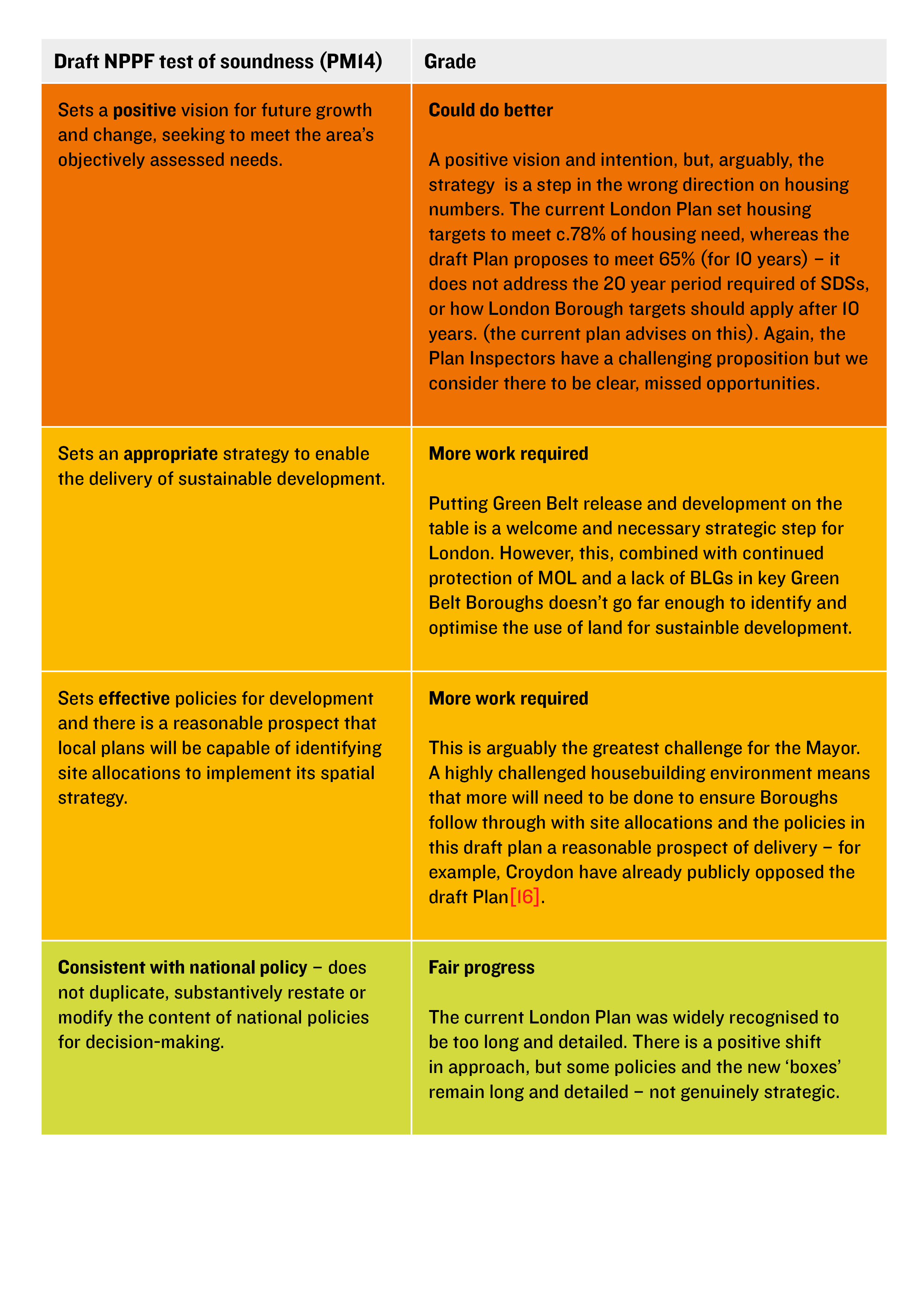
Our Initial Verdict: The Draft London Plan Report Card
Based on the draft NPPF’s tests of soundness for SDSs, we’ve given our initial verdict on the draft London Plan’s approach to housing matters:
Footnotes
[1] Based on the shortfall of the Plan to the level of need, the next set of London Plan Inspectors will certainly feel like they’ve been here before.
[2] In an attempt to signal a change in direction from the London Plan – the only example SDS that we have available – the government has states that it “does not intend to set a limit or range on the size or length of SDSs, but they are expected to be succinct, and not get into detail or locally specific issues.” https://www.gov.uk/government/consultations/areas-for-producing-spatial-development-strategies/areas-for-producing-spatial-development-strategies#spatial-development-strategies
[3] Which is now delayed to enable our incoming Prime Minister the opportunity to make his first mark on the planning system.
[4] The examination of the 2021 London Plan used the NPPF local plan tests of soundness as a proxy.
[5] https://www.london.gov.uk/sites/default/files/2025-05/Towards%20a%20new%20London%20Plan%20%28final%29.pdf
[6] The draft London Plan plans for 558k homes, against a standard method requirement of 848k homes.
[7] https://lichfields.uk/blog/2026/june/25/sound-prospects-from-abercrombie-to-opportunity-areas-to-the-next-london-plan
[8] Draft NPPF PM1 requires that SDS set out a strategy for a sustainable pattern of growth covering a period of at least 20 years.
[9] Which requires that Plan-making authorities should “positively plan for additional longer-term capacity of at least 850k up to 2047”.
[10] Compared to 18 London Boroughs with some Green Belt.
[11] https://lichfields.uk/blog/2026/january/05/draft-nppf-minimum-density-maximum-impact and https://lichfields.uk/blog/2015/november/9/the-logic-of-the-london-density-matrix
[12] It is also a clearer presentation of the policy position, which has been subject to appeal and High Court appeal precedents which established that a tall building proposal outside a designated area must not be automatically refused.
[13] https://lichfields.uk/blog/2026/july/22/affordable-housing-under-the-draft-london-plan-progress-or-further-complexity
[14] https://lichfields.uk/blog/2025/december/16/all-aboard-or-stuck-between-stations-how-the-new-nppf-might-unlock-growth-around-rail-stations
[15] Despite a recent appeal decision to the contrary, this clearly removes any suggestion that grey belt policies can be applied to MOL.
[16] Croydon Council to oppose draft London Plan over Green Belt proposals – NewStartMag